
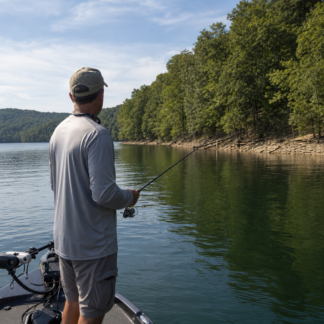
You Do Not Need All Day to Fish Better
Many people picture a successful fishing trip as an all-day adventure. They imagine arriving before sunrise, carrying several rods, constantly changing lures, and covering miles of shoreline before finally finding fish.
That can be an enjoyable way to fish, but it is not the only way.
You can learn a great deal about a lake—and give yourself a realistic chance of catching fish—in approximately two hours. The key is not rushing through more casts. It is making better decisions before and during the time you have available.
That is what this field guide is designed to help you do.
The Two-Hour Kentucky Bank-Fishing Plan was created for busy anglers, beginners, parents, families, and anyone who wants to enjoy fishing without devoting an entire day to the trip. It is especially suited to Kentucky’s community lakes, Fishing in Neighborhoods lakes, park ponds, small reservoirs, and other waters that can be explored from the bank.
A short fishing trip does not have to feel incomplete. In fact, limiting your time can encourage you to become more observant, more organized, and more willing to adjust when the lake is not responding as expected.
Instead of arriving and casting toward the first open patch of water, you will learn to pause and study what is happening around you.
Which shoreline is receiving the wind?
Where does shallow water meet deeper water?
Is shade beginning to form along one bank?
Are birds, insects, or baitfish revealing areas of activity?
Can you safely and comfortably cast from the spot you have chosen?
These observations often matter more than owning another lure.
Start With the Lake, Not the Lure
The plan in this guide is built around the L.A.K.E. Method™, a straightforward decision-making framework for bank anglers:
Look Before You Cast.
Observe the wind, water clarity, shade, cover, shoreline activity, and available casting room before selecting a fishing spot.
Analyze the Lake.
Identify features such as points, coves, flats, drop-offs, inflows, vegetation, channels, and changes in shoreline shape.
Key In on Productive Water.
Concentrate on the smaller percentage of the lake that offers the best combination of depth, cover, food, comfort, and access.
Execute a Simple Plan.
Fish a few carefully chosen areas, give each one a reasonable amount of time, and adjust based on what the lake shows you.
The method does not guarantee that every trip will produce fish. No ethical fishing guide can honestly make that guarantee. Weather, water temperature, seasonal movement, fishing pressure, stocking cycles, and many other conditions can influence the outcome.
The purpose of the method is to help you stop fishing randomly.
Even when the fish are not cooperating, you can leave the lake with useful information. You may learn which bank becomes difficult to fish during a strong crosswind, where deeper water lies close to shore, when a shaded edge begins producing activity, or which areas receive the heaviest fishing pressure.
Those observations make your next trip stronger.
A Plan That Fits Real Life
A two-hour trip can fit into an evening after work, a weekend morning, a family visit to a local park, or a small opening in an otherwise busy schedule. It requires less preparation than an all-day outing, yet it still gives you enough time to observe the lake, test several areas, make adjustments, and finish with purpose.
Throughout this guide, you will learn how to divide those two hours into manageable stages. You will prepare before leaving home, conduct a quick shoreline assessment, select a small number of promising areas, fish them efficiently, and use the final portion of the trip to either refine what is working or test one last carefully chosen location.
You will also learn why moving is not always the answer. Sometimes a promising area needs a few more minutes. At other times, staying in an unproductive location simply consumes the limited time you have. The plan will help you recognize the difference.
Most importantly, this guide is intended to reduce the pressure anglers sometimes place on themselves. A successful trip does not always require a full stringer, a personal-best fish, or a dramatic photograph.
Success can mean making one good decision after another.
It can mean introducing a child to fishing without turning the outing into an exhausting day.
It can mean safely exploring a new lake in Kentucky and learning enough to return with greater confidence.
It can mean spending two peaceful hours outdoors while becoming a more thoughtful angler.
Use the Plan, Then Make It Your Own
The two-hour framework is a starting point rather than an inflexible schedule. As you gain experience, you may spend more time observing, move between locations more quickly, or focus almost entirely on a single productive stretch of shoreline.
That is a sign of progress.
The goal is not to follow a timer forever. The goal is to develop a dependable process that eventually becomes natural. Over time, you will begin to notice wind direction, shade, changes in depth, shoreline cover, water clarity, and fishing pressure without needing to remind yourself to look.
You will cast with a reason.
You will move with a reason.
You will change your presentation for a reason.
And when a trip does not produce the result you hoped for, you will have a better idea of what to try next.
You do not need all day to become a better bank angler. You need a lake, a reasonable plan, and enough patience to observe before you cast.
Let us begin with why two hours can be enough.