GET THE FREE WIND AND STRUCTURE CHEAT SHEET
Most anglers spend entirely too much time guessing. They cast at random shorelines, hoping for a bite, without understanding the mechanics of the water in front of them.
This guide provides a foundational system for reading any lake. By understanding the core principles of fish behavior—specifically how they react to wind and underwater structure—you can eliminate dead water and make highly calculated decisions before you ever make your first cast.
The underlying principle is simple: fish are not random. Their movements are dictated by survival. They are constantly balancing the need to feed, the need for oxygen, and the need for security. Wind and structure are the two major forces that dictate where those three survival needs intersect.
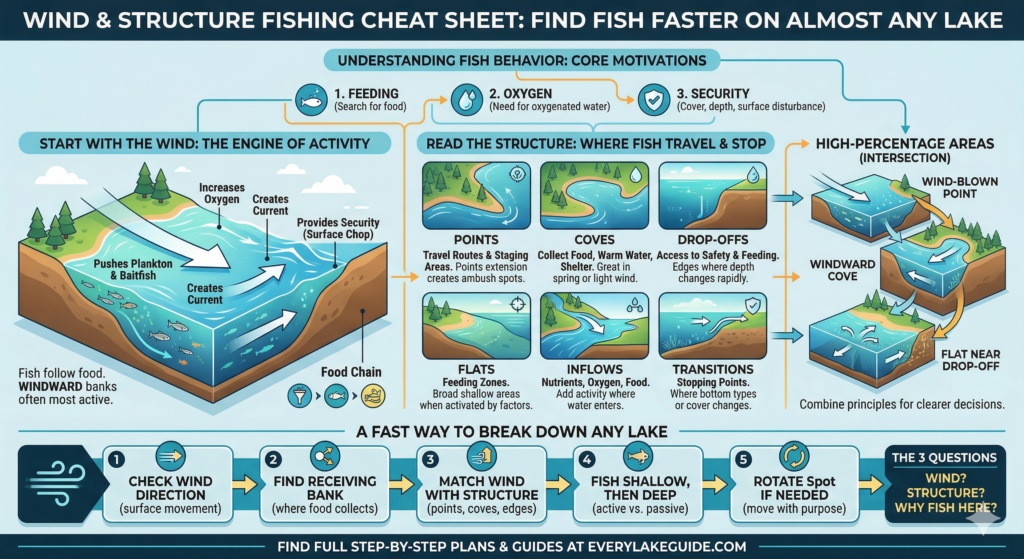
The Biology of Wind: Why Surface Movement Matters
Wind is much more than a weather condition; it is the engine that drives the lake’s food chain.
When wind pushes across the water, it creates a surface current. This current sweeps microscopic food (plankton) toward the windward banks. Small baitfish follow the plankton, and larger, predatory gamefish follow the baitfish. By understanding this chain reaction, you realize that the windy side of the lake is often an active feeding zone, while the calm side is largely dormant.
What wind actually does underwater:
- Funnels the food chain: It pins baitfish against specific banks and coves, giving predators an easy ambush advantage.
- Generates artificial current: It forces water to move in otherwise stagnant lakes, positioning fish to face the current to catch passing food.
- Increases oxygen levels: Surface disturbance mixes oxygen into the water, energizing fish and increasing their metabolism.
- Provides a security blanket: Rippled, broken water reduces light penetration. This makes fish feel hidden from predators above, encouraging them to move into shallower water to feed aggressively.
The Golden Rule of Wind: If the wind has been blowing steadily into a specific bank, point, or corner for several hours, the food chain has likely stacked up there. Check these areas first.
Where to look on a windy day:
- Wind-blown banks: The end of the “food funnel.”
- Points facing the wind: Natural ambush structures intercepting moving water.
- Coves receiving pushed water: Traps for warm water and baitfish.
- Inflow areas: Zones where extra movement and nutrients wash in.
A note on severe weather: When the wind is excessively strong, the main crash zone can become too turbulent. In these conditions, fish will often slide just outside the hardest wind, holding on to nearby structure in slightly calmer water to save energy while still having access to the feeding zone.
Decoding Structure: Why Fish Relate to the Bottom
If wind dictates where the food goes, structure dictates how the fish travel to get there.
Structure is simply the physical shape of the lake bottom. Fish use structure the same way humans use highways and rest stops. They require distinct physical features to navigate, to hide from their own predators, and to ambush their prey without expending unnecessary energy.
You do not need a high-tech sonar map to utilize structure. You simply need to understand the function of the main fish-holding features.
The functional purposes of lake structure:
- Points (The Intersections): A point is a piece of land extending out into the lake. Fish use these as travel routes between deep and shallow water. Because points stick out, they also create natural breaks in the current, serving as premier ambush spots.
- Coves (The Incubators): Coves are naturally protected. In the spring, they warm up faster than the main lake, drawing in baitfish. They act as catch-basins for pushed food and offer calmer holding areas away from heavy main-lake turbulence.
- Drop-Offs (The Escape Routes): A drop-off is a distinct edge where shallow water rapidly turns deep. Fish prefer these edges because they provide immediate vertical access to deep-water safety while keeping them inches away from a shallow feeding flat.
- Flats (The Dining Rooms): Flats are broad, relatively uniform, shallow areas. Fish do not typically live here, but they commute here to feed. When wind, warming water, or the presence of baitfish activate a flat, predators will roam it aggressively.
- Inflows (The Delivery Systems): Creeks, culverts, or runoff areas where water enters the lake. These bring fresh oxygen, temperature changes, and washed-in nutrients, sparking immediate biological activity.
- Transitions (The Stopping Points): A transition is a change in the environment—where rock turns to mud, where weeds end, and sand begins, or where a slope changes angles. Fish are instinctively drawn to edges and irregularities, using them as reference points to pause and hunt.
The High-Percentage Zones: Where Wind Meets Structure
Understanding wind is only half the equation. To truly predict fish behavior, you must combine that surface movement with the underwater landscape.
If you only have a short window of time to fish, ignore the rest of the lake and go straight to the areas where active wind collides with distinct structure. This is where the ambush point (structure) meets the food delivery system (wind).
The highest-probability targets:
- A long point with the wind blowing directly across its tip.
- A shallow cove acting as a catch-basin for strong winds.
- A shallow flat adjacent to a deep drop-off, with wind pushing water up the ledge.
- A structural transition bank with heavy surface ripples pushing into visible cover.
When two or three of these environmental factors align, your odds of finding feeding fish increase exponentially.
A Fast Way to Break Down Any Lake
Use this systematic approach every time you arrive at a body of water, regardless of its size.
- Analyze the Wind: Look at the surface before you rig your rod. Identify the exact direction the water is pushing.
- Locate the Receiving Zones: Find the banks, corners, or points that are taking the direct hit from that wind.
- Layer in the Structure: Do not just cast blindly into the wind. Scan the wind-blown areas for a distinct feature—a point, a drop-off, a patch of cover, or an inflow. Fish the intersection.
- Establish Depth: Start your search shallow. Active, feeding fish will push up high in the water column. If you don’t find them, back off and probe the nearest drop-off or depth change.
- Rotate with Purpose: If a high-percentage spot looks perfect but fails to produce a bite, do not linger. The fish are telling you they aren’t there. Move immediately to the next zone that shares similar wind and structure traits.
Adapting to Changing Variables
Nature is dynamic. Here is how the underlying principles shift when the environment changes:
- During Calm Conditions: Without wind to position the food, fish rely heavily on the safety of structure. Focus strictly on sharp drop-offs, deep points, and shaded transitions.
- During Light-to-Moderate Wind: This is the ideal feeding scenario. The food chain is moving, but the water isn’t too turbulent. Target wind-blown banks and points aggressively.
- During Warming Trends, Fish metabolism increases. Shallow coves, protected pockets, and sun-baked flats become highly active ecosystems.
- During Cooling Trends: Fish metabolism slows, and they prioritize stability. They will pull back from the shallows and hold tightly to steep drop-offs and deeper structural transitions.
The Bank Angler’s Advantage
If you are fishing from shore, your biggest mistake is trying to mentally conquer the entire lake.
Instead of walking aimlessly, focus your energy on high-percentage structural features you can actually reach. Look for accessible points, the mouths of small coves, banks where you can physically see the wind pushing the water, and areas near runoff pipes or creeks. Pick one structurally sound zone, fish it methodically at different depths, and only move when you are confident it is empty.
The 3 Questions to Ask Before Every Cast
To build true angling authority, you must fish with intention. Stop casting to just cast. Ask yourself these three questions before your lure hits the water:
- What is the wind doing to the water right here?
- What physical underwater structure is nearby?
- Biologically, why would a fish choose to stop and feed in this exact spot?
If you can confidently answer those three questions, you are no longer guessing. You are reading the water.
You do not need to memorize every inch of a lake to fish it successfully. You just need to understand the principles of movement, structure, and opportunity. That is where better fishing begins.
Want a full step-by-step plan for reading a real lake? Put these principles into practice today. Start with the comprehensive Alexandria Community Park Guide at EveryLakeGuide.com.