Wind Direction Predicts Where Fish Can Be Found
Most anglers start with lures, colors, or gear. But before you ever tie on a bait, one simple clue can tell you where fish are more likely to be: wind direction.
Wind does not guarantee a catch. Nothing in fishing does. But wind can point you toward the highest-percentage banks, points, flats, and pockets because it moves water, food, oxygen, and baitfish around a lake.
That is why EveryLakeGuide starts with the lake first. When you understand what the wind is doing, you stop guessing and start making better decisions from the first cast.
Why Does Wind Direction Help You Find Fish?
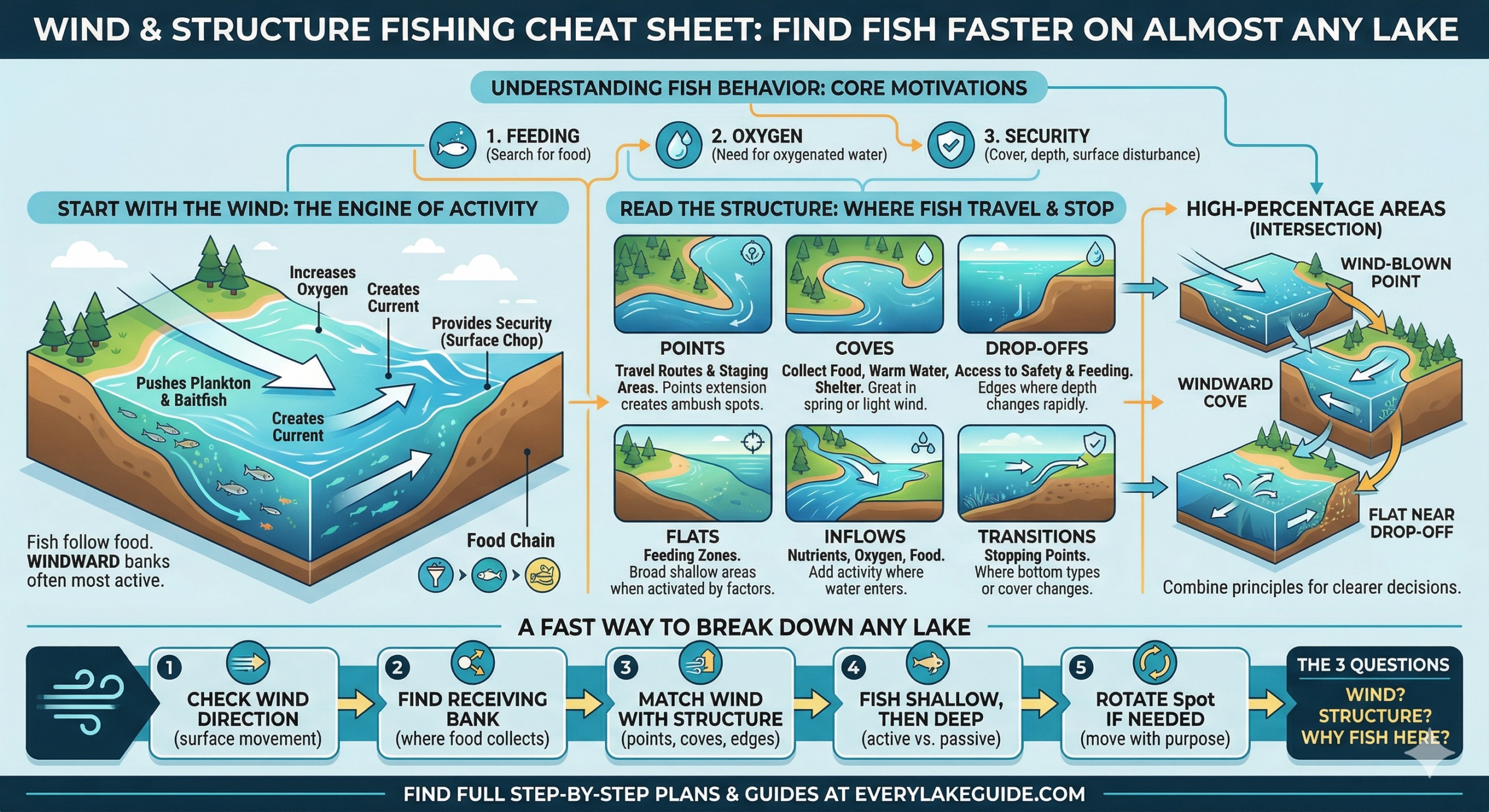
Wind direction helps you find fish because wind pushes surface water, floating food, insects, plankton, and baitfish toward certain shorelines. The bank the wind blows into often becomes more active because wave action can add oxygen, break up light penetration, and concentrate food. On small lakes, this can turn one shoreline into a better starting point than another.
The simplest rule is this: fish the bank the wind is blowing into first, then adjust for season, water clarity, and safety.
Quick Knowledge Check: Do You Read the Wind Correctly?
Before you pick your first spot, test what you already know.
- If the forecast says “west wind,” which bank is likely receiving the wind?
- Would a light ripple usually help or hurt shallow-water fishing?
- When should you avoid the wind-blown bank?
- What matters more: wind direction alone, or wind plus structure?
- If you only have two hours, should you start randomly or begin with the highest-percentage wind zone?
If those questions made you pause, this guide will make the lake easier to read.
First, Understand What Wind Direction Actually Means
Wind direction is named for the direction the wind comes from, not where it is going.
South Wind
A south wind blows from the south toward the north. That means the north side of the lake is usually the wind-blown side.
West Wind
A west wind blows from the west toward the east. That means the east bank is usually receiving the wind.
North Wind
A north wind blows from the north toward the south. In colder seasons, that can be helpful or harmful depending on water temperature.
Southwest Wind
A southwest wind pushes water toward the northeast. Look for northeast-facing banks, points, pockets, or flats.
For a plain-language weather definition, the National Weather Service glossary explains wind direction as the true direction from which the wind is blowing.
Why Wind Matters More Than Most Beginner Anglers Realize
Wind changes a lake because it does more than move air. It pushes the top layer of water, creates small currents, builds ripple, and changes how food and baitfish collect along certain shorelines.
That matters because fish rarely scatter evenly across a lake. They respond to comfort, cover, food, oxygen, temperature, and easy feeding opportunities. Wind can influence all of those at once.
EveryLakeGuide rule: Wind does not tell you the only place fish can be found. It tells you where to start looking first.
- Wind can push floating food and insects toward a shoreline.
- Baitfish often follow food and ripple zones.
- Predator fish often follow baitfish.
- Wave action can add oxygen and make fish more comfortable feeding shallow.
- Ripple can break up sunlight and make predators less cautious.
What Happens on the Wind-Blown Bank?
The wind-blown bank is the shoreline the wind is pushing into. On many days, that bank becomes one of the best places to start because several helpful changes happen at the same time.
Food stacks up
Plankton, insects, tiny organisms, and floating debris can collect along wind-blown shorelines. Baitfish may move into those zones, and larger fish may follow.
Oxygen can improve near the surface
Wind and wave action can help mix surface water. Healthy oxygen levels matter because fish and other aquatic life depend on dissolved oxygen. For more background on ponds and dissolved oxygen, see this helpful overview from Clemson Cooperative Extension.
Ripple gives fish cover
A flat, glassy lake can make shallow fish nervous. Ripple breaks up the surface and reduces visibility. That can help bass, crappie, trout, bluegill, and catfish feed with more confidence.
Warm surface water can shift
In spring and fall, wind can push warmer surface water toward a bank. On the right day, that slight temperature change can make a shallow shoreline more attractive.
Mud and scent can move
Wind can stir bottom material in shallow areas. That can help catfish and carp locate food, especially along banks, flats, and soft-bottom edges.
The Simple Wind Direction Formula for Bank Fishing
You do not need a complicated app to use wind direction. You only need to know where the wind is coming from and where it is going.
| Forecast Wind | Wind Moves Toward | Start Looking On | Best Added Feature |
|---|---|---|---|
| North wind | South | South-facing bank | Deeper edge, protected pocket, or warmer corner |
| South wind | North | North-facing bank | Shallow flat, point, or sun-warmed bank |
| East wind | West | West-facing bank | Wind-blown cove, dock line, or grass edge |
| West wind | East | East-facing bank | Point, riprap, drop-off, or shade line |
| Southwest wind | Northeast | Northeast bank | Point near a shallow flat |
The best spot is usually not just “the windy side.” It is the windy side plus something fish already like, such as a point, drop-off, grass edge, dock, rock bank, cove mouth, or inflow.
How to Pick a Fishing Spot in Five Minutes
Use this quick method when you arrive at a lake and do not know where to start.
Step 1: Check the wind direction
Open your weather app and look for the wind direction. Remember, the wind name tells you where it is coming from.
Step 2: Find the bank the wind is blowing into
If the wind is from the southwest, look toward the northeast side of the lake. If it is from the west, look toward the east bank.
Step 3: Add structure
Do not stop at wind direction alone. Look for the best feature on that wind-blown side: a point, shallow flat, riprap bank, dock, drop-off, cove, inflow, weed edge, or shaded corner.
Step 4: Fish a short search pattern
Give the area a fair chance, but do not camp there all day. If you do not get bites within 30 to 45 minutes, slide to the nearest point, pocket, or deeper edge.
Step 5: Adjust for safety and season
If the wind is too strong, the safest and smartest spot may be a protected pocket near the wind-blown side, not the roughest bank itself.
For a deeper beginner plan, read How to Catch Fish When You Only Have 2 Hours.
When the Wind-Blown Bank Is Not the Best Spot
Wind is powerful, but it is not the only factor. These are the moments when you should be careful about blindly fishing the windy side.
Very strong wind
If waves are heavy, fish may pull slightly away from the bank and hold on nearby points, breaks, or calmer pockets.
Cold north wind
During winter or after a sharp cold front, wind may push colder water into a bank. Fish may slide deeper or become less active.
Water gets too muddy
A little stain can help. Too much mud can hurt sight-feeding species like bass and crappie.
Unsafe bank access
If the bank is slick, steep, crowded, or unsafe for kids, choose a safer nearby angle. No fishing clue is worth a fall.
Beginner shortcut: If the exact wind-blown bank is too rough, fish the closest protected corner, cove mouth, or point near it.
How Different Fish React to Wind
Different species use wind in different ways. The pattern is not identical for every fish, but the same lake-first logic still applies.
| Species | How Wind Can Help | Best Beginner Starting Point |
|---|---|---|
| Bass | Wind can push baitfish into feeding lanes and make shallow bass less cautious. | Wind-blown points, riprap, grass edges, and shaded banks. |
| Bluegill | Light wind can move insects and food toward shallow areas. | Warm shallow banks, docks, weed edges, and protected pockets. |
| Crappie | Wind can position baitfish near brush, docks, and edges. | Structure near wind-blown banks, especially with nearby depth. |
| Catfish | Wind can move scent, stir shallow bottom areas, and create feeding activity. | Wind-blown flats, soft-bottom banks, coves, and inflow areas. |
| Trout | Ripple can make stocked trout more comfortable cruising and feeding near the bank. | Wind-rippled shorelines, stocking areas, and open casting lanes. |
| Carp | Wind can push warmer water and natural food toward shallow flats. | Soft-bottom flats, muddy edges, and calm pockets near wind. |
If you fish Kentucky community lakes, the Kentucky Fishing in Neighborhoods program is worth checking because many small lakes are managed to create easier access close to population centers. Always check current rules, daily limits, and local signage before fishing.
How to Use Wind Direction on Small Lakes
Small lakes react quickly to wind. A light breeze may not seem like much, but on a park lake, neighborhood lake, or small reservoir, it can shift food and surface activity faster than many beginners expect.
That makes wind direction especially useful for bank anglers. You may not have a boat, sonar, or a full day to explore. But you can still read the surface, look at the shoreline, and choose a smarter starting point.
- Start on the wind-blown side when conditions are safe.
- Prioritize points, flats, pockets, and visible structure.
- Watch for surface ripple, baitfish flickers, birds, and stained-water edges.
- Move if the water becomes too muddy or the wind is too strong.
- Use the first 30 to 45 minutes as a test, not a lifetime commitment.
For more beginner-friendly lake reading, visit How to Fish a Lake and Lake Bank Fishing Tips for Beginners in Kentucky.
The 2-Hour Wind Plan
If you only have a short window to fish, use this simple plan.
| Time | What to Do | Why It Helps |
|---|---|---|
| First 10 minutes | Check wind direction, water clarity, safe access, and visible structure. | You avoid wasting time on a random bank. |
| Next 35 minutes | Fish the best wind-blown structure you can safely reach. | You start where food and baitfish may be collecting. |
| Next 35 minutes | Move to the nearest point, cove mouth, drop-off, or protected edge. | You stay near the wind pattern but adjust if fish are not shallow. |
| Final 40 minutes | Repeat your best bite zone or switch to a simpler presentation. | You finish with confidence instead of chasing the whole lake. |
Need lure help after you choose the right bank? Read Best Lures for Bank Fishing.
FAQs About Wind Direction and Fishing
Is the wind-blown bank always the best place to fish?
No. It is often a smart starting point, but not always the final answer. Strong wind, cold fronts, muddy water, unsafe access, or missing structure can make another nearby area better.
What wind speed is best for fishing small lakes?
A light to moderate breeze is often easier for beginners than dead-calm water. Around 5 to 12 mph can create helpful ripple without making bank fishing too difficult, but conditions vary by lake shape and access.
What does a west wind mean for fishing?
A west wind means the wind is coming from the west and blowing toward the east. On a lake, that usually makes the east bank the wind-blown bank.
Should beginners fish into the wind?
Sometimes, yes. Fishing into the wind can be harder to cast, but it may put your bait where food and fish are collecting. If casting is difficult, stand at an angle or fish a nearby protected pocket.
Does wind help bluegill, bass, catfish, and trout the same way?
No. Bass may use wind to ambush baitfish, bluegill may move shallow near food, catfish may respond to scent and stirred bottom, and trout may cruise ripple zones. The shared idea is that wind can concentrate activity.
Putting It All Together
If you want to catch more fish on small lakes, start with the wind. It tells you where food may collect, where baitfish may move, where oxygen and ripple may improve, and where the first realistic bite may happen.
Then add structure. Wind plus a point is better than wind alone. Wind plus a shallow flat is better than random casting. Wind plus a safe bank, good access, and the right season gives you a plan.
That is the EveryLakeGuide difference. You do not need to know everything about fishing. You just need a better first decision.
Final reminder: Start with the lake, read the wind, find the structure, then choose the lure. That order saves time.
Want a Lake-Specific Wind Plan?
EveryLakeGuide helps beginners and busy bank anglers fish smarter by showing how wind, structure, seasonal movement, and simple lure choices work together on real lakes.
Each guide is built to help you make faster decisions when you only have a short window to fish.
- Wind-blown banks for specific lakes
- Simple structure zones
- Seasonal adjustments
- Bank-friendly fishing plans
- Clear 2-hour strategies
Get EveryLakeGuide Updates
Want new lake guides, quick fishing tips, and beginner-friendly updates? Use the form below to stay connected.