How to Read Any Lake | A Simple Fishing System for Beginners
A lake only looks confusing when you do not yet know what to notice.
To most beginners, water feels wide, open, and random. One bank looks about the same as the next. One cast feels as hopeful as another. People try different baits, move often, and wonder whether fish are simply not biting. But the truth is usually much simpler than that.
Fish are not using the lake randomly.
They are relating to food, comfort, movement, and safety. They are drawn toward certain banks, certain edges, certain depths, and certain forms of structure for reasons that repeat again and again. Once you understand those reasons, the lake begins to make sense. It stops feeling like a mystery and starts feeling like a system.
That is what this guide is here to teach.
This is not a list of rigid instructions. It is not a one-lure trick or a one-spot shortcut. It is a way of seeing. It gives you the deeper logic behind fish location so you can adapt, improvise, and make smarter decisions wherever you go.
The real goal is not just to catch fish on one lake.
The real goal is to learn how to walk up to almost any lake, read the clues in front of you, and quickly narrow down where fish are most likely to be.
That is the difference between blind casting and deliberate fishing.
That is the EveryLakeGuide system.
The Core Philosophy
Learn the lake first. Fish it second.
Most people begin with tackle.
They ask which lure to throw, what color to use, or which species might be active. Those questions matter, but they matter later. The first job is to understand how the lake is behaving. Because until you know how the lake is setting up, you are making every other decision in the dark.
A lake is a living system shaped by a few powerful forces.
Wind pushes food and surface activity. Structure creates routes, stopping points, and feeding opportunities. Depth gives fish comfort and safety. Sunlight changes temperature and visibility. Seasonal conditions influence where fish can hold efficiently and when they feel comfortable moving shallow.
Once you understand those forces, the lake starts revealing itself.
You stop asking, “Where should I randomly try next?” and start asking, “Why would a fish choose this area right now?”
That single shift changes everything.
Lake Truth
The first truth every beginner should understand
Fish do not need the whole lake.
They only need the parts of the lake that solve their immediate problem.
Sometimes that problem is food. Sometimes it is temperature. Sometimes it is safety from light, pressure, or sudden weather changes. Sometimes it is the need to move from deep water to shallow feeding areas without spending too much energy.
This means only part of the lake is usually high percentage at any given time.
That is why experienced anglers do not fish water evenly. They do not treat all shoreline as equal. They look for the small sections of a lake where the right conditions overlap. A windblown bank next to a point. A shallow flat near deeper water. A riprap edge that absorbs heat. An inflow that adds oxygen or current. A shaded side that offers cover. A corner where bait gets pushed and trapped.
These areas matter because they give fish efficiency.
And efficiency is one of the deepest truths in fishing. Fish want access to what they need without wasting energy. The parts of a lake that provide that balance become your best starting points.
The Three Big Forces
The ideas that unlock almost every lake
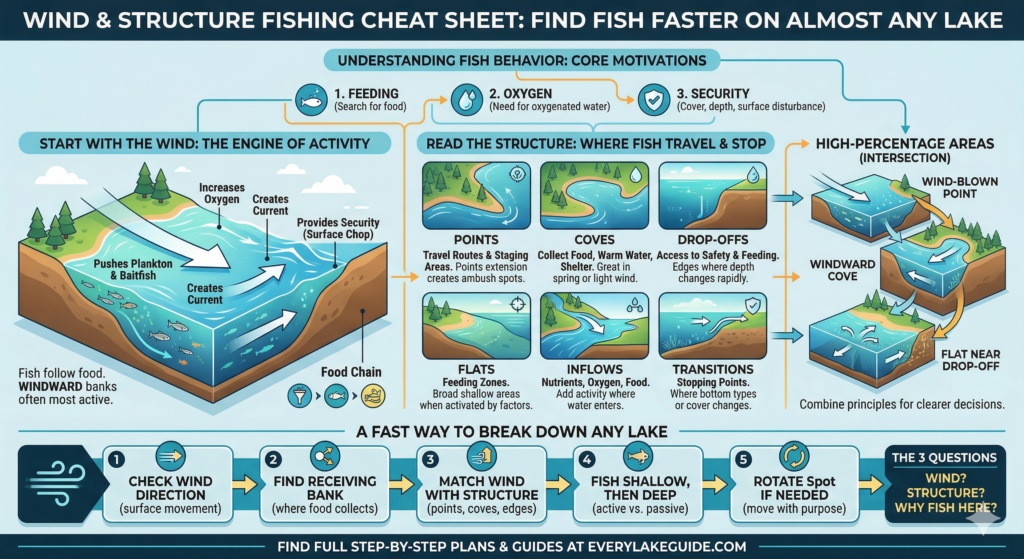
1. Wind organizes the lake
Wind is not just background weather. It is one of the fastest fish-positioning forces a beginner can learn to trust.
When wind pushes across a lake, it moves more than water. It helps gather floating food, stirs up tiny organisms, concentrates bait, and brings life toward certain banks and corners. In small lakes and neighborhood ponds, this can be especially important because a single windy side can become much more active than the calm side.
Wind also creates direction.
Instead of treating the whole lake as a blank canvas, you begin narrowing your attention. Which shore is receiving the push? Which cove is collecting drift? Which point is breaking the movement? Which bank now has stirred-up food and oxygen?
You do not follow wind because it is magic.
You follow wind because life often follows movement.
2. Structure gives fish a reason to be there
Fish do not just sit in open water without purpose. They relate to something.
That “something” is often structure.
Structure can be obvious, like a dock, a point, a dam, a riprap bank, a laydown, or a weed edge. It can also be subtle, like a bottom change, a depth drop, a shelf, a ditch, a small inflow, or a transition from soft bottom to rock.
These features matter because they create routes and stopping points.
A fish moving through a lake often wants edges, breaks, or places where food becomes easier to intercept. Structure provides those opportunities. It helps fish travel with purpose, pause with security, and feed with efficiency.
When beginners learn to see structure, they stop wasting time on empty-looking water.
3. Depth creates comfort and options
Depth is not just about how deep the water is. It is about what that depth allows.
Deeper water often offers safety, stable temperature, and a place to retreat when conditions are harsh. Shallower water often offers feeding opportunities, warmth, and easier access to food. Fish move between these zones based on season, light, pressure, and weather.
That is why the best areas are often not simply “deep” or “shallow.”
They are places where fish have options.
A shallow flat near a drop. A bank where a fish can slide from three feet to eight feet quickly. A cove with a nearby point. A shoreline where cover meets a depth change. These are the kinds of areas that let fish feed without feeling exposed for long.
The more options an area gives a fish, the more valuable that area becomes.
How to Read a Lake Before You Cast
A simple mental sequence
The fastest way to improve is to stop rushing your first cast.
Before you fish, pause and read.
Look at the wind first. Notice where it is pushing. Notice which banks are calm, which are active, and which corners seem to be collecting movement.
Then study the shape of the water. Ask where fish could travel, hold, or feed efficiently. Look for points, turns, coves, inflows, dam faces, shade lines, weed edges, riprap, deeper-looking water, and any place where one type of water transitions into another.
Next, think about depth access. Where can fish move from comfort to feeding without a long journey? Where could they hold if pressure or sunlight increases? Where would they slide if the weather changes quickly?
Only then think about how to fish it.
This order matters because location usually matters more than lure choice. A simple bait in the right water beats a perfect bait in dead water again and again.
Wind Zones
What wind usually tells you
A lake tends to divide itself into simple zones once wind enters the picture.
The windblown bank is often the most obvious place to begin. This is where food and movement may gather. It often feels alive. The water may be slightly stained, rippled, or active-looking. Fish that want an easy feeding opportunity often use these areas.
The protected bank can still matter, but usually for different reasons. On cold days, calm water may warm faster. Under heavy fishing pressure, some fish may slide to quieter water. Calm water can also be useful when fish are spooky or when the windblown side becomes too turbulent.
Windblown corners are especially important. These areas often act like collection bowls. Food drifts there. Bait piles there. Fish can trap and intercept more efficiently there.
Windblown points can also be high percentage because they combine movement with structure. Fish can hold on the edges, slide shallow to feed, and move off quickly if they need to.
The lesson is not that every windy area is automatically good.
The lesson is that wind gives you a starting map.
Structure Zones
The places fish naturally relate to
Most lakes can be simplified into a handful of repeating structure types.
Points matter because they are natural travel extensions. They reach into the lake, often touch different depths, and give fish a path between shallow and deep water. A point is rarely just a shape. It is a route.
Corners matter because they concentrate movement. Wind, bait, and fish often gather there more easily than on a featureless straight bank.
Dams and riprap matter because they provide depth access, rock, warmth, and edge. These areas often stay productive longer than they appear to beginners.
Shallow flats matter because they are feeding tables. Fish may not live there all day, but they often visit them when conditions line up.
Drop-offs matter because they create fast transitions. Fish can use them as safe lines, holding zones, or retreat paths.
Inflows matter because they change the water. They may add oxygen, cooler water, warmer runoff, scent, or movement. Even a small inflow can create a meaningful difference.
Shade lines matter because they offer comfort and concealment. In bright conditions, that edge between light and dark can become a quiet ambush line.
The deeper lesson is simple. Fish love edges because edges create choices.
The Beginner’s Bank-Fishing Framework
A smarter way to move around the lake
Bank anglers often make one mistake that ruins everything.
They move based on frustration instead of logic.
They cast for a few minutes, feel uncertain, and then leave before the area had a real chance or before they fully understood what made it good or bad. This creates a rushed, scattered style of fishing that feels active but teaches very little.
A better system is to move with intention.
Start with the highest-percentage bank. Usually that means the bank where wind, structure, and depth access overlap best. Fish it patiently but not endlessly. Pay attention to signs of life. Look for bait flickers, bird activity, shade, surface movement, clearer versus dirtier water, and where the lake seems to have the most energy.
Then move to the next area that offers a different version of the same logic. A nearby point. A corner. A depth change. A calmer backup bank. You are not wandering. You are testing ideas.
The goal is not just to “cover water.”
The goal is to learn what kind of water is winning today.
That is how better anglers improve fast. They are always collecting evidence.
What the Crowd Gets Wrong
The myths that keep beginners stuck
One of the biggest mistakes people make is assuming fish are spread evenly around a lake. They are not. A lake may have one active third and two quiet thirds. The best anglers find the active water sooner.
Another mistake is treating lure choice as the main answer. Lures matter, but location comes first. Too many people keep changing baits when they should be changing angles, zones, or banks.
Another common mistake is ignoring wind because it feels inconvenient. Wind often makes fishing feel harder, but it frequently makes fish location easier.
Many beginners also fish the prettiest water instead of the most useful water. They choose the easiest shoreline, the most comfortable position, or the calmest-looking bank even when the more productive water is somewhere else.
And finally, people often give up on subtle structure because it does not look dramatic enough. But small changes matter. A little turn, a little drop, a little rock, a little inflow, a little corner can change everything.
The crowd usually looks for excitement.
The fish usually respond to advantage.
Seasonal Movement
Why fish do not use the same water all year
A lake changes with the season, and fish change with it.
In colder periods, fish often lean toward stability. Deeper water, slower movement, sun-warmed banks, and areas with nearby comfort become more important. The feeding windows may be shorter, but the logic remains the same. Fish still want efficiency.
In warming periods, shallow zones begin to matter more, especially when they warm faster and gather food. Fish often become more willing to move onto flats, into coves, or along banks with good exposure.
In summer, fish may still feed shallow at times, but comfort becomes more important again. Shade, oxygen, early and late feeding windows, and access to deeper refuge can make the difference.
In fall, movement and feeding urgency often increase. Fish may roam more, but they still use structure, depth changes, and wind-driven food concentration.
The season changes the mood of the lake, but it does not erase the system.
Wind still matters. Structure still matters. Depth still matters.
A Simple Two-Hour Plan
What to do when you arrive at a new lake
For the first ten minutes, do not rush. Observe. Watch the wind. Study the shoreline. Look for the most promising overlap of movement, structure, and depth access.
For the next forty minutes, fish your best-looking zone thoroughly. Work the bank, the corner, the point, or the edge that makes the most sense. Focus on confidence and observation, not random experimentation.
For the next thirty minutes, shift to a second area that gives fish a slightly different option. If you started on the active windblown side, now try the nearby transition, secondary point, or calmer edge close to deeper water.
For the next twenty minutes, commit to the clearest clue you have learned so far. Maybe fish are relating to shade. Maybe they are on the wind. Maybe they are near rock. Maybe they are using the first depth break.
For the final twenty minutes, return to your highest-confidence water and fish it with greater belief. You are no longer guessing. You are now working from evidence.
That is a better way to spend two hours than simply circling the lake and hoping.
Confidence, Patience, and Pattern Recognition
The deeper skill you are really building
The real power of this system is not that it tells you one exact cast.
It teaches you pattern recognition.
You begin noticing that fish often use the same kinds of areas across many lakes. Not the same exact spots, but the same underlying logic. Windblown corners. Shallow feeding tables near deeper refuge. Structured banks with movement. Transition zones. Efficient travel routes.
This is the point where fishing becomes much more enjoyable.
You stop feeling lost. You stop thinking every bad session means you failed. You start understanding that every trip teaches you something about how fish are using the lake that day.
And that creates confidence.
Confidence is not blind optimism. It is earned understanding.
Final Word
The goal is not perfection. The goal is clarity.
You do not need to read every inch of a lake perfectly.
You only need to see it more clearly than before.
That is how progress begins. One better question. One smarter bank choice. One clearer understanding of why fish would be there. One less random cast. One more deliberate move.
The lake has always been telling the truth.
This guide simply helps you hear it.
Read the lake first.
Trust the clues.
Let the fish make sense.