How to Build a Simple 2-Hour Fishing Plan for Any Small Kentucky Lake
A short bank trip should not feel random. With a simple 2-hour plan, you can walk up to almost any small Kentucky lake, read the water faster, choose a better bank, and fish with more confidence before your time runs out.
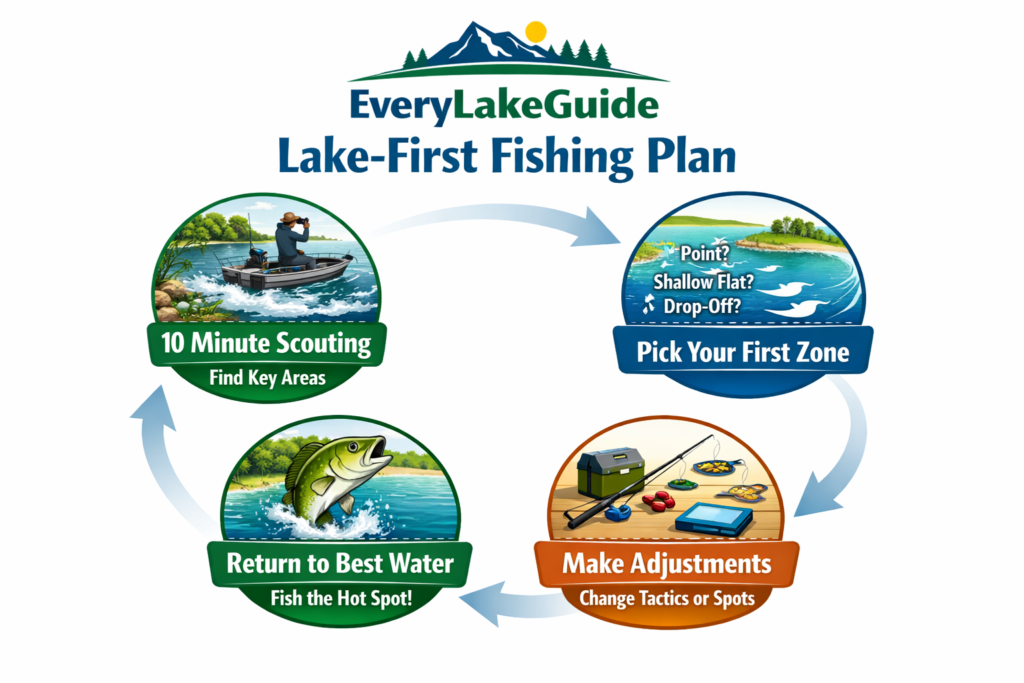
A good 2-hour fishing plan for a small Kentucky lake starts before the first cast. Spend 10 minutes reading the wind, water color, shade, access points, and visible structure. Spend the next 30 minutes testing the most promising bank. Use the middle hour to rotate between points, coves, flats, drop-offs, docks, riprap, or inflow areas. Use the final 20 minutes to return to the best-looking water with your most reliable bait or lure.
Most short fishing trips fail for one simple reason. The angler starts fishing before they start reading the lake.
That is especially true on small Kentucky lakes. These lakes often look simple from the parking lot. You see a walking path, a few banks, a dam, maybe a cove, and a couple of open-water areas. It feels like you should be able to walk up, cast anywhere, and catch fish.
Sometimes that happens. Most of the time, it does not.
Small lakes still have patterns. Wind pushes food. Shade changes fish behavior. Shallow flats warm faster. Drop-offs hold fish when the sun is high. Points can act like underwater highways. Inflow areas can pull fish close when the water is moving. The trick is not to fish harder. The trick is to fish with a plan.
That is where the EveryLakeGuide 2-hour system comes in. It gives bank anglers a repeatable way to approach local lakes, FINs waters, neighborhood ponds, park lakes, and quick evening trips without overthinking every cast.
Before You Fish: The 2-Hour Plan Mindset
A 2-hour plan is not about rushing. It is about removing guesswork.
Instead of standing in one easy spot and hoping fish swim by, you divide your trip into simple blocks. Each block has a job. First you observe. Then you test. Then you adjust. Then you finish strong.
This keeps you from making the most common beginner mistake: fishing the closest bank just because it is closest.
On many small lakes, one side of the lake will simply set up better than the other. It may have wind blowing into it, better shade, nearby depth, more cover, or a cleaner food chain. If you want a deeper look at that idea, read Why One Side of the Lake Usually Fishes Better Than the Other.
Small-Lake Reality Check: What Do You Notice First?
Before we build the plan, test how you usually think when you arrive at a lake. Tap each question to reveal the better lake-first answer.
1. Should you start fishing at the closest open bank?
Not automatically. The closest bank may be convenient, but the best bank is usually the one with the best combination of wind, cover, shade, access, and nearby depth.
2. Is a calm, pretty bank always the best place to fish?
No. A calm bank can be comfortable, but a wind-blown bank may collect food and attract active fish. Comfort and fish activity are not always the same thing.
3. Should you change lures before changing locations?
Usually, no. If you are fishing dead water, a new lure may not fix the problem. Move to better water first, then fine-tune your presentation.
4. What matters more on a short trip: covering water or standing still?
Covering water usually matters more during the first hour. Once you find the best-looking zone or get a bite, then slowing down makes sense.
5. What is the main goal of the first 10 minutes?
The goal is to read the lake before casting. Look for wind direction, baitfish activity, shade lines, bank access, water clarity, and structure clues.
The Simple 2-Hour Fishing Plan
Here is the basic structure. You can use this at almost any small Kentucky lake, whether you are fishing for bass, bluegill, catfish, stocked trout, or just trying to learn the water better.
| Time Block | Your Job | What to Look For | What to Avoid |
|---|---|---|---|
| 0–10 minutes | Read the lake before casting. | Wind, shade, water color, baitfish, bank access, points, coves, flats, and deeper edges. | Making your first cast just because the bank is open. |
| 10–40 minutes | Test the best-looking bank. | Wind-blown edges, shade lines, visible cover, riprap, docks, grass, drains, or inflow areas. | Staying too long without signs of life. |
| 40–100 minutes | Rotate through high-percentage areas. | Points, cove mouths, shallow flats near depth, drop-offs, dam edges, and transitions. | Changing bait every few casts without learning anything. |
| 100–120 minutes | Return to the best water and finish focused. | The bank with the most activity, best wind, best shade, or most promising structure. | Ending the trip by wandering aimlessly. |
Minutes 0–10: Read the Lake Before You Tie On a Plan
The first 10 minutes may be the most important part of the whole trip.
This is when you stop thinking like a person looking for a place to stand and start thinking like an angler looking for fish. The lake is already giving you clues. Your job is to notice them.
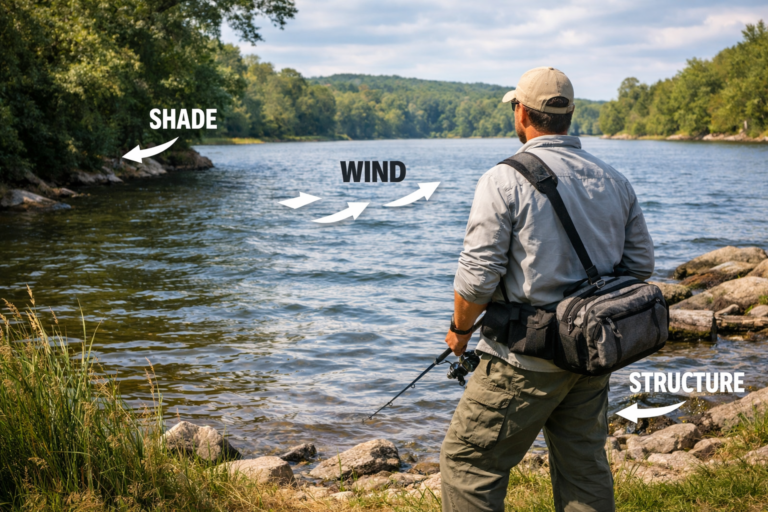
Start with wind. Which bank is the wind touching? Is it pushing small waves into one side? Is it blowing across a point? Is it stacking foam, leaves, or surface debris in a corner? Wind can move tiny food, stir the shallows, and make fish feel safer along the bank.
Next, look at shade. In warm months, shade can turn a dead-looking bank into a useful holding area. Trees, docks, bridges, steep banks, and the shadow side of a dam can all create cooler, safer water.
Then look for structure. Points, coves, flats, drop-offs, riprap, drains, inflows, brush, and bank transitions all matter. You do not need a fancy map to notice these things. You just need to slow down before you cast.
For a full breakdown of this arrival routine, use The First 10 Minutes at Any Lake: What Smart Bank Anglers Look For Before Casting as your companion guide.
Your 10-Minute Arrival Checklist
- Which bank has wind blowing into it or across it?
- Where is the best shade now, not later?
- Do you see baitfish, bluegill dimples, surface swirls, birds, or insects?
- Where does shallow water sit close to deeper water?
- Where are the points, cove mouths, flats, drains, or dam edges?
- Which bank lets you move safely without getting trapped in brush?
- Are there posted regulations, park rules, or access limits you need to follow?
Minutes 10–40: Test the Best Bank First
After the first 10 minutes, choose the best-looking bank and give it a fair test.
This does not mean you camp there all morning. It means you fish it with purpose. You are trying to answer a simple question: are active fish using this bank right now?
Start with fan casts. Cast left, straight out, and right. Work close to the bank before bombing casts into open water. Many fish in small lakes use the first few feet of shoreline, especially when shade, wind, cover, or food is present.
If you are fishing for bass, test visible cover, points, shade edges, and transitions. If you are fishing for bluegill, look for shallow pockets, docks, grass edges, and quiet corners. If you are fishing for catfish, think about deeper corners, inflow areas, and places where food naturally settles. If you are fishing for stocked trout in a FINs lake, pay attention to access points, open casting lanes, deeper nearby water, and stocking-season pressure.
The key is not to panic after five casts. Give the bank enough time to tell you something. A follow, a tap, a swirl, small baitfish movement, or one missed bite can all be clues.
If nothing happens after 25 to 30 focused minutes, do not keep proving the same water wrong. Move.
If you want a more detailed bank-selection system, read How to Pick the Best Bank Before You Ever Tie On a Lure.
Minutes 40–100: Rotate Through High-Percentage Water
This is the working part of the trip.
By now, you have observed the lake and tested your first bank. During the middle hour, your job is to rotate through the places most likely to hold fish. You are not wandering. You are checking specific zones.
On small Kentucky lakes, those zones are usually easy to name once you know what to look for.
The best anglers do not just ask, “What lure should I use?” They ask, “What is this part of the lake doing for the fish?”
That shift changes everything.
A point gives fish a travel route. A cove gives them a feeding pocket. A flat gives them shallow food. A drop-off gives them safety. A shaded bank gives them comfort. A wind-blown bank gives them movement and food. Once you understand that, the lake stops looking random.
For a broader beginner-friendly breakdown, read How to Find Fish in a Lake: A Beginner-Friendly Lake Reading Guide.
Minutes 100–120: Finish Where the Clues Were Strongest
The final 20 minutes are not throwaway time.
This is where many bank anglers make a mistake. They either give up mentally or start moving too fast. Instead, use the final stretch to return to the best water you found during the trip.
Maybe one shaded bank had bluegill activity. Maybe a wind-blown point had a missed bass strike. Maybe the dam bank had bait flickering near the rocks. Maybe one cove looked dead early but now has shade, ripples, and insect activity.
Go back there.
Then simplify. Use your most reliable presentation. Slow down. Make better casts. Hit the highest-percentage targets again.
A good 2-hour plan often catches fish late because the first 100 minutes taught you where not to waste the final 20.
The Best Baits and Lures for a 2-Hour Small-Lake Plan
You do not need a giant tackle bag for this system. In fact, too many options can hurt you on a short trip.
The goal is to carry enough to cover the main situations without turning your fishing time into a constant lure-changing session.
| Target | Simple Choice | When It Works Best | Lake-First Reason |
|---|---|---|---|
| Bass | Small soft plastic, inline spinner, shallow crankbait, or finesse jig | Points, shade, riprap, grass edges, and transitions | These options let you cover water and slow down when you find cover. |
| Bluegill | Worm piece, small jig, cricket, or tiny float rig | Shallow pockets, docks, brush, grass, and sunny edges | Bluegill often reveal active zones quickly, which helps you read the lake. |
| Catfish | Prepared bait, chicken liver, cut bait where legal, or nightcrawler | Deeper corners, inflows, evening shade, and settled food zones | Catfish often use scent trails and natural food collection areas. |
| Stocked Trout | Small spoon, spinner, trout dough bait, or salmon egg where permitted | Cooler seasons, open banks, deeper nearby water, and stocking-access zones | Stocked trout often roam, so simple coverage and legal bait choices matter. |
Always check the lake’s posted rules and current Kentucky fishing regulations before keeping fish or choosing bait. Some waters have special restrictions, and FINs lakes have their own posted standards.
Regulation-Safe Note for Kentucky Anglers
Kentucky’s Fishing in Neighborhoods program is designed to create close-to-home fishing opportunities, and FINs lakes are regularly stocked with catfish and rainbow trout. However, regulations, creel limits, trout requirements, special bait rules, and access rules can change.
Before fishing, check the signs at the lake and review the official Kentucky Department of Fish & Wildlife Resources pages for Fishing in Neighborhoods, statewide size and daily limits, and license information.
This article is a fishing-planning guide, not a legal regulation summary.
How to Use the 2-Hour Plan on a FINs Lake
FINs lakes are perfect for this system because they are often small, accessible, and built for short local trips. Many are located in parks or community areas, which means anglers may only have an hour or two after work, before dinner, or on a weekend morning.
But easy access does not mean the fishing is automatic.
FINs lakes often receive pressure. The most obvious banks may get fished hard. Stocked fish may spread out. Bass and bluegill still respond to structure, shade, weather, and pressure. Catfish still use deeper edges, food zones, and low-light windows.
That is why the plan matters.
On a FINs lake, start by identifying the highest-use areas. These are often near parking lots, piers, flat open banks, and easy access points. Then look beyond them. Is there a quieter bank with shade? A wind-blown corner? A dam edge? A cove mouth? A stretch of bank where deeper water comes close?
Do not ignore convenient areas, but do not let convenience make the whole decision.
How to Use the Plan on a Small Park Lake
Small park lakes can be sneaky. They may not have obvious maps, big boat ramps, or dramatic depth changes. Still, they usually have enough clues to build a plan.
Look for the dam first if there is one. Dam banks often mean deeper water, rock, and a clean edge. Then look for inflows, drains, culverts, shade lines, and any place where the shoreline changes shape.
One of the easiest beginner mistakes is treating the whole shoreline as equal. It is not equal. A straight, shallow, muddy bank with no shade may not fish like a rocky corner with wind, depth, and bluegill activity.
Your job is to rank the banks before you fish them.
That is why the EveryLakeGuide method starts with the lake, not the lure. A lure can only help once you put it in front of fish. For more on that mindset, read Fishing for Beginners Lake Guide: Start With the Water, Not the Lure.
How Weather Changes Your 2-Hour Plan
The same lake can fish differently from one day to the next. That does not mean the plan fails. It means the plan needs to adjust.
On a sunny day
Prioritize shade, depth, docks, overhanging trees, and wind-blown banks. Fish may hold tighter to cover or slide deeper after the early morning window.
On a cloudy day
Fish may roam more. Cover water faster during the middle hour. Points, flats, and cove mouths can stay productive longer because harsh light is less of a factor.
After rain
Check inflows, drains, stained water edges, and areas where fresh water enters the lake. Be careful with footing, muddy banks, and fast runoff.
During wind
Do not automatically hide from the wind. A wind-blown bank can be productive, especially if it has safe access. Cast at angles and use slightly heavier presentations if needed.
During calm, hot conditions
Move early, look for shade, and slow down around deeper edges. The most comfortable bank may not be the best bank, but extreme heat can make shaded, oxygen-rich, or deeper nearby water more important.
A Simple Walking Route for Any Small Lake
If you are not sure where to begin, use this walking route.
The EveryLakeGuide 2-Hour Route
- Start at the access point, but do not start casting yet. Look across the lake and identify wind, shade, and structure.
- Walk toward the best-looking bank. This may be the wind-blown side, the shaded side, the dam, a point, or a cove mouth.
- Fish your way through that bank for 25 to 30 minutes. Make fan casts and watch for any sign of life.
- Move to the next high-percentage feature. Do not move randomly. Move to a point, cove, drop-off, inflow, or bank transition.
- Keep one small note. Write down where you saw activity, got a bite, or found better water.
- Return to the best zone for the final 20 minutes. Finish with focus instead of wandering.
What to Write Down After the Trip
A 2-hour trip becomes more valuable when you leave with notes.
You do not need a complicated fishing journal. A few lines on your phone are enough. Write down the date, weather, wind direction, water clarity, where you started, where you got bites, and what you would do first next time.
That last part matters most.
Ask yourself: “If I only had 30 minutes here tomorrow, where would I start?”
That question turns a casual trip into lake knowledge. Over time, your notes become your own custom lake guide.
| Trip Note | Example | Why It Helps Later |
|---|---|---|
| Wind Direction | Southwest wind blowing into the dam corner | Helps you predict which bank may set up next time. |
| Best Bank | Shaded east bank near the cove mouth | Shows where fish used comfort and structure together. |
| Fish Activity | Bluegill dimples near grass at 7:20 p.m. | Reveals food activity and timing. |
| Missed Opportunity | Did not fish the wind-blown point until the end | Gives you a better starting point for the next trip. |
Common 2-Hour Trip Mistakes
A short fishing trip gives you less room for wasted time. These mistakes are easy to make, but they are also easy to fix.
Mistake 1: Fishing the easiest bank first
The easiest bank may be fine, but it should still earn your attention. Choose the bank with the best clues, not just the shortest walk.
Mistake 2: Changing lures too often
If the water is wrong, a new lure may not solve anything. Move to better water before blaming your bait.
Mistake 3: Ignoring wind
Wind can be annoying, but it can also improve a bank. Learn to read what wind is doing before you avoid it.
Mistake 4: Standing still too long
If you have no bites, no baitfish, no cover, no shade, and no reason to believe fish are there, keep moving.
Mistake 5: Leaving without learning
Even a slow trip can teach you something. The goal is not only to catch fish today. The goal is to understand the lake better for next time.
Example: A 2-Hour Evening Trip
Imagine you arrive at a small Kentucky park lake at 6:00 p.m. You have until 8:00 p.m.
The wind is blowing into the left side of the lake. The right side is calmer, but it is also shallow, bright, and crowded. A small cove sits on the wind-blown side. The dam bank has rock and deeper water. A shaded point sticks out between the cove and the dam.
A random plan would start at the open bank near the parking lot.
A lake-first plan starts differently.
From 6:00 to 6:10, you watch the water. You notice small bait flickers near the wind-blown cove. From 6:10 to 6:40, you test that cove and the nearby point. You get one tap near the shade line. From 6:40 to 7:40, you rotate to the dam bank, then back to the point, then to the outside edge of the cove. At 7:40, you return to the shaded point because it had the best combination of wind, shade, and nearby depth.
Even if you only catch one fish, that trip was not random. You learned where the lake wanted to set up that evening.
That is the real value of a 2-hour plan.
Start With the Lake, Not the Lure
The lure matters. The bait matters. The rod, line, and hook matter too.
But on a short bank trip, location matters first.
If you learn to read wind, shade, structure, depth, access, and fish activity, you will make better choices before your first cast. That is how a simple 2-hour trip becomes a repeatable system.
FAQs About Building a 2-Hour Fishing Plan
Can you really catch fish in only two hours?
Yes, but you need to avoid wasting the first hour. A 2-hour plan helps you observe first, choose better water, move with purpose, and finish where the clues are strongest.
What is the best first place to fish on a small Kentucky lake?
The best first place is usually the bank with the strongest combination of wind, shade, nearby depth, cover, and safe access. It is not always the closest bank.
Should beginners fish for bass, bluegill, catfish, or trout first?
Bluegill are often the easiest way to learn a lake because they reveal active areas quickly. Bass teach structure. Catfish teach food zones and timing. Stocked trout can be great during the right season, especially on FINs waters where trout are stocked.
How long should I stay in one spot without a bite?
On a short trip, give a good-looking area about 20 to 30 focused minutes. If you see no activity, get no bites, and have no strong reason to stay, move to another high-percentage feature.
Do I need a lake map for this system?
A map helps, but you can still use the system without one. Look for visible clues such as points, coves, dam banks, inflows, shade lines, riprap, and changes in shoreline shape.
Want a Faster Way to Read Your Next Lake?
EveryLakeGuide helps bank anglers start with the lake, choose better water, and build short-trip plans that make sense before the first cast.