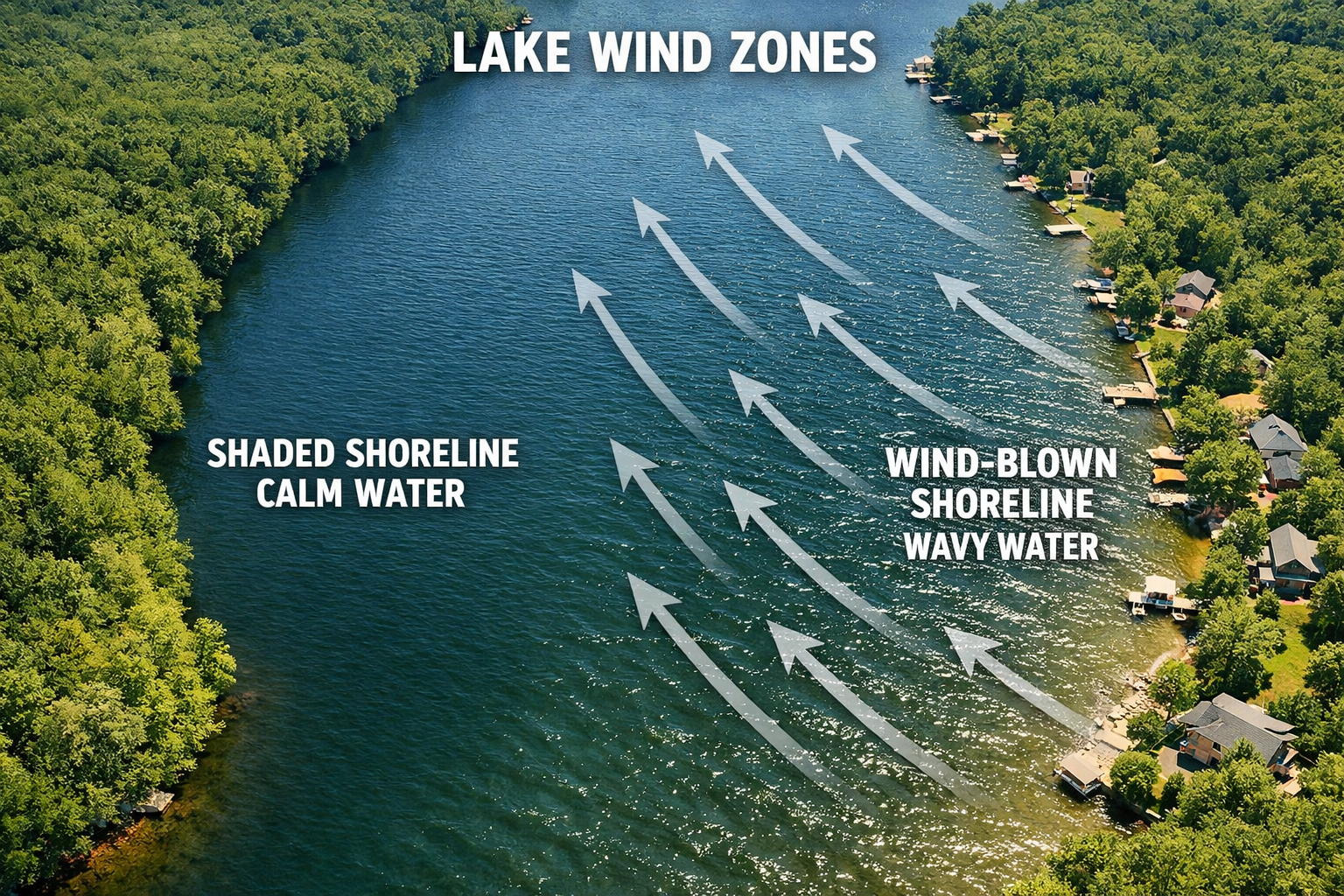
Why One Side of the Lake Usually Fishes Better
One side of a lake often fishes better because wind, shade, depth, structure, current, and food movement are rarely balanced evenly. Smart anglers learn to read those clues before choosing a bank, point, cove, or shoreline.
That is the difference between random casting and lake-first fishing. You are not trying to cover every inch of water. You are trying to find the side of the lake where fish have the best reason to be active.
Most beginners walk up to a lake and ask the same question: “What should I throw?”
That question matters, but it is not the first question. The better question is, “Which side of this lake gives fish the best reason to be here right now?”
Once you start thinking that way, the lake begins to look different. The bank with ripples may matter more than the calm bank. The shaded side may hold fish longer on a hot afternoon. The deeper side may protect fish during weather swings. The side with grass, rock, wood, inflow, or wind-blown bait may quietly outfish the pretty-looking shoreline across the water.
This is why one side of the lake usually fishes better than the other. It is not luck. It is water movement, comfort, cover, food, and timing working together.
Quick answer: One side of the lake usually fishes better because it offers better fish conditions at that moment. The best side may have wind pushing food toward it, shade keeping water cooler, deeper water nearby, more structure, more cover, or a better seasonal position.
Lake-Reading Self Check: Are You Picking the Right Side?
Before you start casting, use this quick check. It helps separate what looks good from what usually fishes well.
- Which side of the lake has wind blowing into it?
- Which bank has shade, especially during bright or hot conditions?
- Which shoreline is closest to deeper water?
- Where do you see visible cover such as grass, brush, laydowns, docks, rock, or riprap?
- Which side gives fish both food and safety within a short swimming distance?
If one side answers more of those questions than the other, start there.
The Best Side of the Lake Is Usually the Side With a Reason
Fish do not spread evenly across a lake like decorations on a map. They respond to conditions. They move toward comfort. They follow food. They use structure like travel lanes. They hold near cover when they need safety. They slide shallow when feeding gets easier and back off when pressure, sun, temperature, or water clarity changes.
That means the lake has a “better side” only because something is happening there. Maybe wind has been pushing plankton and baitfish toward one bank. Maybe the morning sun warmed a shallow flat faster than the rest of the lake. Maybe a shaded bank stays cooler after lunch. Maybe the dam side has deeper water and a cleaner edge. Maybe the upper end has inflow, color, oxygen, and feeding activity.
The trick is not memorizing one magic bank. The trick is learning why that bank might be better today.
Wind Is Often the First Clue
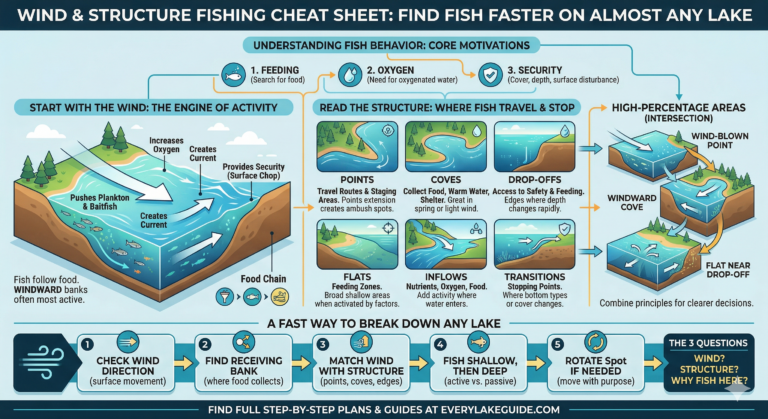
Wind is one of the fastest ways to choose a side of the lake. When wind blows across the surface, it pushes tiny food sources, warmer surface water, and bait activity toward the downwind bank. That can make one shoreline more active than the calm, slick-looking side.
Many beginners avoid the windy side because casting feels harder. That is understandable. Wind can be annoying. It can bow your line, reduce casting accuracy, and make light lures harder to control. However, the windy side often has more life.
Ripples break up light. Fish feel less exposed. Baitfish may get pushed closer to the bank. Bass, bluegill, crappie, and catfish may use that edge differently depending on season, but wind almost always changes how a lake fishes.
| Wind Situation | What It Usually Means | How to Fish It |
|---|---|---|
| Wind blowing into a bank | Food and bait may collect along that side. | Start with the wind-blown shoreline, points, pockets, or corners. |
| Wind crossing a point | Fish may use the point as an ambush lane. | Cast across the point and work your bait through the moving water. |
| Calm side of the lake | May be easier to fish but less active unless shade, depth, or cover helps. | Use slower presentations and focus on visible cover. |
| Strong wind on shallow water | Can create feeding activity but may become difficult or unsafe. | Fish protected pockets near the wind instead of fighting the worst gusts. |
For a deeper look at this idea, read how wind direction predicts where fish will be on any lake. Wind is one of the core clues behind the EveryLakeGuide system.
Shade Can Make One Bank Better Fast
Shade is another reason one side of the lake may fish better. On sunny days, shaded water can hold fish longer because it offers comfort and protection. This is especially important in shallow ponds, park lakes, and smaller reservoirs where fish may feel exposed in clear, bright water.
In the morning, the sunny side may warm first and attract activity. Later in the day, the shaded side may become better because fish can feed without sitting in harsh light. This is one reason the best bank can change between sunrise, noon, and evening.
Shade can come from trees, steep banks, docks, bridges, riprap walls, tall grass, or even the angle of the shoreline. A small strip of shade along a bank may not look dramatic from a distance, but fish may use it like a comfort lane.
Morning Clue
A sunny shallow side can warm faster, especially in spring. That can pull bait and fish into reachable water.
Afternoon Clue
A shaded bank can stay more comfortable when the sun is high. This can be a strong clue during summer and early fall.
Depth Changes Matter More Than a Pretty Shoreline
A shoreline can look perfect and still fish poorly if it has no depth change nearby. Fish often want options. They may feed shallow, but they like being able to slide into safer or more comfortable water without traveling far.
This is why the side of the lake near deeper water often has an advantage. A bank close to a creek channel, dam bowl, drop-off, old roadbed, or steep contour can hold fish through more conditions than a flat, featureless shoreline.
That does not mean shallow flats are bad. In spring, during low light, around bluegill beds, or when bait is shallow, a flat can be excellent. But the best shallow flats usually have something extra nearby: a ditch, point, weed edge, rock transition, or quick access to deeper water.
Simple rule: If one side of the lake gives fish shallow feeding water and nearby deeper escape water, it often beats the side that only offers one or the other.
Structure and Cover Can Stack the Odds on One Side
Structure and cover are not the same, but both can make one side of a lake better.
Structure is the shape of the lake bottom. Points, channels, humps, flats, ledges, inside turns, outside bends, and drop-offs are structure. Cover is the stuff fish can hide in or around. Grass, wood, brush, docks, rock, reeds, and laydowns are cover.
When one side of the lake has better structure and better cover, that side deserves attention. Fish may use the structure to travel and the cover to feed, rest, or ambush prey.
| Lake Feature | Why It Helps | Good Beginner Approach |
|---|---|---|
| Point | Works like a fish travel lane and feeding shelf. | Cast from shallow to deep and from deep to shallow until you find the angle. |
| Grass edge | Holds insects, baitfish, bluegill, and ambush cover. | Fish parallel to the edge instead of only casting straight out. |
| Riprap or rock | Absorbs heat, holds crawfish, and creates small hiding places. | Work slowly along the rocks and pay attention to corners. |
| Laydown or brush | Gives fish shade, protection, and ambush cover. | Cast beside it first, then closer after you test the edges. |
| Dam side | Often has deeper water and a clean edge. | Fish the corners, riprap, and nearby transitions. |
The “Best Side” Changes With the Season
The best side of the lake is not fixed forever. Fish shift with the season. A bank that feels dead in winter may come alive in spring. A shallow cove that produces in May may become tough in August. A windy bank that is excellent in fall may be too cold or muddy after a front.
This is why EveryLakeGuide focuses on reading the lake instead of memorizing one lure or one spot. The side that fishes better is usually the side that matches the current season.
| Season | Side That Often Improves | Why It Can Be Better |
|---|---|---|
| Early Spring | Sunny, protected shallow banks | They may warm faster and attract bait, bluegill, and bass. |
| Late Spring | Flats, spawning pockets, and nearby edges | Fish may be shallow, but still relate to cover and protected areas. |
| Summer | Shade, deeper banks, wind-blown edges, and oxygen-rich areas | Fish often seek comfort during heat and bright light. |
| Fall | Wind-blown banks, bait-rich coves, and points | Feeding activity can follow bait movement. |
| Winter | Deeper, slower, more stable water | Fish often conserve energy and hold near stable depth. |
If you fish Kentucky neighborhood lakes, park lakes, or small public waters, this seasonal shift is especially important. Smaller lakes can change quickly because wind, sun, rain, and fishing pressure affect them fast.
Fishing Pressure Can Make the Obvious Side Worse
Sometimes one side of the lake looks better because it is easier to reach. It has the parking lot, the clean bank, the dock, the bench, the open grass, and the obvious casting area. That side may still hold fish, but it may also get the most pressure.
Fish in public lakes learn from repeated activity. They may move slightly deeper, slide to the side of cover, hold tighter to shade, or become less willing to chase. This does not mean you should ignore easy access banks. It means you should read them carefully.
If the popular side has wind, shade, depth, and cover, it may still be the best side. But if the quiet side has better fish conditions and less pressure, it may be worth the walk.
Beginner tip: Do not assume the empty bank is bad. Sometimes it is empty because it is less comfortable for people, not because it is less useful to fish.
How to Pick the Better Side in the First 10 Minutes
You do not need a boat, expensive electronics, or years of experience to make a better first choice. You need a simple observation routine.
When you arrive, pause before tying on a lure. Look across the whole lake. Watch the surface. Notice where the wind is landing. Check the sun angle. Look for shade, points, grass, wood, rock, inflow, outflow, and deeper water access.
Then ask: “Which side gives fish the best mix of food, comfort, safety, and movement?”
This is the same idea behind the first 10 minutes at any lake. The first few minutes should help you choose a smarter starting area instead of simply walking to the closest open spot.
The 10-Minute Side-Picking Plan
- Check the wind. Which bank is the wind blowing into?
- Check the light. Which side has shade now or will have shade soon?
- Check the shape. Which side has points, corners, coves, or deeper water nearby?
- Check the cover. Where do you see grass, rock, wood, docks, reeds, or brush?
- Check the pressure. Where are most anglers standing, and where might fish slide away from that activity?
After that, pick the best-looking side and fish it with purpose for 20 to 30 minutes before making a big move.
A Simple Bank Angler Example
Imagine you arrive at a small lake in the afternoon. The left side is calm, sunny, shallow, and easy to walk. The right side has wind blowing into it, a shaded tree line, a rocky corner, and a point that drops into deeper water.
The left side may look peaceful, but the right side gives fish more reasons to be active. Wind may push food there. Shade may reduce light. Rock may hold bait and small prey. The point may give fish a travel route.
In that situation, the right side is not better because it is magic. It is better because several clues overlap.
That overlap is what you are looking for. One clue is interesting. Two clues are better. Three or more clues can make a bank worth serious time.
What to Throw Once You Pick the Better Side
After you choose the better side, lure choice becomes easier. Instead of guessing, you match your presentation to the conditions in front of you.
| Condition | Good Beginner Choice | Why It Works |
|---|---|---|
| Wind-blown bank | Small spinnerbait, beetle spin, crankbait, swimbait, or moving bait | Helps cover water and imitate active bait. |
| Shaded bank | Soft plastic, jig, live bait, small worm, or slow presentation | Lets you work likely holding areas carefully. |
| Rocky edge | Crankbait, ned rig, small jig, or worm | Can imitate crawfish, insects, or small baitfish near rock. |
| Grass or weeds | Weedless soft plastic, light jig, or float rig | Helps fish near cover without constant snagging. |
| Deeper bank | Slip float, jig, worm, ned rig, or slow bottom bait | Lets you reach fish that are holding off the bank. |
The lure matters, but the location matters first. A simple lure in the right place usually beats a perfect lure in dead water.
Do Not Ignore the “Worse” Side Completely
One side usually fishes better, but that does not mean the other side is useless. Lakes are living systems. Conditions change. Fish move. Shade shifts. Wind direction changes. Anglers come and go. A bank that looks weak at 9 a.m. may improve by 6 p.m.
The goal is not to permanently label one side good and the other side bad. The goal is to choose the best starting side based on the clues you can see right now.
After you test the better side, you may still check the other side with a purpose. Maybe it has one isolated laydown. Maybe it has a small drain. Maybe bluegill are popping near the surface. Maybe a calm pocket lets you fish slowly after the wind gets too strong.
Lake-first fishing gives you a starting point. It does not lock you into one decision all day.
Quick Field Guide: Which Side Should You Start On?
| If You See This | Start Here | Reason |
|---|---|---|
| Wind blowing into one shoreline | The wind-blown side | Food and bait activity may collect there. |
| Bright sun and hot conditions | Shaded banks or deeper edges | Fish often seek comfort and protection. |
| Cold early spring day | Sunny protected shallows | Warmer water can attract life. |
| Lots of anglers on the obvious bank | Nearby secondary cover or the quieter side | Pressure can move fish slightly away from easy areas. |
| One side has points, rock, grass, or wood | The side with mixed structure and cover | Fish have more feeding and holding options. |
The EveryLakeGuide Rule: Start With the Lake, Not the Lure
This entire topic comes back to one core idea: start with the lake, not the lure.
When one side of the lake fishes better, it is usually because the water is telling you something. Wind is telling you where food may be moving. Shade is telling you where fish may feel safer. Depth is telling you where fish can adjust. Structure is telling you where they travel. Cover is telling you where they can hide and feed.
Once you learn to read those clues, fishing starts to feel less random. You still will not catch fish every trip. No honest guide can promise that. But you will waste less time on dead water and make better decisions from the bank.
If you are new to this method, you may also like Fishing for Beginners Lake Guide: Start With the Water, Not the Lure and Lake Bank Fishing Tips for Beginners in Kentucky.
FAQs About Why One Side of the Lake Fishes Better
Why does one side of a lake catch more fish?
One side may catch more fish because it has better wind direction, shade, depth, structure, cover, bait movement, or seasonal positioning. Fish usually gather where food, comfort, and safety overlap.
Should I always fish the windy side of the lake?
Not always, but the windy side is often worth checking first. Wind can push food and bait toward a bank, but strong wind, muddy water, or unsafe footing may make a protected nearby area a better choice.
Is the shaded side always better?
The shaded side can be better during bright or hot conditions. However, in colder water or early spring, the sunny side may warm faster and attract more activity.
What is the best side of a lake for bank fishing?
The best side for bank fishing is usually the side that combines access, safety, wind, shade, cover, and nearby depth. A bank with multiple fish clues is usually better than a bank that only looks convenient.
How long should I fish one side before moving?
If the side has strong clues, give it at least 20 to 30 focused minutes. If you see no bait, no bites, no cover, and no signs of life, move to the next best area with a clear reason.
Regulation-Safe Reminder
Always check current local fishing regulations, license requirements, lake rules, size limits, creel limits, and seasonal restrictions before fishing. Conditions and rules can change, especially on public lakes, city lakes, park lakes, and managed fisheries.