How to Pick the Best Bank Before You Ever Tie On a Lure
The best bank is not always the prettiest bank, the closest bank, or the bank with the most people standing on it. The best bank is the one that gives fish a reason to be nearby.
Before you choose a lure, choose the water. That one habit can change everything for beginner bank anglers.
The best bank to fish is usually the one that combines access, wind, depth change, cover, shade, visible bait activity, and a safe casting angle. Instead of starting with a lure, walk the shoreline first and look for signs that fish have food, shelter, comfort, or an easy travel route within casting distance.
Most beginners pick a bank for human reasons. It is close to the parking lot. It has open grass. It has a bench. It looks peaceful. Those things matter for comfort, but fish do not care where the picnic table is. Fish care about oxygen, temperature, food, shade, safety, and movement.
That is why the bank you choose can matter more than the lure you tie on. A great lure in dead water is still a poor plan. A simple bait or lure in the right zone suddenly looks smarter than anything in the tackle aisle.
EveryLakeGuide rule: Start with the lake, not the lure. The lure is only the final tool. The bank is where the decision begins.
Bank-Picking Self-Check: Are You Reading the Water or Just Picking a Spot?
Before the deeper strategy, take a quick self-check. These five questions reveal whether you are choosing a bank like an angler or simply stopping at the first easy opening.
Quick lake-reading quiz
1. Do you know which way the wind is pushing across the lake?
If not, you may be ignoring one of the strongest clues on the water.
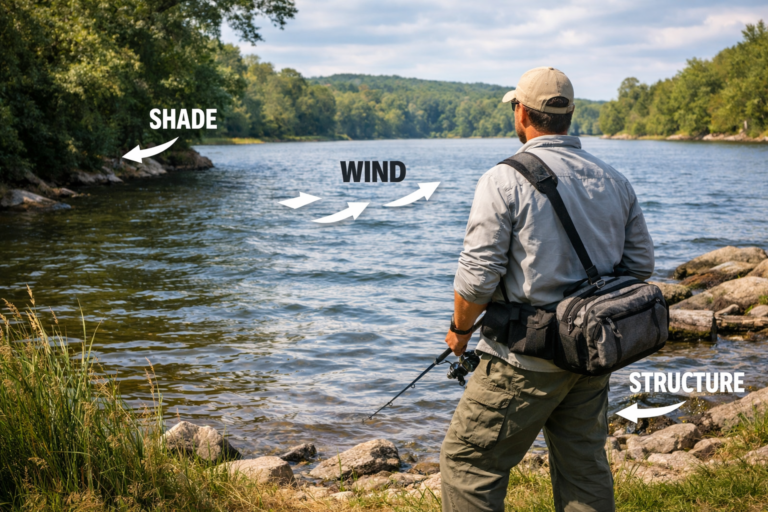
2. Can you see a depth change, point, drain, dock, riprap, weeds, shade line, or transition nearby?
If not, the bank may be convenient but not productive.
3. Do you see baitfish, bluegill dimples, insects, birds, swirls, or surface activity?
Life near the bank is often a better sign than perfect-looking scenery.
4. Can you fish the bank safely without trees, steep mud, private property, or unsafe footing?
A good bank still has to be a safe bank.
5. Can you cover three zones from one position: shallow, mid-depth, and slightly deeper water?
If yes, that bank gives you options before you ever change lures.
Why the Bank Comes Before the Lure
A lure does not magically find fish. It only works well when it travels through water where fish are already willing to feed, rest, or move. That is why experienced anglers often spend more time reading the bank than digging through a tackle box.
For bank anglers, location matters even more because you cannot easily move across the entire lake like someone in a boat. Your casting range is limited. Your angle is limited. Your access is limited. So the bank has to do more of the work.
The right bank gives you a better chance to reach fish. It may have wind pushing food toward it. It may have a drop-off close to shore. It may have a shaded edge during bright sun. It may have cover that attracts bluegill, bass, or catfish. It may sit near a corner, point, creek arm, spillway area, or transition where fish naturally travel.
The wrong bank may look wide open and easy, but if it offers no food, no cover, no depth change, and no movement, it can feel lifeless. That is when beginners start blaming the lure when the real problem was the starting point.
Start With Wind: The Bank Fish Often Visit First
Wind is one of the fastest clues a bank angler can read. A light to moderate wind can push plankton, insects, warmer surface water, and small baitfish toward one side of a lake. Predators often follow that food chain.
This does not mean the windiest bank is always the best bank. A hard wind can make casting difficult, muddy the water, and create unsafe footing. But when the wind is manageable, the windblown bank is often worth checking before calm, glassy water.
If you want the full breakdown, read Wind Direction Predicts Where Fish Can Be Found. That post supports the same simple idea: wind does not guarantee fish, but it can point you toward the first bank worth testing.
Beginner tip: Do not fight dangerous wind. Pick the bank that gives you a useful breeze, safe footing, and a castable angle. A good fishing decision should never turn into a risky shoreline decision.
Look for Banks With Depth Close to Shore
Not every fish wants to sit in ankle-deep water. Many fish move shallow to feed, then slide slightly deeper when conditions change. That is why a bank with nearby depth is often better than a long, flat, featureless shoreline.
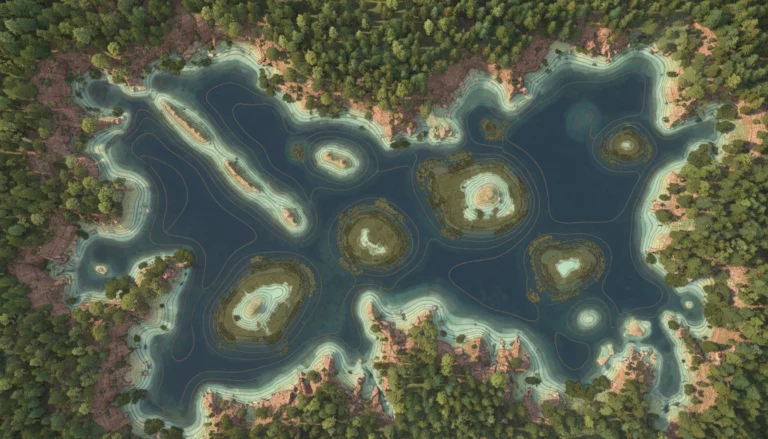
A productive bank may have a visible drop, a steeper slope, a dam face, riprap, a point, a creek channel nearby, or a shoreline that falls away faster than the bank beside it. You may not always see the bottom, but you can read clues from the land.
If the land drops sharply into the water, the underwater edge may also drop faster. If the shoreline forms a point, fish may use it as a travel lane. If a corner collects wind, leaves, insects, and bait, it may become a feeding area. If the bank is flat for a long distance with no cover or change, it may still hold fish at times, but it gives you fewer reasons to stay.
For a stronger map-reading approach, pair this article with How To Read A Lake Map For Fishing More Productively. Bank reading gets easier when you connect what you see on shore with what the lake bottom is probably doing.
Choose Banks With Cover, But Do Not Worship Cover
Cover attracts fish because it creates shade, ambush points, protection, and feeding edges. Bank anglers should look for laydowns, weeds, rock, brush, docks, shade, culverts, overhanging limbs, riprap, and man-made structure.
But cover by itself is not enough. A single stick in dead water is not magic. The best banks usually combine cover with another advantage: wind, depth, bait, shade, or a travel route.
Think of cover as a reason to slow down, not as a guarantee. If you find cover on a windblown bank near deeper water, that is much more interesting than cover sitting in flat, stagnant water with no visible life around it.
Watch for Life Before You Make Your First Cast
A good bank often shows signs of life before you ever tie on a lure. Watch the water for one or two minutes before casting. Look for tiny bait flickers, bluegill dimples, feeding swirls, cruising shadows, insects touching the surface, birds working the edge, or nervous movement near the bank.
Beginners often rush this step. They arrive, set down their bag, tie on a lure, and cast immediately. A smarter habit is to stand still first. Let the lake speak before you interrupt it.
If you see baitfish or bluegill near the bank, predators may not be far away. If the water looks completely empty, especially during bright sun or heavy pressure, it may be better to walk another stretch before committing your time.
Pick the Bank That Matches the Season
The best bank changes with the season. A shoreline that is excellent in spring may be slow in late summer. A shaded bank that matters during heat may not be the first place to check on a cool spring morning.
| Season or Condition | Bank to Check First | Why It Can Work |
|---|---|---|
| Early spring warming trend | Protected banks with sun exposure and nearby depth | Shallow water can warm faster, but fish still like an escape route nearby. |
| Late spring into early summer | Banks near bluegill activity, weeds, shade, and points | Food activity often increases near the shoreline. |
| Hot summer afternoons | Shade lines, deeper banks, riprap, and areas with moving water | Fish may avoid the hottest, brightest, shallowest water. |
| After several stable weather days | Banks with visible feeding activity and comfortable wind | Stable conditions can make fish more predictable. |
| Cooling fall weather | Windblown banks, bait-rich pockets, and transition areas | Bait movement often becomes a major clue. |
The point is not to memorize a perfect rule. The point is to ask, “What would make fish use this bank today?” Once you start asking that question, you stop fishing randomly.
The Best Bank Usually Has More Than One Good Thing Going For It
A single clue can help, but several clues together are much stronger. This is where beginners can make a fast leap in skill.
A shaded bank is useful. A shaded bank with bluegill activity is better. A shaded bank with bluegill activity, a light wind, and a nearby depth change is better still. That is the bank worth fishing carefully.
When you arrive at a lake, do not ask, “Where can I stand?” Ask, “Which bank gives me the most reasons to believe fish are nearby?” That one shift can save an hour of unproductive casting.
Good Clue
A comfortable wind blowing into the bank.
Better Clue
Wind plus baitfish or bluegill activity near the edge.
Best Clue
Wind, bait, cover, and deeper water within casting range.
Do Not Ignore the Bank Behind You
Bank fishing is not only about the water in front of you. The land behind you matters too.
Overhanging trees can block your cast. Mud can make footing unsafe. Tall weeds can hide holes or trash. A steep bank may make landing a fish difficult. A busy walking path may limit where you can safely cast. Private property boundaries may restrict access.
The best bank is fishable from both directions. It gives fish a reason to be there, and it gives you enough room to make accurate casts, move safely, and land a fish without turning the moment into a mess.
Kentucky Fish & Wildlife provides official tools for finding fishing and boating access sites, including filters for bank access, fishing piers, species, waterbody type, and FINS lakes. That makes it a useful starting point when planning where to fish, especially if you are exploring a new lake. Visit the official Kentucky Fish & Wildlife fishing page before relying only on memory or social media suggestions.
A Simple 10-Minute Bank-Picking Plan
If you only remember one section from this article, remember this plan. It works because it forces you to slow down before choosing a lure.
The EveryLakeGuide 10-minute bank scan
Minute 1-2: Check the wind.
Which bank is receiving a manageable breeze? Which bank is too rough or unsafe?
Minute 3-4: Look for depth clues.
Find points, steeper banks, dams, riprap, corners, cuts, or shoreline changes.
Minute 5-6: Look for cover.
Find weeds, shade, wood, rocks, docks, pipes, brush, or man-made edges.
Minute 7-8: Watch for life.
Look for bait, bluegill, insects, swirls, birds, bubbles, or surface movement.
Minute 9-10: Choose your first casting lane.
Pick the bank that gives you the best mix of safe access, fish clues, and reachable water.
Now the lure decision becomes easier. You are no longer asking a lure to solve a location problem. You are choosing a lure that fits the bank you already selected.
How This Changes Your Lure Choice
Once you pick the right bank, lure selection becomes more logical. A shallow weedy bank may call for something weedless. A rocky bank may favor a lure that can bump along without snagging constantly. A windblown bank may need a bait you can cast accurately. A clear, calm bank may require a quieter approach.
This is why the “start with the lake” method works. The bank tells you what kind of presentation makes sense. The lure does not come first. The situation comes first.
For a broader beginner system, read Fishing for Beginners Lake Guide: Start With the Water, Not the Lure. That article explains why water-reading is the foundation, especially for anglers who are tired of guessing.
Common Bank-Picking Mistakes Beginners Make
Most bank fishing mistakes happen before the first cast. They feel small in the moment, but they can shape the entire trip.
| Mistake | Why It Hurts | Better Move |
|---|---|---|
| Fishing the closest bank automatically | Convenience does not always match fish activity. | Walk first, then choose the strongest water. |
| Ignoring wind | Wind can move food and influence fish location. | Check the wind direction before tying on. |
| Choosing only open, easy banks | Easy casting does not always mean good fish habitat. | Look for cover, transitions, shade, and depth nearby. |
| Standing too close to the water right away | Fish may be shallow and easily spooked. | Stop back from the edge and observe first. |
| Changing lures before changing locations | The problem may be the bank, not the bait. | Move to better water before blaming your tackle. |
The Best Bank for Bass, Bluegill, Catfish, and Trout May Not Be the Same
Different fish use banks differently. A bank that is good for bluegill may not be the first choice for catfish. A stocked trout bank may behave differently than a bass bank. That is why EveryLakeGuide focuses on lake-specific patterns instead of giving every angler the same generic advice.
Bass
Look for ambush edges: shade, rock, wood, weeds, points, drop-offs, and banks where bluegill or baitfish are active.
Bluegill
Look for calmer pockets, shallow cover, beds in season, docks, weeds, and visible dimples or small feeding activity.
Catfish
Look for corners, deeper banks, inflows, wind-collected food areas, evening access, and banks that let bait sit near travel routes.
Stocked Trout
Look for easy shoreline travel lanes, release-area movement, wind lanes, open casting space, and banks where trout can cruise within range.
If you are still choosing your first lake, read The Best Beginner Lake to Start Fishing. Picking the right lake and the right bank work together.
What to Do When Every Bank Looks the Same
Some small lakes look simple at first glance. A walking path circles the water. The shoreline looks similar. The bank is open almost everywhere. That can make beginners feel lost.
When every bank looks the same, look harder for small differences. One side may have more wind. One corner may collect leaves and insects. One stretch may have a slightly steeper slope. One area may have darker water from shade. One bank may have more bluegill activity. One spot may have riprap instead of mud.
Small differences matter because fish do not need a dramatic structure change to use an area. Sometimes a tiny edge is enough.
A Practical 2-Hour Bank Fishing Plan
If you only have two hours, do not spend the whole trip planted on the first open bank. Use a simple route.
The 2-hour bank plan
First 10 minutes: Walk and observe before fishing. Check wind, access, cover, depth clues, and visible life.
Next 35 minutes: Fish the best-looking bank slowly. Cover the near edge first, then mid-range water, then the outside edge.
Next 35 minutes: Move to a second bank with a different condition. If the first was calm and shallow, try windblown or deeper.
Next 25 minutes: Return to the bank with the most signs of life or the best bite response.
Final 15 minutes: Make focused casts to the highest-percentage target: shade, rock, wood, weed edge, point, or wind seam.
This plan keeps you from guessing for two full hours. It also helps you learn the lake faster because you compare banks instead of blaming one spot.
Final Takeaway: The Best Bank Gives Fish a Reason
The best bank is not random. It gives fish a reason to be there.
Maybe the wind is pushing food into it. Maybe the shade is holding bluegill. Maybe the bottom drops quickly. Maybe a point creates a travel lane. Maybe a brush pile gives bass an ambush spot. Maybe a corner collects bait after a steady breeze.
Whatever the reason is, find it before you tie on a lure.
That is the EveryLakeGuide way. Start with the lake. Pick the bank. Read the clues. Then choose the lure that fits the water in front of you.
Want a lake-specific plan instead of guessing from the bank?
EveryLakeGuide field guides are built for bank anglers who want to understand wind, structure, access, seasonal movement, and simple 2-hour fishing plans before they arrive.
FAQs About Picking the Best Bank to Fish
How do I know which bank is best for fishing?
The best bank usually has more than one useful clue, such as wind, cover, nearby depth, shade, baitfish activity, safe access, or a point that fish can use as a travel route.
Should I fish the windy side of a lake?
Often, yes, if the wind is safe and manageable. A light to moderate wind can push food and bait toward a bank. However, strong wind can make casting difficult and create unsafe shoreline conditions.
Is the closest bank usually good enough?
Sometimes, but not always. The closest bank may be convenient for people while offering little for fish. Walk first and look for signs of life, structure, shade, wind, or depth change before settling in.
Should I change lures or move banks first?
If the bank has no visible life, no cover, no depth change, and no wind advantage, moving may be smarter than changing lures. A lure change helps most when you are already fishing productive water.
What is the best bank for beginners?
The best beginner bank is safe, open enough to cast, and close to fish-holding features such as shade, rocks, weeds, docks, points, or deeper water. Safe access matters just as much as fish potential.
Stay Updated With EveryLakeGuide
Want more lake-first fishing help, new guide announcements, and beginner-friendly bank fishing tips?
The best bank is not always the prettiest bank, the closest bank, or the bank with the most people standing on it. The best bank is the one that gives fish a reason to be nearby.
Before you choose a lure, choose the water. That one habit can change everything for beginner bank anglers.
The best bank to fish is usually the one that combines access, wind, depth change, cover, shade, visible bait activity, and a safe casting angle. Instead of starting with a lure, walk the shoreline first and look for signs that fish have food, shelter, comfort, or an easy travel route within casting distance.
Most beginners pick a bank for human reasons. It is close to the parking lot. It has open grass. It has a bench. It looks peaceful. Those things matter for comfort, but fish do not care where the picnic table is. Fish care about oxygen, temperature, food, shade, safety, and movement.
That is why the bank you choose can matter more than the lure you tie on. A great lure in dead water is still a poor plan. A simple bait or lure in the right zone suddenly looks smarter than anything in the tackle aisle.
EveryLakeGuide rule: Start with the lake, not the lure. The lure is only the final tool. The bank is where the decision begins.
Bank-Picking Self-Check: Are You Reading the Water or Just Picking a Spot?
Before the deeper strategy, take a quick self-check. These five questions reveal whether you are choosing a bank like an angler or simply stopping at the first easy opening.
Quick lake-reading quiz
1. Do you know which way the wind is pushing across the lake?
If not, you may be ignoring one of the strongest clues on the water.
2. Can you see a depth change, point, drain, dock, riprap, weeds, shade line, or transition nearby?
If not, the bank may be convenient but not productive.
3. Do you see baitfish, bluegill dimples, insects, birds, swirls, or surface activity?
Life near the bank is often a better sign than perfect-looking scenery.
4. Can you fish the bank safely without trees, steep mud, private property, or unsafe footing?
A good bank still has to be a safe bank.
5. Can you cover three zones from one position: shallow, mid-depth, and slightly deeper water?
If yes, that bank gives you options before you ever change lures.
Why the Bank Comes Before the Lure
A lure does not magically find fish. It only works well when it travels through water where fish are already willing to feed, rest, or move. That is why experienced anglers often spend more time reading the bank than digging through a tackle box.
For bank anglers, location matters even more because you cannot easily move across the entire lake like someone in a boat. Your casting range is limited. Your angle is limited. Your access is limited. So the bank has to do more of the work.
The right bank gives you a better chance to reach fish. It may have wind pushing food toward it. It may have a drop-off close to shore. It may have a shaded edge during bright sun. It may have cover that attracts bluegill, bass, or catfish. It may sit near a corner, point, creek arm, spillway area, or transition where fish naturally travel.
The wrong bank may look wide open and easy, but if it offers no food, no cover, no depth change, and no movement, it can feel lifeless. That is when beginners start blaming the lure when the real problem was the starting point.
Start With Wind: The Bank Fish Often Visit First
Wind is one of the fastest clues a bank angler can read. A light to moderate wind can push plankton, insects, warmer surface water, and small baitfish toward one side of a lake. Predators often follow that food chain.
This does not mean the windiest bank is always the best bank. A hard wind can make casting difficult, muddy the water, and create unsafe footing. But when the wind is manageable, the windblown bank is often worth checking before calm, glassy water.
If you want the full breakdown, read Wind Direction Predicts Where Fish Can Be Found. That post supports the same simple idea: wind does not guarantee fish, but it can point you toward the first bank worth testing.
Beginner tip: Do not fight dangerous wind. Pick the bank that gives you a useful breeze, safe footing, and a castable angle. A good fishing decision should never turn into a risky shoreline decision.
Look for Banks With Depth Close to Shore
Not every fish wants to sit in ankle-deep water. Many fish move shallow to feed, then slide slightly deeper when conditions change. That is why a bank with nearby depth is often better than a long, flat, featureless shoreline.
A productive bank may have a visible drop, a steeper slope, a dam face, riprap, a point, a creek channel nearby, or a shoreline that falls away faster than the bank beside it. You may not always see the bottom, but you can read clues from the land.
If the land drops sharply into the water, the underwater edge may also drop faster. If the shoreline forms a point, fish may use it as a travel lane. If a corner collects wind, leaves, insects, and bait, it may become a feeding area. If the bank is flat for a long distance with no cover or change, it may still hold fish at times, but it gives you fewer reasons to stay.
For a stronger map-reading approach, pair this article with How To Read A Lake Map For Fishing More Productively. Bank reading gets easier when you connect what you see on shore with what the lake bottom is probably doing.
Choose Banks With Cover, But Do Not Worship Cover
Cover attracts fish because it creates shade, ambush points, protection, and feeding edges. Bank anglers should look for laydowns, weeds, rock, brush, docks, shade, culverts, overhanging limbs, riprap, and man-made structure.
But cover by itself is not enough. A single stick in dead water is not magic. The best banks usually combine cover with another advantage: wind, depth, bait, shade, or a travel route.
Think of cover as a reason to slow down, not as a guarantee. If you find cover on a windblown bank near deeper water, that is much more interesting than cover sitting in flat, stagnant water with no visible life around it.
Watch for Life Before You Make Your First Cast
A good bank often shows signs of life before you ever tie on a lure. Watch the water for one or two minutes before casting. Look for tiny bait flickers, bluegill dimples, feeding swirls, cruising shadows, insects touching the surface, birds working the edge, or nervous movement near the bank.
Beginners often rush this step. They arrive, set down their bag, tie on a lure, and cast immediately. A smarter habit is to stand still first. Let the lake speak before you interrupt it.
If you see baitfish or bluegill near the bank, predators may not be far away. If the water looks completely empty, especially during bright sun or heavy pressure, it may be better to walk another stretch before committing your time.
Pick the Bank That Matches the Season
The best bank changes with the season. A shoreline that is excellent in spring may be slow in late summer. A shaded bank that matters during heat may not be the first place to check on a cool spring morning.
| Season or Condition | Bank to Check First | Why It Can Work |
|---|---|---|
| Early spring warming trend | Protected banks with sun exposure and nearby depth | Shallow water can warm faster, but fish still like an escape route nearby. |
| Late spring into early summer | Banks near bluegill activity, weeds, shade, and points | Food activity often increases near the shoreline. |
| Hot summer afternoons | Shade lines, deeper banks, riprap, and areas with moving water | Fish may avoid the hottest, brightest, shallowest water. |
| After several stable weather days | Banks with visible feeding activity and comfortable wind | Stable conditions can make fish more predictable. |
| Cooling fall weather | Windblown banks, bait-rich pockets, and transition areas | Bait movement often becomes a major clue. |
The point is not to memorize a perfect rule. The point is to ask, “What would make fish use this bank today?” Once you start asking that question, you stop fishing randomly.
The Best Bank Usually Has More Than One Good Thing Going For It
A single clue can help, but several clues together are much stronger. This is where beginners can make a fast leap in skill.
A shaded bank is useful. A shaded bank with bluegill activity is better. A shaded bank with bluegill activity, a light wind, and a nearby depth change is better still. That is the bank worth fishing carefully.
When you arrive at a lake, do not ask, “Where can I stand?” Ask, “Which bank gives me the most reasons to believe fish are nearby?” That one shift can save an hour of unproductive casting.
Good Clue
A comfortable wind blowing into the bank.
Better Clue
Wind plus baitfish or bluegill activity near the edge.
Best Clue
Wind, bait, cover, and deeper water within casting range.
Do Not Ignore the Bank Behind You
Bank fishing is not only about the water in front of you. The land behind you matters too.
Overhanging trees can block your cast. Mud can make footing unsafe. Tall weeds can hide holes or trash. A steep bank may make landing a fish difficult. A busy walking path may limit where you can safely cast. Private property boundaries may restrict access.
The best bank is fishable from both directions. It gives fish a reason to be there, and it gives you enough room to make accurate casts, move safely, and land a fish without turning the moment into a mess.
Kentucky Fish & Wildlife provides official tools for finding fishing and boating access sites, including filters for bank access, fishing piers, species, waterbody type, and FINS lakes. That makes it a useful starting point when planning where to fish, especially if you are exploring a new lake. Visit the official Kentucky Fish & Wildlife fishing page before relying only on memory or social media suggestions.
A Simple 10-Minute Bank-Picking Plan
If you only remember one section from this article, remember this plan. It works because it forces you to slow down before choosing a lure.
The EveryLakeGuide 10-minute bank scan
Minute 1-2: Check the wind.
Which bank is receiving a manageable breeze? Which bank is too rough or unsafe?
Minute 3-4: Look for depth clues.
Find points, steeper banks, dams, riprap, corners, cuts, or shoreline changes.
Minute 5-6: Look for cover.
Find weeds, shade, wood, rocks, docks, pipes, brush, or man-made edges.
Minute 7-8: Watch for life.
Look for bait, bluegill, insects, swirls, birds, bubbles, or surface movement.
Minute 9-10: Choose your first casting lane.
Pick the bank that gives you the best mix of safe access, fish clues, and reachable water.
Now the lure decision becomes easier. You are no longer asking a lure to solve a location problem. You are choosing a lure that fits the bank you already selected.
How This Changes Your Lure Choice
Once you pick the right bank, lure selection becomes more logical. A shallow weedy bank may call for something weedless. A rocky bank may favor a lure that can bump along without snagging constantly. A windblown bank may need a bait you can cast accurately. A clear, calm bank may require a quieter approach.
This is why the “start with the lake” method works. The bank tells you what kind of presentation makes sense. The lure does not come first. The situation comes first.
For a broader beginner system, read Fishing for Beginners Lake Guide: Start With the Water, Not the Lure. That article explains why water-reading is the foundation, especially for anglers who are tired of guessing.
Common Bank-Picking Mistakes Beginners Make
Most bank fishing mistakes happen before the first cast. They feel small in the moment, but they can shape the entire trip.
| Mistake | Why It Hurts | Better Move |
|---|---|---|
| Fishing the closest bank automatically | Convenience does not always match fish activity. | Walk first, then choose the strongest water. |
| Ignoring wind | Wind can move food and influence fish location. | Check the wind direction before tying on. |
| Choosing only open, easy banks | Easy casting does not always mean good fish habitat. | Look for cover, transitions, shade, and depth nearby. |
| Standing too close to the water right away | Fish may be shallow and easily spooked. | Stop back from the edge and observe first. |
| Changing lures before changing locations | The problem may be the bank, not the bait. | Move to better water before blaming your tackle. |
The Best Bank for Bass, Bluegill, Catfish, and Trout May Not Be the Same
Different fish use banks differently. A bank that is good for bluegill may not be the first choice for catfish. A stocked trout bank may behave differently than a bass bank. That is why EveryLakeGuide focuses on lake-specific patterns instead of giving every angler the same generic advice.
Bass
Look for ambush edges: shade, rock, wood, weeds, points, drop-offs, and banks where bluegill or baitfish are active.
Bluegill
Look for calmer pockets, shallow cover, beds in season, docks, weeds, and visible dimples or small feeding activity.
Catfish
Look for corners, deeper banks, inflows, wind-collected food areas, evening access, and banks that let bait sit near travel routes.
Stocked Trout
Look for easy shoreline travel lanes, release-area movement, wind lanes, open casting space, and banks where trout can cruise within range.
If you are still choosing your first lake, read The Best Beginner Lake to Start Fishing. Picking the right lake and the right bank work together.
What to Do When Every Bank Looks the Same
Some small lakes look simple at first glance. A walking path circles the water. The shoreline looks similar. The bank is open almost everywhere. That can make beginners feel lost.
When every bank looks the same, look harder for small differences. One side may have more wind. One corner may collect leaves and insects. One stretch may have a slightly steeper slope. One area may have darker water from shade. One bank may have more bluegill activity. One spot may have riprap instead of mud.
Small differences matter because fish do not need a dramatic structure change to use an area. Sometimes a tiny edge is enough.
A Practical 2-Hour Bank Fishing Plan
If you only have two hours, do not spend the whole trip planted on the first open bank. Use a simple route.
The 2-hour bank plan
First 10 minutes: Walk and observe before fishing. Check wind, access, cover, depth clues, and visible life.
Next 35 minutes: Fish the best-looking bank slowly. Cover the near edge first, then mid-range water, then the outside edge.
Next 35 minutes: Move to a second bank with a different condition. If the first was calm and shallow, try windblown or deeper.
Next 25 minutes: Return to the bank with the most signs of life or the best bite response.
Final 15 minutes: Make focused casts to the highest-percentage target: shade, rock, wood, weed edge, point, or wind seam.
This plan keeps you from guessing for two full hours. It also helps you learn the lake faster because you compare banks instead of blaming one spot.
Final Takeaway: The Best Bank Gives Fish a Reason
The best bank is not random. It gives fish a reason to be there.
Maybe the wind is pushing food into it. Maybe the shade is holding bluegill. Maybe the bottom drops quickly. Maybe a point creates a travel lane. Maybe a brush pile gives bass an ambush spot. Maybe a corner collects bait after a steady breeze.
Whatever the reason is, find it before you tie on a lure.
That is the EveryLakeGuide way. Start with the lake. Pick the bank. Read the clues. Then choose the lure that fits the water in front of you.
Want a lake-specific plan instead of guessing from the bank?
EveryLakeGuide field guides are built for bank anglers who want to understand wind, structure, access, seasonal movement, and simple 2-hour fishing plans before they arrive.
FAQs About Picking the Best Bank to Fish
How do I know which bank is best for fishing?
The best bank usually has more than one useful clue, such as wind, cover, nearby depth, shade, baitfish activity, safe access, or a point that fish can use as a travel route.
Should I fish the windy side of a lake?
Often, yes, if the wind is safe and manageable. A light to moderate wind can push food and bait toward a bank. However, strong wind can make casting difficult and create unsafe shoreline conditions.
Is the closest bank usually good enough?
Sometimes, but not always. The closest bank may be convenient for people while offering little for fish. Walk first and look for signs of life, structure, shade, wind, or depth change before settling in.
Should I change lures or move banks first?
If the bank has no visible life, no cover, no depth change, and no wind advantage, moving may be smarter than changing lures. A lure change helps most when you are already fishing productive water.
What is the best bank for beginners?
The best beginner bank is safe, open enough to cast, and close to fish-holding features such as shade, rocks, weeds, docks, points, or deeper water. Safe access matters just as much as fish potential.
Stay Updated With EveryLakeGuide
Want more lake-first fishing help, new guide announcements, and beginner-friendly bank fishing tips?
Similar Posts
7 Beginner Fishing Mistakes That Kill Your Chances of Catching Fish
EveryLakeGuide Beginner Series Most beginner anglers start by asking, “What lure should I throw?” A better question is, “Where is the water telling me to fish?” This fishing for beginners lake guide shows you how to read wind, structure, depth, access, and fish movement before you ever open your tackle box. Suggested SEO title: Fishing…
How to Catch Fish When You Only Have 2 Hours
Short on time? Learn how to catch fish when you only have 2 hours by reading the lake first, choosing high-percentage bank spots, and avoiding wasted casts. Quick Answer The best way to catch fish when you only have 2 hours is to stop guessing and fish the highest-percentage water first. Start by reading the…
- Blogging | fishing tips | how to read a lake | Local Lake Insight | Quick‑Trip Fishing Tips | System Education
The First 10 Minutes at Any Lake: What Smart Bank Anglers Look For Before Casting
The first 10 minutes at a lake may be more important than the first 10 casts. Smart bank anglers do not rush to throw a lure. They pause, read the water, study the shoreline, and choose a starting spot with a reason. Why The First 10 Minutes Matter So Much Most beginner anglers arrive at…
How To Read A Lake Map For Fishing More Productively
EveryLakeGuide Skill Builder A lake map turns a confusing body of water into a fishing plan. Instead of guessing where fish might be, you can read depth changes, points, channels, flats, and structure before you ever make a cast. That simple shift can save time, reduce frustration, and help you fish with more purpose. At…
Alexandria Community Park Lake | Water Anglers Miss
Campbell County FINs Lake Guide Alexandria Community Park Lake looks simple from the bank, but the best water is not always the easiest water. This guide shows why depth changes, short travel lanes, wind, and bank positioning matter more here than most anglers realize. What water do anglers miss at Alexandria Community Park Lake? Many…