
The Sky Cleared. Your Old Pattern May Need a New Test.
Yesterday, clouds softened the shoreline and a breeze pushed life toward one bank. Today, the air feels different, the surface is brighter, and the same casts seem to disappear into empty water.
A cold front can change the fishing conditions you can see. It does not prove that every fish stopped feeding. Before rebuilding the tackle box, separate what the front changed from the lake features that stayed useful.
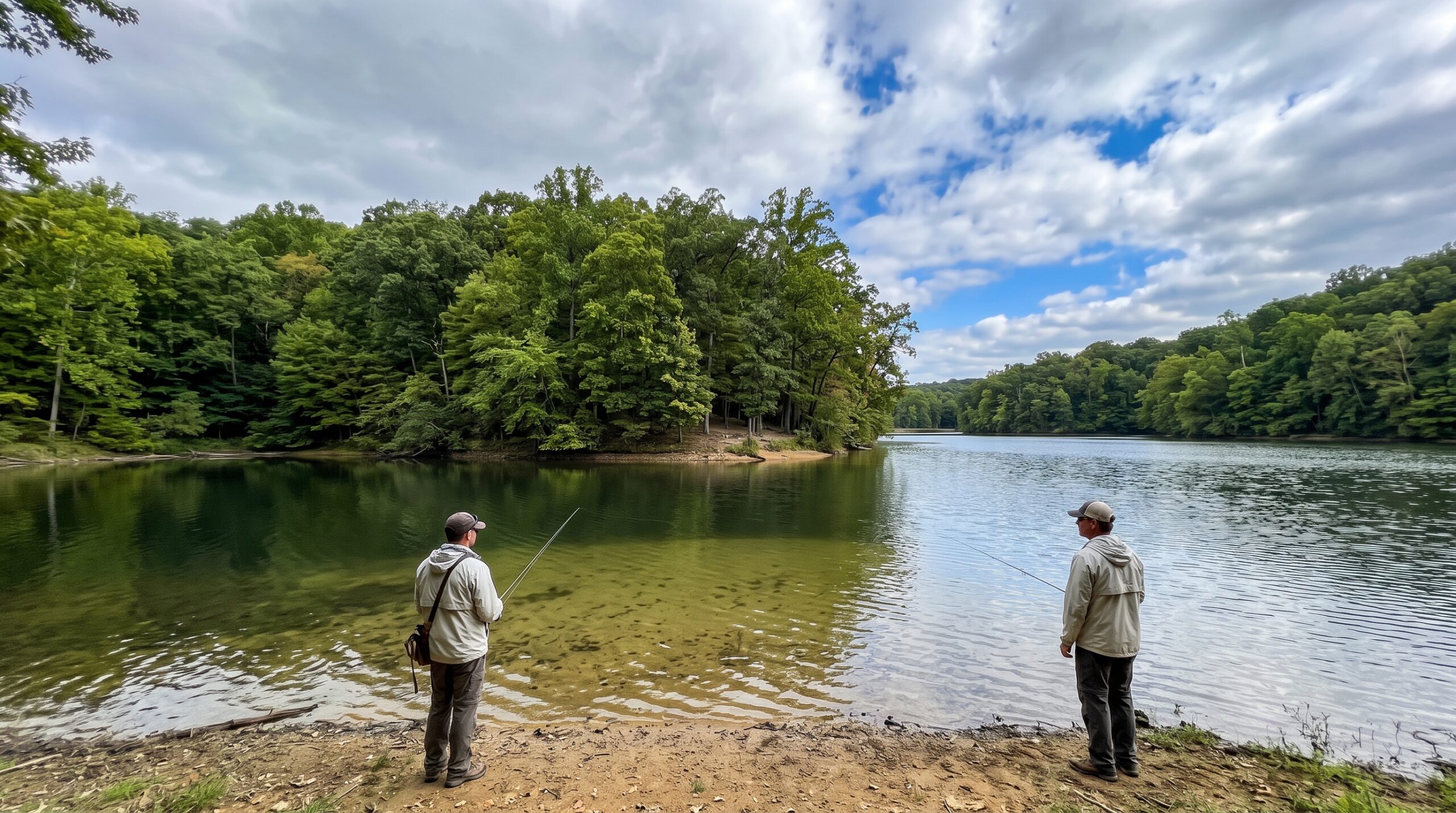
What should a bank angler do after a cold front?
After the storm risk has passed, reread the actual lake before changing lures. Begin with the last useful combination of structure, cover, depth, shade, wind, or baitfish. Make a quiet baseline cast, then compare the nearest protected edge or first reachable depth change.
If bright, calm conditions replaced clouds and wind, fish may be harder to approach in exposed shallow water. Step back, reduce noise, place the presentation closer to cover, and change only one variable—usually angle, depth, speed, or distance from the edge. Do not assume “post-front” automatically means “go as deep as possible” or “use the smallest lure you own.”
A front is a boundary between air masses. NOAA describes a cold front as the transition where colder air replaces warmer air; the passage can bring a rapid weather change, including rain and strong wind. That definition explains the sky—not the exact location of a bass, bluegill, catfish, or trout.
The fishing question begins after the weather question: Which reachable part of this lake still gives fish food, comfort, cover, depth, or a travel route? That keeps a broad forecast from becoming an excuse for random casts.
Post-front decision card: Change, keep, test
This visual belongs directly after the quick answer because it turns the weather change into three bank-friendly decisions.
Five clues deserve more attention than the words “cold front”
Light at the water
Did thick cloud cover become bright sun? Compare the exposed flat with shade, stain, vegetation, a dock edge, or a steeper bank. The useful change is visibility—not the label on the forecast.
Wind direction and strength
Did the productive drift stop or reverse? Check whether floating food and debris remain in the old corner, then compare the nearest wind-plus-structure area. Use the Kentucky Wind & Structure Cheat Sheet when the surface no longer points to the same bank.
Reachable depth
Do not leap from shallow water to the deepest cast you can make. Test the first meaningful change: the outside weed edge, the end of a point, a steeper bank, or the first drop-off.
Cover and shade
Wood, rock, green vegetation, dock posts, stain, and shade can make fish less exposed. Look for cover connected to a route, not an isolated object surrounded by unusable water.
Fish and food activity
Watch for baitfish dimples, fleeing minnows, insects, surface rings, a follow, a missed strike, or one repeatable bite. No visible activity is information, but it is not proof that the lake is empty.
Your own disturbance
Bright, smooth water can expose movement near the bank. Stand back, keep your shadow off the target, fish the near edge first, and avoid turning a weather change into an approach problem.
Cool air does not instantly reset the whole lake
A short-lived drop in air temperature does not tell you the temperature at every depth. Lake size, depth, sunlight, wind, inflow, and mixing all affect how water responds. The U.S. Geological Survey’s water-temperature overview explains why temperature matters to aquatic life and why lakes can develop different thermal layers.
That is why one chilly walk from the parking lot should not send every cast to deep water. Compare shallow cover with the nearest depth route and let fish activity, contact, and repeatable results narrow the pattern. This also builds naturally on The Mornings Feel Cooler—Are Fish Moving Shallow Yet?, which separates cool air from evidence of a broader seasonal move.
Before, during, and after a cold front
| Stage | What a bank angler may notice | Best decision | Avoid assuming |
|---|---|---|---|
| Front approaching | Building clouds, strengthening or shifting wind, falling light, distant thunder, changing surface activity. | Keep a fast route to proper shelter. End the trip immediately when thunder is heard or lightning is seen. | That a possible “pre-front bite” is worth staying through unsafe weather. |
| Front passing | Thunderstorms, gusts, heavy rain, lightning, rapid runoff, falling limbs, unstable shoreline conditions. | Do not fish. Remain in a substantial building or enclosed hard-topped vehicle. | That a pavilion, isolated tree, or open bank is safe shelter. |
| Early post-front | Clearing sky, different wind, brighter shallow water, cooler air, changed debris or stain. | Pause, compare two banks, make one baseline test, then check cover and the nearest depth change. | That every fish moved deep or stopped feeding. |
| Conditions stabilize | A repeatable light and wind pattern, clearer surface clues, new shade, baitfish routes, returning activity. | Follow the best overlap and record which change actually produced a response. | That yesterday’s post-front adjustment must remain correct today. |
A front is weather first and a fishing pattern second
If you hear thunder, stop fishing and move immediately to a substantial building or an enclosed hard-topped vehicle. The National Weather Service lightning-safety guidance says to wait at least 30 minutes after the last thunder or lightning before returning outside.
After heavy rain or strong wind, also check for slick clay, soft shoulders, damaged trees, flooded paths, fast runoff, floating debris, high water, and newly hidden drop-offs. A lake can be meteorologically “post-front” while the bank remains unsafe.
Use this 15-minute post-front reset
The reset keeps one difficult stretch from consuming the trip. It also protects the information you already earned before changing color, size, speed, depth, and location all at once.
- Minutes 0–3: Watch before casting. Compare light, wind, stain, shade, debris, baitfish, access, and the water closest to the bank. Identify the safest route and the nearest useful depth change.
- Minutes 3–6: Name the old explanation. Was the bank useful because of cloud cover, wind, shade, a point, vegetation, baitfish, or depth? If you cannot name the reason, you do not have a baseline to repair.
- Minutes 6–9: Make the quiet baseline cast. Keep the same general presentation and test the best remaining part of the old pattern. Fish close cover or the near edge before launching across open water.
- Minutes 9–12: Change one variable. Try one new angle, one depth step, a slower pass, a longer pause, or tighter contact with cover. Do not combine all five changes.
- Minutes 12–15: Compare one different feature. Move to the nearest legal, safe area that adds something the first bank lacks—shade, wind, stain, cover, a cove mouth, a steeper slope, or the first drop.
Decision at minute 15: stay when a bite, follow, baitfish reaction, clean repeatable contact, or strong feature overlap gives you a reason. Move when the bank remains bright, featureless, inactive, or difficult to fish safely.
Should you fish deeper, slower, or smaller?
Those are useful comparisons, not automatic rules. Ask them in an order that protects what you learn.
1 · Check location and angle
Put the presentation beside the best edge, cover, shade, or travel route. A perfect lure in featureless water still gives you a weak test.
2 · Check one depth step
Compare shallow cover with the outside edge or first reachable drop. If that transition is hard to identify, use Cast, Count, Compare to find the first drop-off without sonar.
3 · Check speed and profile
Only then try a slower pass, longer pause, or more compact presentation. If it works, you will know which variable changed the answer.
For a bobber or live-bait presentation, “slower” may mean holding the bait beside cover or checking the depth rather than letting it drift through empty water. For an artificial lure, it may mean extending the pause or keeping the retrieve in contact with one useful edge. The goal is controlled comparison—not motionless fishing everywhere.
Apply the L.A.K.E. Method after the weather changes
The post-front label gets you to the lake with a question. The L.A.K.E. Method turns that question into a test. For the full clue-ranking system, scorecard, examples, and printable field tools, explore How to Read Any Lake: A Beginner’s Fishing System.
Three common post-front banks—and how to test them
The bright, flat cove
Do not walk straight to the water and cast toward the middle. Stand back, fish the near edge, then compare the cove mouth, shaded side, outside weed line, or first drop. If the cove offers no food, cover, stain, depth, or activity, let it lose quickly.
The old wind-blown corner
Leaves, foam, insects, and baitfish may remain after the wind shifts. Give the collection edge a short test, especially where it meets rock, vegetation, or depth. If wind was the only reason to stay, use the calm-water reset to find the nearest replacement clue.
The shaded point beside deeper water
This bank keeps several advantages when the weather changes: shade, multiple casting angles, structure, and a route between shallow and deep water. Test both sides of the point and the end where the bottom falls away. One strong feature can survive a weak weather pattern; several overlapping features deserve more time.
Build the post-front question into a two-hour trip
Do not try to prove that every fish in the lake reacted the same way. Let the outing answer one smaller question: Did the weather change weaken the shallow pattern, or did it simply move the best shallow-to-depth route?
Record the date, front timing, cloud cover, wind, water appearance, best feature, first response, and single adjustment that helped. The Two-Hour Kentucky Bank-Fishing Plan adds the reusable before-you-leave checklist, timed routine, and trip record.
Continue the lake-first system
Kentucky Wind & Structure Cheat Sheet
Use the free field reference when the wind shifts, weakens, or starts favoring a different point, corner, flat, or edge.
Get the free cheat sheetHow to Read Any Lake
Learn to rank food, comfort, safety, cover, depth, wind, edges, and movement before the first cast.
Explore the field guideKentucky Shore Fishing
Go deeper into coves, flats, cover, points, and drop-offs—the permanent features that remain after weather changes.
Explore the structure guideFive post-front mistakes that erase useful evidence
- Letting a pressure number choose every cast. A barometer can describe part of the weather pattern. It cannot show you the shade line, baitfish route, weed edge, first drop, or safe access in front of you.
- Changing everything after three quiet casts. If you move, downsize, slow down, change depth, and switch color together, one bite will not tell you which decision mattered.
- Walking past close cover to cast deep. Test the near edge quietly before assuming every fish abandoned shallow water.
- Fishing “deep” without finding a feature. Deep water is not a target by itself. Connect the cast to a point, drop, cove mouth, channel edge, vegetation line, rock change, or cover.
- Returning before the site is safe. Rain ending is not the same as lightning risk ending, and clearing skies do not repair unstable banks or damaged trees.
Prepare for the fish before a careful reset produces one
Late-summer fish may already be dealing with warm water, and a long fight or slow photo setup adds avoidable stress. Have pliers and a wet rubberized net ready. Wet your hands, keep the fish in the water as much as practical, minimize air exposure, support it without squeezing, and remove the hook efficiently.
If a hook is deeply swallowed, follow applicable rules and consider cutting the line close rather than tearing the hook free. The U.S. Fish and Wildlife Service’s responsible fishing guidance emphasizes keeping fish wet, minimizing airtime, and cutting the line when a swallowed hook cannot be removed safely.
Can you rebuild the plan after a cold front?
Select one answer for each question, then check your score.
Cold-front bank fishing: practical answers
Do fish stop biting after a cold front?
No universal switch turns the bite off. A front can change light, wind, surface movement, runoff, and how exposed shallow water feels, but fish response varies by species, lake, season, water temperature, clarity, depth, and fishing pressure. Test the strongest remaining feature before declaring the whole lake inactive.
Should I automatically fish deeper after a cold front?
No. Test the nearest useful depth connected to cover, food, shade, or a travel route. The first drop or outside edge may be more useful than the deepest water you can reach, and some fish may remain shallow where conditions still fit.
Should I use a smaller lure after a cold front?
A smaller or more compact presentation can be a useful comparison, especially when fish follow without committing or when close cover demands precision. Check location, angle, and depth first. Downsizing should answer a question—not replace lake reading.
Does barometric pressure predict whether fish will bite?
Pressure is one part of a larger weather change, not a stand-alone catch forecast. A number on a phone cannot tell you where wind meets a point, where shade reaches cover, where baitfish are traveling, or whether the first drop is within casting range. Use the forecast for context and the lake for the decision.
How long does a post-front pattern last?
There is no dependable universal clock. The front’s strength, season, lake size, water depth, wind, sunlight, runoff, and the weather that follows all matter. Record what you observe instead of treating “one day after” or “two days after” as a guaranteed pattern.
When is it safe to fish after a front passes?
Follow current official forecasts and warnings. If thunder or lightning occurred, remain in proper shelter for at least 30 minutes after the last thunder or lightning. Recheck flooded paths, unstable banks, damaged trees, high water, and posted closures before returning to the shoreline.
What changed first at your lake after the front?
Did the wind reverse, did a shallow flat become brighter, did baitfish leave the bank, or did a shaded point keep producing? Share the lake type, time of day, weather change, feature you tested, and the one adjustment that helped in the comments. A specific observation may help another bank angler recognize the same transition.
Official resources used for this guide
- NOAA JetStream: Air Masses and Weather Fronts
- National Weather Service: Lightning Safety Overview
- U.S. Geological Survey: Temperature and Water
- Kentucky Department of Fish & Wildlife Resources: Current Fishing and Boating Guide
- U.S. Fish and Wildlife Service: Responsible Fishing Tips
Accuracy note: Reviewed August 24, 2026. Weather, access, water levels, fish behavior, and regulations can change. This article provides a decision process, not a catch guarantee or a substitute for current forecasts, posted notices, official advisories, or waterbody-specific rules. Confirm current licenses, seasons, limits, bait restrictions, access, and closures in the 2026–2027 Kentucky Fishing and Boating Guide and at the lake.
The front changed the test—not the whole purpose of the lake
A clearing sky can weaken yesterday’s shallow pattern, but it does not erase every point, drop-off, weed edge, shaded bank, cove mouth, laydown, or baitfish route.
Name what changed. Keep the strongest permanent clue. Make one quiet baseline cast. Compare one depth step or replacement feature. Then stay or move because the lake gave you evidence—not because the words “cold front” made the decision for you.
Start with the lake. Let the weather sharpen the next question.