
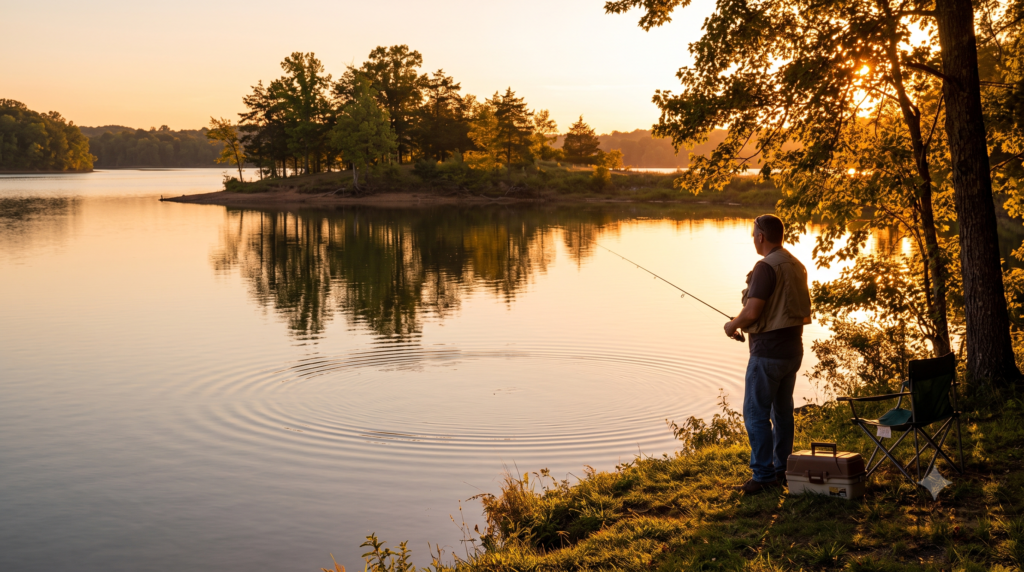
The Breeze Quit. The Lake Did Not Stop Talking.
One minute, ripples are pushing toward a point and your line is sliding across the surface. Then the water goes flat. Glare sharpens. A bobber sits still. The bank that looked alive suddenly feels empty.
The calm surface does not prove the fish vanished. It proves the conditions changed. Before changing everything, identify which part of the wind-created opportunity remains.
What should a bank angler do when the wind stops?
Give the original area a short, controlled retest before leaving. Keep the same basic presentation, then check the closest shade, cover, depth change, or visible activity that made the bank useful before the water flattened. Calm water can change surface drift, glare, line behavior, and how exposed shallow fish feel, but it does not prove that every fish left.
If the bank still combines two or more useful clues—such as a point beside deeper water, shade over cover, or baitfish near a weed edge—stay long enough to test it. If wind was the only strong clue and the area now looks blank, make one purposeful move to the nearest replacement feature.
Four things changed when the surface went calm
The most useful reset begins by separating what you can observe from what you are merely assuming. “The fish left” is an assumption. These are observable changes you can test.
Surface drift weakened
Foam, loose vegetation, insects, and other floating material may stop traveling toward the same corner or edge. The collection zone can remain useful for a while, but it may no longer be building.
The visibility equation changed
Ripples break glare and disturb the view through the surface. Flat water can make shallow fish feel more exposed—and makes your movement, shadow, and noisy approach more important.
Your line and float became easier to read
A calm surface can improve line control and bite detection. A stationary bobber, straighter line, or slower drift may reveal subtle contact that the breeze hid.
The permanent features stayed put
The point, first drop-off, weed edge, laydown, riprap, and shaded bank did not vanish. Wind may have strengthened those features, but structure can continue giving fish a reason to travel or pause.
Calm water does not mean the lake instantly lost its oxygen
A breeze can help mix surface water, and long stretches of hot, stagnant weather can contribute to difficult summer oxygen conditions. However, a wind lull during your fishing trip is not evidence that dissolved oxygen suddenly collapsed across the lake.
Treat oxygen as part of the larger seasonal picture—not as a reason to panic after five calm minutes. The U.S. Geological Survey explains that warm water generally holds less dissolved oxygen than cold water and that hot, stagnant summer conditions can become stressful over time. Read the USGS dissolved-oxygen overview.
Breezy-water clues versus calm-water tests
| What you notice | While the breeze is working | After it stops | Your next test |
|---|---|---|---|
| Surface texture | Ripples soften glare and reveal a wind direction. | Flat water may increase visibility in both directions. | Step back, lower your profile, and test the edge before walking closer. |
| Floating material | Foam, leaves, or insects move toward a corner or shoreline. | The drift slows, but the collection area may remain. | Fish the edge of the accumulated material, not the thickest debris. |
| Line and bobber | Wind bows line or moves the float. | Line straightens and the float may become easier to read. | Recheck depth and watch for smaller, more deliberate movement. |
| Wind-touched bank | Moving water strengthens an already useful point, flat, or weed edge. | Structure remains, but one attraction has weakened. | Stay if cover, depth, shade, or bait activity still overlaps there. |
| Visible activity | Ripples can hide small rings, follows, and direction changes. | Subtle surface clues may become easier to separate. | Pause for two quiet minutes before making the next cast. |
Keep the clue, check the change, replace only what disappeared
Use this three-part sequence before reaching for another lure or walking to the opposite bank. It turns a vague feeling—“the lake died”—into a decision you can test.
Name the permanent clue
Point, shade, cover, first drop-off, weed edge, riprap, inflow, or cove mouth. If you cannot name one, wind may have been the entire pattern.
Make the quiet retest
Work the near edge and first reachable depth change. Change only angle, depth, speed, or position so the next result means something.
Move to the nearest better overlap
If wind was the only strong clue, compare the closest safe bank that adds shade, depth, cover, food, or visible activity.
Use this 10-minute calm-water reset
The reset protects the information you already earned. It changes one decision at a time, so a useful wind pattern does not disappear beneath five new lures and a rushed walk around the lake.
- Pause for two minutes. Put the rod down safely. Watch the old wind line, the nearest shade, the edge of floating debris, baitfish movement, and any rings or wakes. Let the flat surface reveal what the ripples hid.
- Name the feature—not the feeling. Say why you chose this area: “point beside depth,” “shade over a weed edge,” or “wind collected food in this corner.” If the explanation was only “it looked fishy,” look again.
- Retest the closest edge. Make a quiet cast parallel to shore, beside cover, or along the debris line before throwing toward open water. Flat water rewards a careful approach.
- Retest the first depth change. Make two or three casts to the first reachable break. If you do not know where it begins, use the simple Cast, Count, Compare test in Where Does the Shallow Water End?
- Make one comparison. Change depth, angle, speed, or location—only one. A second reachable feature should answer a different question, not repeat the same water.
- Decide at minute ten. Stay if the area still shows food, cover, depth, shade, or activity. Move if wind was the only useful clue and the lake now offers a stronger replacement nearby.
Keep the wind decision in your tackle bag
The free Kentucky Wind & Structure Cheat Sheet helps you compare wind direction with points, corners, flats, drop-offs, vegetation, and safe bank access. Use it when a breeze starts, changes, or disappears.
Apply the L.A.K.E. Method after the wind dies
Look Again
Notice surface texture, glare, shade, debris, baitfish, your shadow, and the safest reachable water.
Analyze What Remains
Separate temporary wind effects from permanent points, edges, cover, and nearby depth.
Key In on Overlap
Choose the feature that still combines at least two needs: food, comfort, safety, depth, or movement.
Execute One Test
Keep one baseline, change one meaningful variable, and let the result guide the next move.
Should you stay on the old wind-blown bank or move?
Stay and retest when…
- The point, drop-off, weed edge, riprap, or laydown remains useful.
- Shade is expanding across the same feature.
- Baitfish, insects, rings, or follows still show life.
- The breeze had pushed floating food or debris into a reachable corner.
- You can now control the line or float more precisely.
Make one purposeful move when…
- Wind was the only reason you selected the bank.
- The shallow water is bright, featureless, and visibly inactive.
- A nearby shaded edge, steeper bank, cove mouth, or point offers a stronger overlap.
- Floating weeds or debris now make the presentation impractical.
- Your safe casting access has worsened as conditions changed.
Use the nearest replacement rule: do not cross the entire lake simply because the surface flattened. Compare the nearest legal, safe feature that adds something the old bank lost.
What the reset looks like on a real bank
The bobber stops drifting
Do not assume the bite ended. Recheck the bait’s depth, remove excess slack, and watch for small lifts, tilts, or sideways movement that the breeze previously disguised.
The wind-touched corner goes flat
Inspect the outside edge of collected leaves, foam, or insects. If no cover, depth, shade, or activity supports the corner, compare the nearest point or cove mouth.
The point still has depth
Retest both sides of the point and the first drop. The breeze disappeared, but the travel route did not. Let the permanent feature earn a few controlled casts.
Build the calm-water reset into a two-hour trip
You cannot schedule the wind, but you can reserve time to reread the lake when conditions change. This plan gives the first pattern a fair test without letting it consume the whole outing.
Read the starting lake
Check forecast, safe shelter, wind direction, shade, access, structure, and surface activity.
Test the best overlap
Fish one wind-plus-structure explanation long enough to establish a useful baseline.
Reset if conditions shift
Pause, reread, retest the near edge and first depth change, then make one comparison.
Compare replacement water
Try the closest feature that adds shade, depth, cover, food, movement, or better control.
Follow the evidence
Finish where the strongest clue remains and record what changed when the wind stopped.
For a reusable before-you-leave checklist, timed trip sequence, and field-note system, explore The Two-Hour Kentucky Bank-Fishing Plan. If the shoreline shapes themselves are still confusing, the Kentucky Shore Fishing ebook goes deeper into points, coves, flats, cover, and drop-offs.
Five mistakes that hide the answer
Changing lure, depth, speed, and bank together
If the next cast works, you will not know which change mattered. Protect the baseline and adjust one variable.
Walking to the water’s edge on a flat surface
Calm water can make your silhouette, footfalls, and shadow more noticeable. Observe from a step back before approaching.
Assuming every wind-blown bank is automatically good
Wind is strongest when it overlaps safe access and useful structure. A featureless bank does not become perfect because waves touch it.
Leaving before testing what the wind collected
A corner or edge may stay useful after the breeze stops. Give the collection zone a brief, careful test.
Waiting forever because the bank was good earlier
A past clue is not a permanent promise. If the overlap disappears and a better reachable feature emerges, move with a reason.
Confusing a weather warning with a fishing puzzle
Darkening skies, thunder, lightning, sudden gusts, or unsafe waves end the experiment. Safety is the decision.
Prepare for the catch before calm water gives you one
A careful reset can produce a bite when you least expect it. If you plan to release the fish, have pliers and a wet rubberized net ready so the release does not turn into a long search through your tackle.
- Wet your hands before touching the fish and avoid dry grass, dirt, concrete, or hot surfaces.
- Keep the fish in the water as much as practical and minimize air exposure.
- Support the fish rather than squeezing it, and remove the hook efficiently.
- If a hook is deeply swallowed, follow applicable rules and consider cutting the line close instead of tearing the hook free.
- Consider barbless hooks or crimped barbs when they fit your fishing situation and local regulations.
The U.S. Fish and Wildlife Service catch-and-release guidance emphasizes keeping fish wet, minimizing airtime, and avoiding forceful hook removal. The goal is a release that is as organized as the fishing plan.
A wind change can be information—or a warning
Check the forecast before leaving and keep a safe shelter plan. If you hear thunder, stop fishing and move to a substantial building or hard-topped vehicle. The National Weather Service recommends staying sheltered for at least 30 minutes after the last thunder. A picnic shelter, isolated tree, or open shoreline is not adequate lightning protection.
Review the National Weather Service lightning-safety overview. Also confirm current access, licenses, seasons, limits, bait rules, and waterbody-specific regulations in the Kentucky Fishing and Boating Guide and on posted signs.
Can you rebuild the plan when the wind stops?
Select one answer for each question, then check your score.
Fishing when the wind stops: practical answers
Do fish stop biting when the wind stops?
No. A lull can change surface drift, visibility, line control, and the strength of a wind-created feeding clue, but it does not switch every fish off. Retest the feature that still provides cover, depth, shade, food, or a travel edge.
Is calm water bad for bank fishing?
Not automatically. Calm water can improve sight-fishing, line control, float reading, and detection of subtle surface activity. It can also make shallow fish more cautious, so approach quietly and use structure or shade to narrow the water.
Should I leave the wind-blown bank as soon as it goes calm?
No. Give the area a short retest if wind had been working with a point, first drop-off, weed edge, shade line, riprap bank, cove corner, or visible food. Move when wind was the only useful clue and a better feature is safely reachable.
Should I make shorter casts in calm water?
Often, yes—especially when a nearshore edge, shade line, cover, or first drop-off is within reach. The goal is not “short” for its own sake; it is a quieter, more accurate cast to the strongest feature.
What if the lake looks active but I still cannot get a bite?
Visible activity may show you a route or food source without revealing the correct depth or presentation. Use The Lake Looks Alive—but Nothing Is Biting to decide whether location, depth, speed, or target species is the missing variable.
What should I record in my fishing planner?
Note when the wind stopped, the feature you were fishing, which surface clues disappeared, what remained, the one comparison you made, and where the strongest response occurred. That record turns one weather change into a reusable lesson.
Fact-check and planning sources
- Kentucky Department of Fish and Wildlife Resources: Fishing and Boating Guide
- National Weather Service: Lightning Safety Overview
- U.S. Geological Survey: Dissolved Oxygen and Water
- U.S. Fish and Wildlife Service: Responsible Fishing and Catch-and-Release Tips
Accuracy note: Fishing conditions, access, weather, water levels, and regulations can change. This article explains a decision process, not a catch guarantee or a substitute for official rules and local notices.
The wind can leave without taking the whole pattern with it
When the lake goes flat, do not ask only, “Where did the fish go?” Ask, “What did the wind create, and which part of that opportunity still exists?”
Pause. Separate temporary drift from permanent structure. Retest the closest edge and first depth change. Compare one replacement feature. Then stay or move because the lake gave you a reason—not because calm water made you impatient.
Start with the lake. Let the change sharpen the next decision.
What changes first at your lake when the wind dies?
Does the surface activity disappear, does your bobber become easier to read, or does a shaded edge suddenly become the better choice? Share the lake type, time of day, and clue you noticed. Your observation may help another bank angler make a smarter next cast.
Join the Comment Conversation