
If you have ever set a regular camp chair on a Kentucky lake bank, you already know how it ends. One leg settles into the mud, the seat leans toward the water, and whoever is sitting in it spends the afternoon half standing. With kids along, that gets worse: the smallest angler can’t climb into a full-size chair, and the chair is too heavy to carry down the path.
This guide sorts portable fishing chairs by what actually goes wrong on soft, sloped ground. It then matches a parent chair with a kid chair, so your family leaves with one clear pick instead of a long list. If you are choosing the best portable fishing chairs for bank fishing, start with the ground, because the ground decides which chairs work.
Why a regular camp chair fails on a Kentucky lake bank
Most camp chairs are designed for flat, firm surfaces: a campsite pad, a driveway, a sports field. A lake bank is the opposite. After rain, clay and loamy soil go soft, and the edge of the water is usually the softest ground of all. Many banks also slope toward the water, so the chair starts out tilted before anyone sits down.

Three things go wrong, and they show up in the same order every time:
- The legs sink. A narrow leg or a small foot concentrates the weight of a person on a very small patch of ground, and soft mud gives way under it.
- The chair tips. Tall seats put your weight high above the ground. On a slope, with a rod pulling you forward, that is easy to tip.
- The chair is too big to manage. A bulky chair is awkward on a narrow path, and a child cannot carry or climb into it. A parent ends up hauling everything.
Each of these has a practical fix, and the fixes are the same four things worth checking on any chair you consider.
The four things that matter on mud and slopes: foot width, seat height, weight and carry
You can judge a chair on these four points in a store aisle or from a product photo, without a brand name or a review score.
Foot width
Look at what touches the ground. Wide, flat feet spread the load over more soil, so they sink less. Thin tubular legs with no foot cap act like tent stakes in soft mud. A chair with a sled-style base, where the frame runs along the ground, or one with broad rubber feet, is far more stable on a bank than one with four bare tube ends.
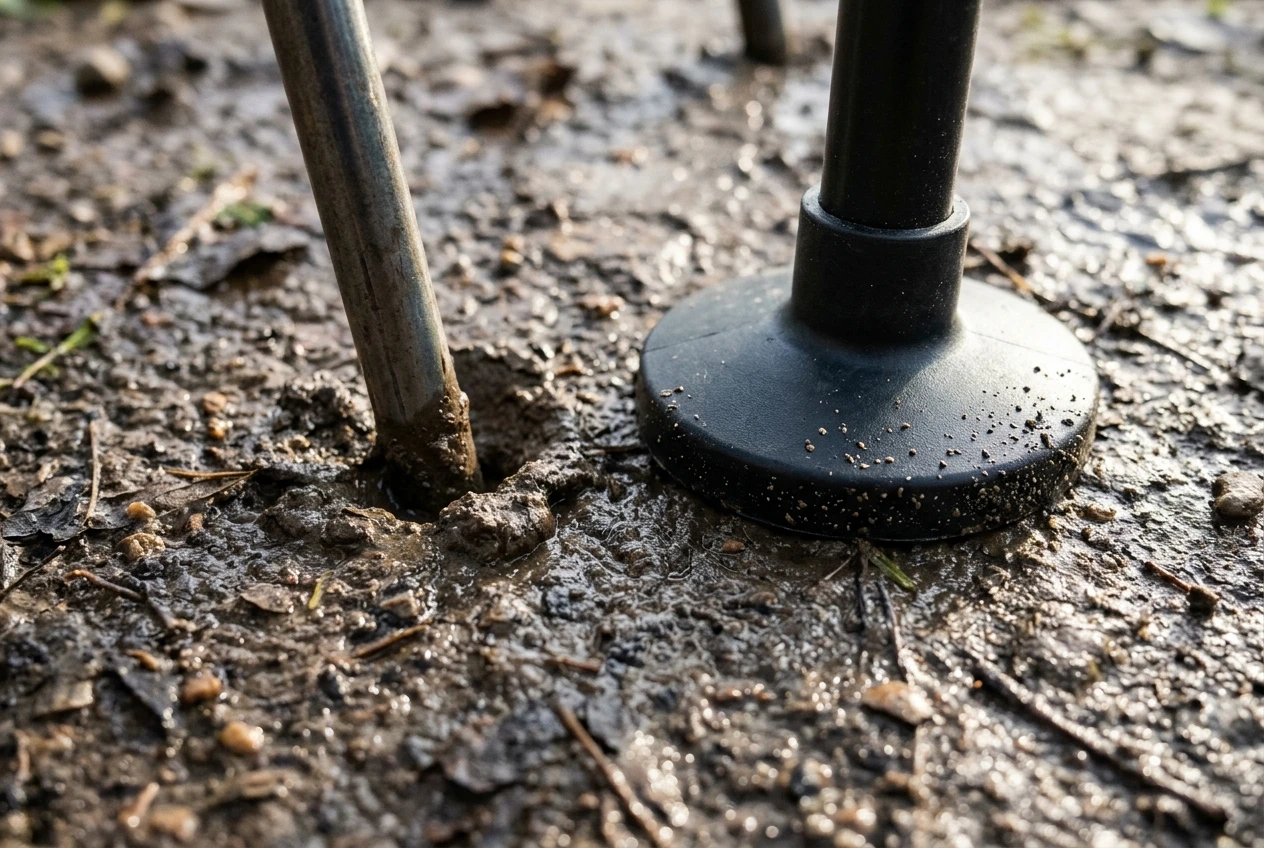
If a chair you like has narrow feet, some models let you add wider foot pads. If not, the chair is better suited to firm gravel or a boat ramp than to a muddy bank.
Seat height
A lower seat means a lower center of gravity, which makes the chair harder to tip. It also puts your rod tip closer to the water, which is fine for casting from a bank. The trade-off is getting up: a very low seat is harder on adult knees and backs, so pick a height where you can stand without pushing hard on the armrests.
Weight
Lighter is easier to carry, but a very light chair is not always the stable one. Some of the lightest designs use thin frames and narrow legs. The sweet spot is a chair light enough to carry in one hand while you hold a rod or a tackle kit in the other, with a base wide enough to stay put.
Carry
Check how the chair folds and what you hold when you carry it. A chair with a shoulder strap or a carry bag leaves your hands free for rods and a bucket. A chair that folds flat and slim fits down narrow paths and into a trunk beside other gear. If a chair needs a separate bag to carry, count that bag as one more thing your family has to manage.
Low-profile folding chairs: the best match for most families
For most families, a low-profile folding chair is the strongest all-round choice. It sits close to the ground, usually has a backrest, and folds into a compact shape you can sling over a shoulder.
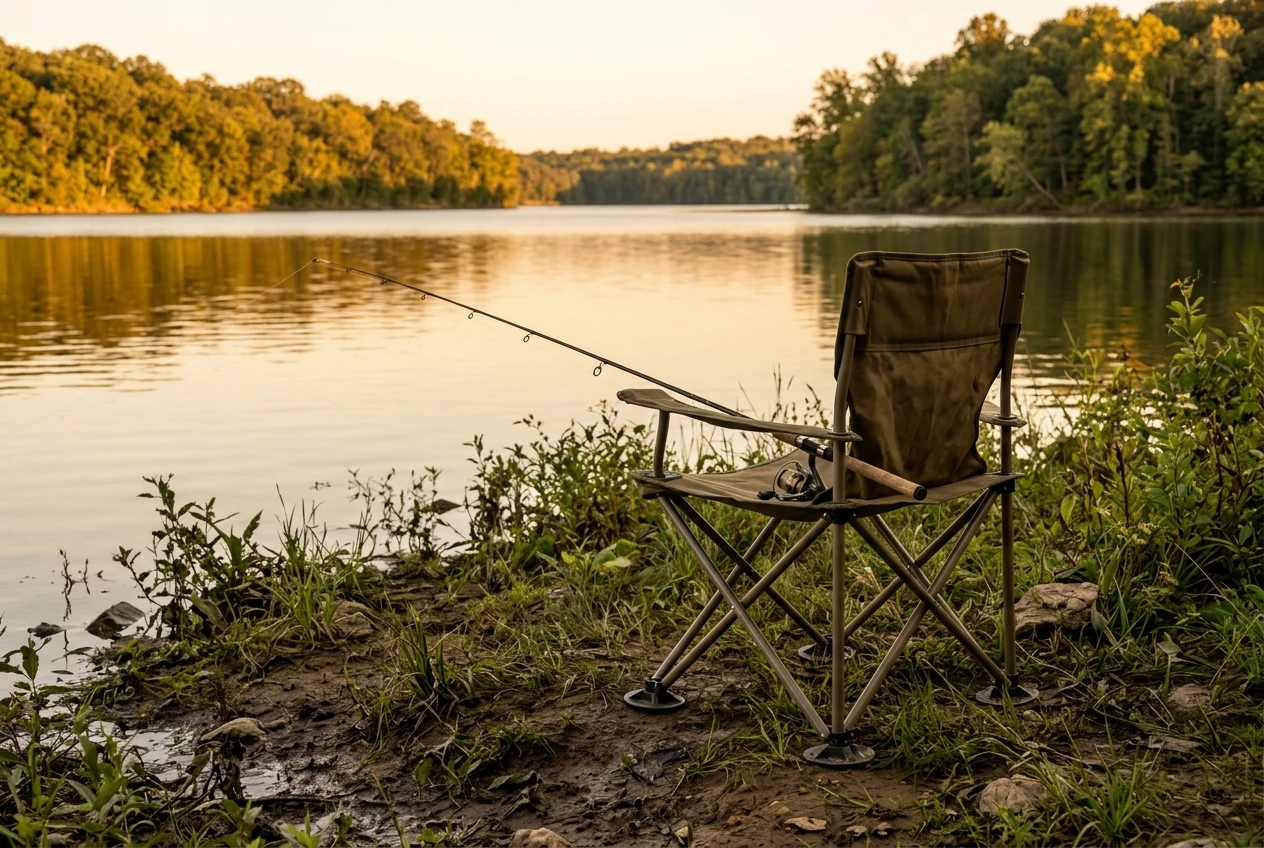
What makes it work on a bank:
- The low seat resists tipping, even when you lean forward to reel.
- A backrest lets you sit through a long wait without slumping.
- Many models have wide feet or a frame that spreads out at the base.
- It folds small enough to share a trunk with a cooler and rods.
When you compare models, check the feet first, the seat height second and the folded size third. Skip features that do not help on a bank: cup holders are handy but not required, and a built-in cooler adds weight you will carry down a path.
One more habit helps on any slope: set the chair so it is level from side to side, even if it tilts a little forward or back. Sideways tilt is what tips people into the water. If the ground will not let you level the chair, pick another spot, or flatten a small patch with your foot before you unfold it.
The low-profile folding chair is the best fit for the parent seat in most families. It is comfortable enough for a long afternoon and stable enough that you can stop worrying about it.
Stool and bucket-style seats: when simple and cheap is enough
Not every trip needs a chair with a backrest. Stools and bucket-style seats work well for short outings, for families trying out bank fishing before they spend much, and for anglers who move along the shore.
Folding stools are small and light, and they fold flat or collapse into a narrow bundle. Their weakness is the legs. A three-legged or four-legged stool with small feet can sink fast in mud. If you choose one, look for wide leg caps, and plan to use it on firmer ground such as packed dirt, gravel or a mowed area.
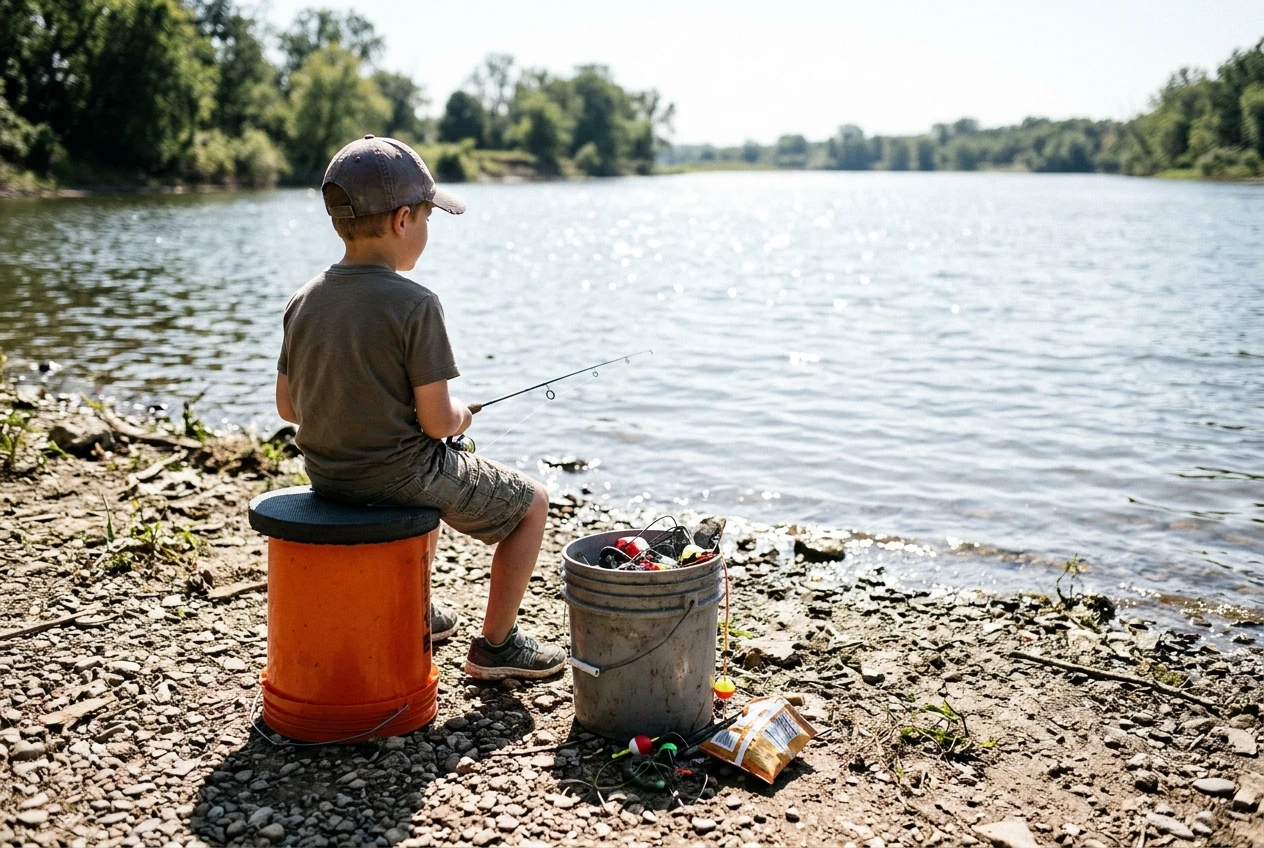
Bucket seats are a bucket, often with a padded or snap-on lid, that doubles as a gear container. The flat, wide base spreads weight well on soft ground, and the bucket carries tackle, snacks and a rag. The trade-offs are no backrest and a fairly high seat, so they suit shorter sessions and younger kids more than a parent who sits for hours.
Choose a stool or bucket seat when:
- Your trips are short, an hour or two at a time.
- You walk along the bank and change spots often.
- You want to see whether your family likes bank fishing before buying a better chair.
- You want a second seat for a friend or grandparent at low cost.
If your trips are getting longer or your back is complaining, move up to a low-profile folding chair. The stool or bucket then becomes the spare seat or the kid seat.
Chairs for kids: size, stability and what a child can carry alone
A kid’s fishing chair has three jobs: fit the child, stay put, and be something the child can manage without help.
Size. A child’s feet should reach the ground, or nearly, while seated. A chair that is too big makes a child slide forward, and a seat that is too tall makes a small angler lean to reach the ground. Kid-sized folding chairs and low stools are made for this.
Stability. Kids shift, wiggle, stand up fast and lean over to look at the water. A low, wide chair forgives all of that. Avoid tall, narrow seats near the water’s edge. Set the chair a few steps back from the waterline, on the most level ground you can find, so a tip does not mean a fall into the lake.
Carry. Before you buy, have your child lift the chair and walk with it. If they cannot carry it from the car to the bank alone, it is the wrong chair, because a parent will end up carrying it every trip. A chair with a shoulder strap, or a small stool that fits in one hand, lets a child take part in the trip from the car onward. That matters for a child’s interest as much as for your back.
A few other points worth checking:
- Can the child open and close the chair without pinching fingers?
- Does the chair have sharp edges or tight hinge points?
- Is the fabric easy to wipe clean? Kids will get it muddy.
If you are outfitting more than one child, our guide on how to equip several kids for bank fishing without buying everything twice covers how to spread costs and share gear across siblings.
How to pair a parent chair and a kid chair so one trip doesn’t need two bags
The goal is one carry load for the family, not a parent loaded down with every seat. Pairing helps.
The most practical pair: a low-profile folding chair for the parent and a small stool or kid-sized folding chair for the child. The parent chair has a strap, the kid’s seat is light enough for the child to carry, and neither needs its own bag.

The budget pair: a bucket seat for the child that also holds the child’s tackle, plus a folding chair for the parent. The bucket does double duty, so there is one less item to pack.
The stool pair: two folding stools, one adult and one kid size. This is the lightest and smallest option, best for short trips on firmer ground.
When you match the two, check these points together:
- Both chairs should stand up to the same ground. A wide-footed parent chair paired with a thin-legged kid stool leaves the kid’s seat as the weak link.
- Seat heights should be close enough that a parent can reach over and help with a line without standing.
- Both should be carried in the hands or over the shoulder, not both in one bag, so a child’s load stays small.
- The pair should fit together in the trunk with rods and a cooler. Fold them at home and pack them once, before the trip, to see how they stack.
This pairing approach is the same one we use for rods. If you are still choosing those, our piece on picking Kentucky bank fishing rods for kids and parents as a pair follows the same logic.
Where to test, how to clean and dry a chair after muddy trips, and what to add to your gear checklist
Test before the trip
Open the chair in your yard, on soft ground if you have any, and sit in it. Press down and lean forward as you would when reeling. Does a foot sink in a few seconds? Does the chair rock? Have your child do the same with theirs. Ten minutes at home saves a ruined afternoon at the lake.
Clean and dry after muddy trips
Mud left on a chair wears the hinges and grows mildew on the fabric. After each muddy trip:
- Knock off loose dirt before you put the chair in the car.
- Rinse the frame, feet and fabric with a hose or a bucket of water, and wipe the joints where grit collects.
- Open the chair fully and let it dry in the air before you fold it for storage.
- Check that the hinges and locks move freely, and that no foot caps have come loose.
A chair stored damp tends to smell and the fabric breaks down. For more on keeping gear ready between outings, see our guide on how to store your fishing gear between Kentucky trips.
Add it to your checklist
Seats are easy to forget when you are packing rods, bait and snacks for kids. Put each chair on your list by name, along with a rag or towel to wipe feet and a bag for muddy gear. Our Kentucky bank fishing gear checklist lets you tick everything off in the driveway before you leave.
Next steps
If you are still building your family’s kit, read our gear checklist next, then look at our Kentucky bank fishing ebooks to find the one that fits your lake and your kids.