The best FIN lakes in Kentucky for beginners are rarely the biggest or the most famous. They are the ones where a seven-year-old can get from the parking lot to the water without a meltdown, stand on the bank without slipping, and catch something within the first hour. FIN stands for Fishing In Neighborhoods, the Kentucky Department of Fish and Wildlife Resources program that puts stocked fishing water in small community lakes close to where people live.
If you want a list of places, the region-by-region guide to bank fishing with kids in Kentucky covers that. This article does something different. It gives you six checks you can run on any FIN lake near you, so you can choose a first outing yourself and understand why one lake suits your family better than another.
Why a small neighborhood lake is the easiest first trip for a family
A first trip with kids succeeds or fails on logistics more than on fishing skill. Children have short attention spans, small legs and limited patience for a long drive followed by a long hike. A small lake close to home removes most of those problems before you cast.
Distance from your house matters more than people expect. A short drive means you can leave when the kids are done, even if that is after forty-five minutes, without feeling you wasted a day. You can also come back the next weekend, which is when children actually get better at fishing.
Small lakes also simplify the water. There is less to read, fewer places for fish to be, and the whole shoreline is usually within sight. You can watch a toddler at one end while helping a nine-year-old at the other.
The six checks below follow the order you will experience a lake: the walk in, the bank, the comforts, the fish, the crowd, and the paperwork.
Check 1: How far is the walk from the car to the water?
Count the walk in minutes with a loaded family, not in steps for one adult. You will be carrying rods, a tackle box, a cooler or water bottles, a chair or two, and possibly a child who decides halfway there that walking is over.
A good first lake lets you park within a short, level walk of a place where you can actually fish. The ideal is a paved or packed path that a wagon or a small cart can roll along. Gravel is fine. A steep, rooty trail is a problem even when the distance is short.
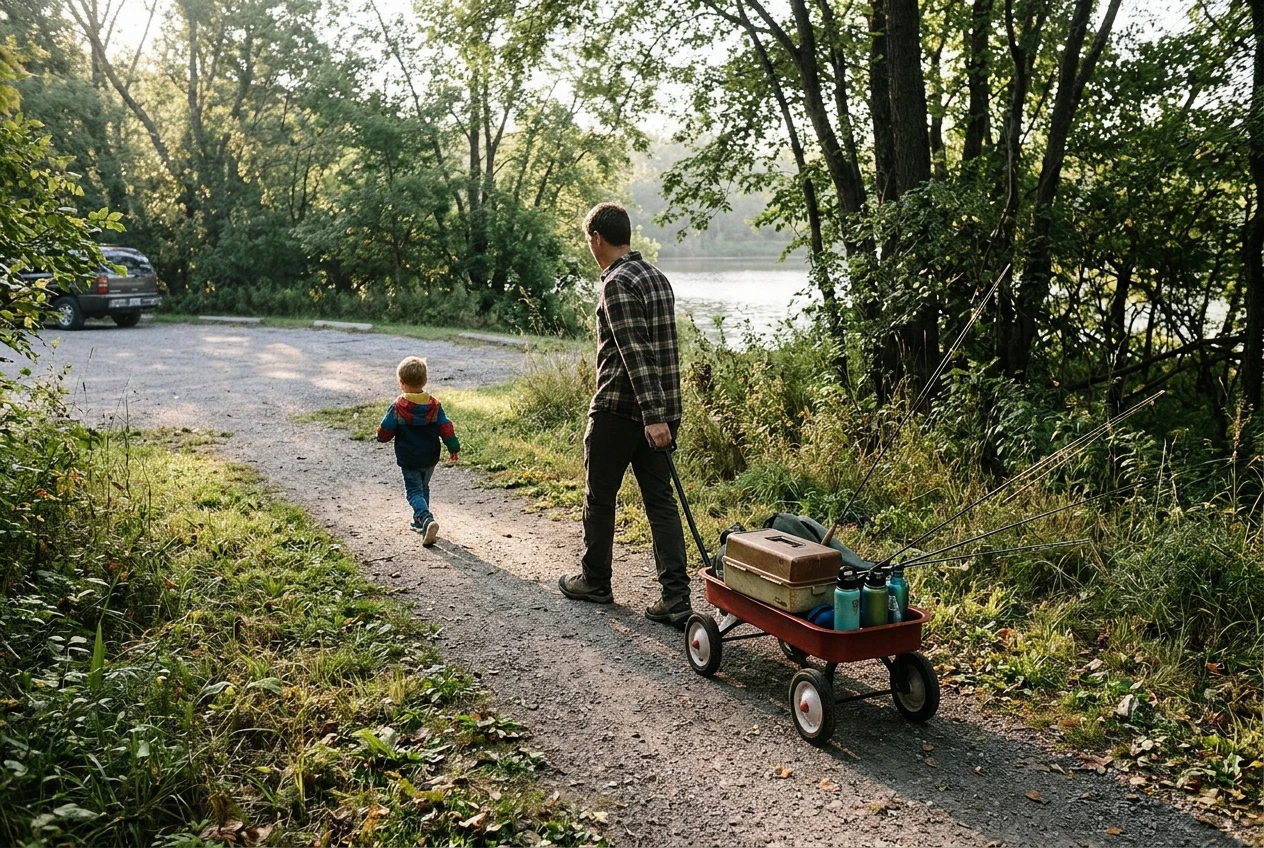
Here is what to look for:
- Where the parking lot sits relative to the water. Some lots overlook the lake and some are tucked behind trees with the water out of sight. If kids can see the water from the car, they walk faster.
- Whether you can drop gear and move the car. If the lot is small, one adult can unload at the closest point while the other parks.
- Surface and slope. Mud after rain, loose stones and stairs all slow you down and make carrying rods riskier.
If you cannot tell from photos, treat the walk as unknown and plan your first visit with only the essentials. You can bring the full kit on trip two, once you know what the path is like.
Check 2: Is the bank gentle enough for small feet and a tangle of lines?
The bank is where children will spend the whole outing, so it deserves a close look. A bank that is gently sloped, firm and open gives kids room to stand, cast, and make mistakes safely.
Look for a shoreline where the ground meets the water gradually. A steep drop or a crumbling edge is a poor fit for young children, whatever the fish are doing. Short grass and packed dirt are easier than tall weeds or loose rock, and a fishing pier or a flat paved edge is better still if the lake has one.
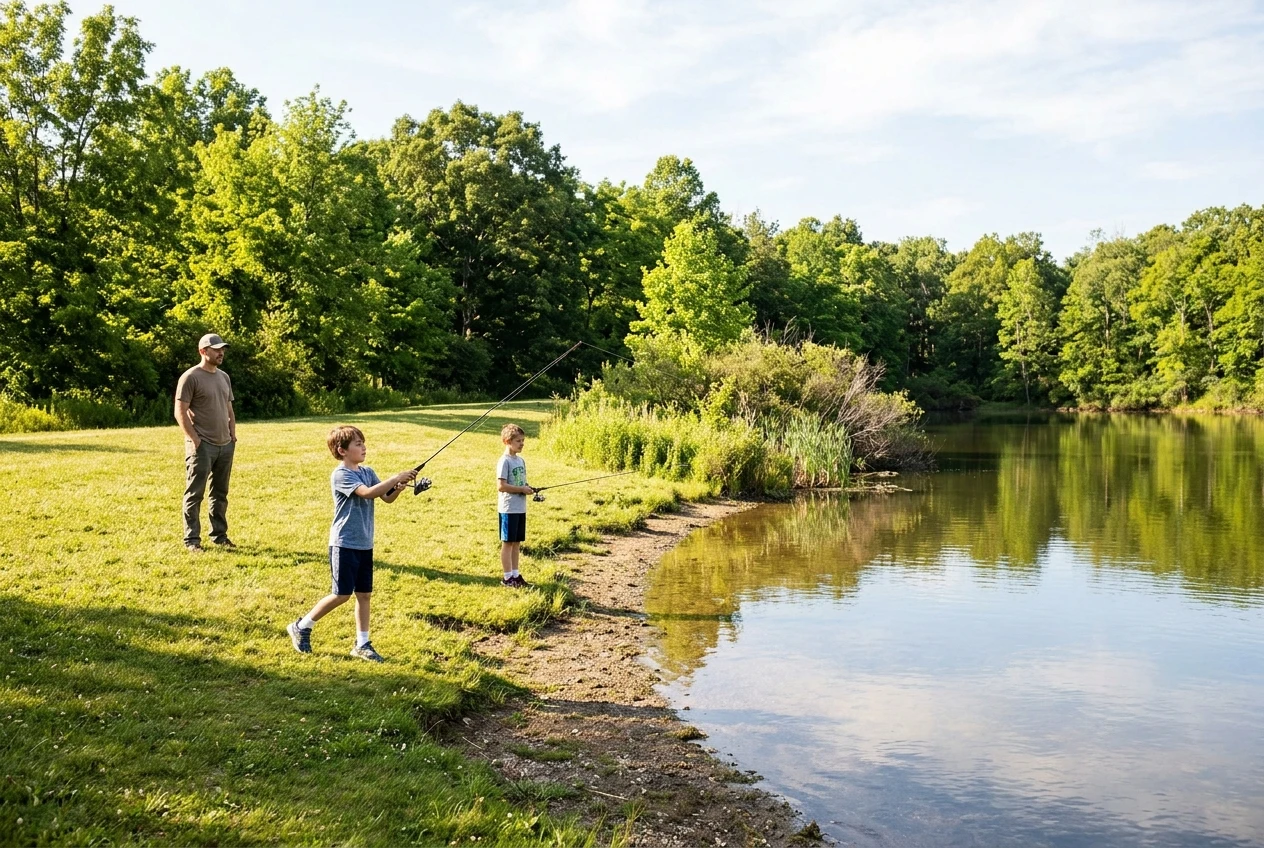
Open space behind the angler matters as much as the water in front. Kids swing rods wide, and a hook that catches a tree branch, a bush or another person ruins the mood quickly. A bank with room behind and beside each child lets a cast go out without a snag. It also gives two or three kids space to fish without their lines crossing, which is the most common first-trip frustration.
Check the water’s edge for cover you can see. Thick brush along the shoreline snags line, though it can also hold fish, so a mix of clear stretches and a few brushy spots gives you both easy fishing and something to try later. For more on reading what the shoreline suggests about the water, see what the bank under your feet tells you about the water in front of you.
Check 3: Where is the shade, the bench and the nearest restroom?
Comfort decides how long a family stays, and how long a family stays decides how many fish get caught. Kentucky summers are hot and humid, and a child with no shade will be done in half an hour.
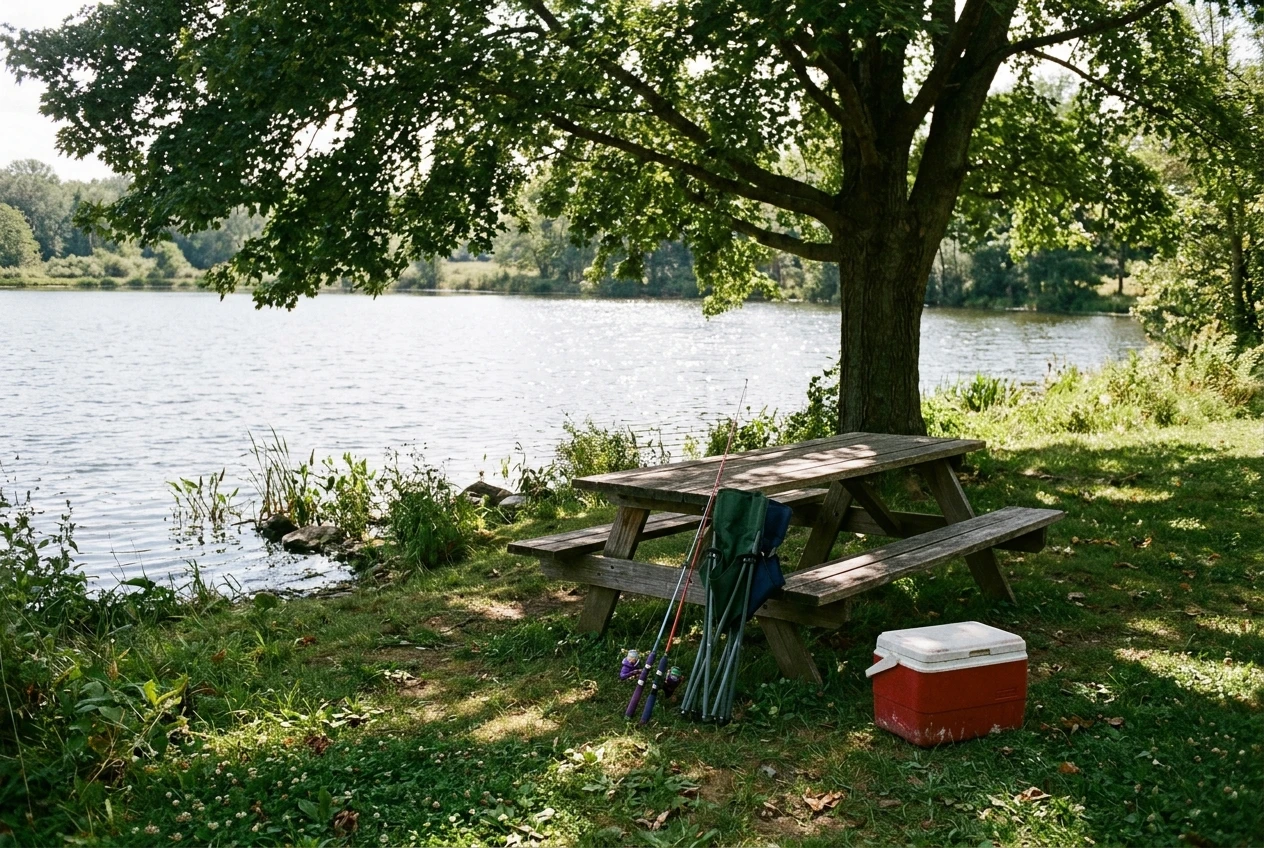
Look at where the trees fall along the bank. Shade that reaches the water’s edge during the hours you plan to fish is worth a lot. If the lake has little shade, a small pop-up canopy or umbrellas become part of your pack, and that changes your Check 1 answer because you will carry more.
Benches and picnic tables give parents and tired kids a place to sit, eat and untangle a line without kneeling on the ground. If the lake has none, bring chairs. Some chairs sink into soft ground, so this comparison of portable fishing chairs for muddy Kentucky banks can save you a poor purchase.
The restroom matters more than any other item here. A long walk back to a distant restroom with a young child can end the outing. Find out whether there is one near the fishing area, whether it is likely to be open, and how far it is from the spot where you will stand. If you cannot confirm it, assume it may not be available and plan the timing of the trip around that.
Check 4: Does the water have easy fish for kids to catch?
A first trip needs fish that bite readily on simple bait. Kids stay engaged when something happens, and a quiet hour can end a young angler’s interest in fishing for a long time.
FIN lakes are stocked by the state, which is part of what makes them good for beginners. The species and the timing of stocking vary from lake to lake, so check what a specific lake holds before you go. Do not assume that every FIN lake has the same fish.
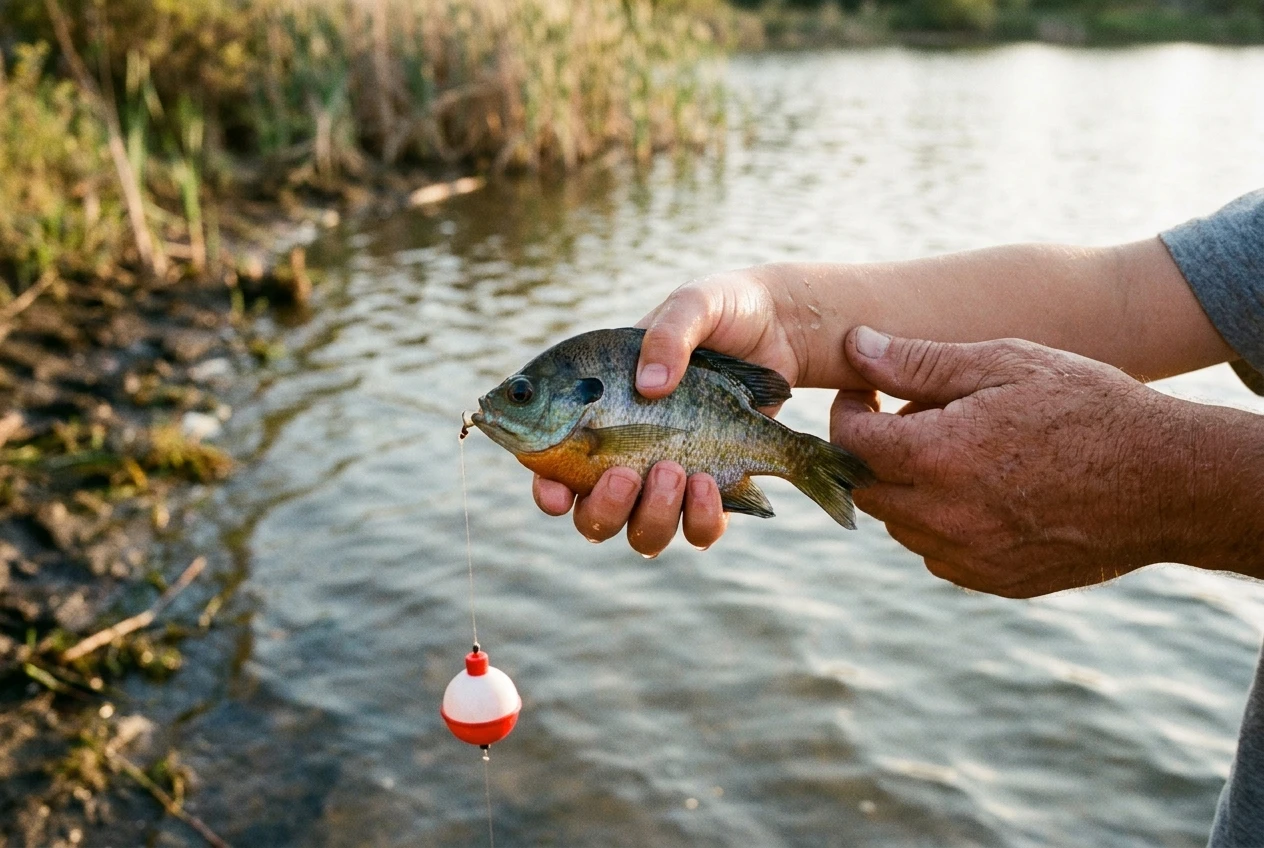
Small, common fish such as bluegill are a good target for beginners because they are plentiful in many lakes, bite on small pieces of bait, and are easy for small hands to handle. Larger fish are exciting but harder on a first outing. When you do catch something, it helps to know what it is and how to hold it, and this guide to telling a bluegill from a bass and handling each safely with kids covers both.
To judge a lake’s fish from home:
- Look at the state’s information on which species the lake holds and whether it is stocked.
- Look for recent reports from other anglers, treating them as hints and not guarantees.
- Look at the shoreline shape on a map for shallow areas and structure where small fish tend to gather.
That map work is worth doing before the drive, and this comparison of Kentucky fishing maps explains which ones show where a family can stand on the bank.
Check 5: How crowded will it be, and does that help or hurt?
Crowds cut both ways, and the right answer depends on your family.
A busy lake has some advantages. Other anglers show you where people are catching fish, and other families make a new angler feel like part of something normal. A parent with a nervous child may find it reassuring to see others nearby, and a friendly neighbor on the bank will often point out what is working.
A busy lake also has costs. Bank space is limited, and a crowded shoreline leaves less room for a child’s wide casts. Parking fills up, restrooms get busy, and a family that arrives late may find the best stretch of bank already taken.
If you have the choice, go at a quieter time. Weekday evenings and early weekend mornings tend to be calmer than midday on a warm Saturday, though this varies by lake and you will learn the pattern of yours over a couple of visits. Weather affects it too: a cloudy, cooler day brings fewer people than a bright one.
For a very first trip with young children, a lake with some room to spread out is usually kinder than one where everyone stands elbow to elbow. If you can only visit at a busy time, arrive early and claim a stretch of open bank before the crowd settles in.
Check 6: What to confirm with the state before you drive
A good lake on paper can still be a poor choice on the day if something has changed. Before you load the car, confirm the practical details with the Kentucky Department of Fish and Wildlife Resources, which runs the FIN program and publishes the official information.
Confirm these items for the specific lake you plan to visit:
- Licensing. Check who needs a fishing license and whether any exemptions apply to your family. Rules depend on age and circumstances, so read the current requirements rather than relying on memory or on another angler’s advice.
- Regulations. Look for any limits on the number or size of fish you can keep, and any rules about bait, gear or the number of rods.
- Access. Check whether the lake is open, whether any part of the bank is closed, and whether there are hours or parking rules.
- Stocking and conditions. See what the lake is stocked with, and look for any notices about water quality, construction or temporary closures.
Rules and conditions change, so check on the week you plan to go, not on the week you first got interested. Five minutes on the state website prevents a wasted drive. When you have the answers, you can pack with confidence, and the gear checklist you can tick off in the driveway keeps you from forgetting the small things.
Scoring the lakes near you and planning a better second trip
Now put the checks to work. List the FIN lakes within an easy drive and give each one a score from 1 to 5 on every check: the walk, the bank, the comforts, the fish, the crowd and the confirmed details. A 5 means it is easy for your family, and a 1 means it will be a struggle.
Add up the scores, but look at the pattern as well as the total. A lake that scores 5 on the bank and 2 on shade might still be a fine choice if you pack a canopy. A lake that scores 1 on the walk may be wrong for a family with a toddler even when everything else is excellent. Weigh the checks by what matters to your children. For very young kids, the walk, the bank and the restroom count most. For older kids who want action, the fish count more.
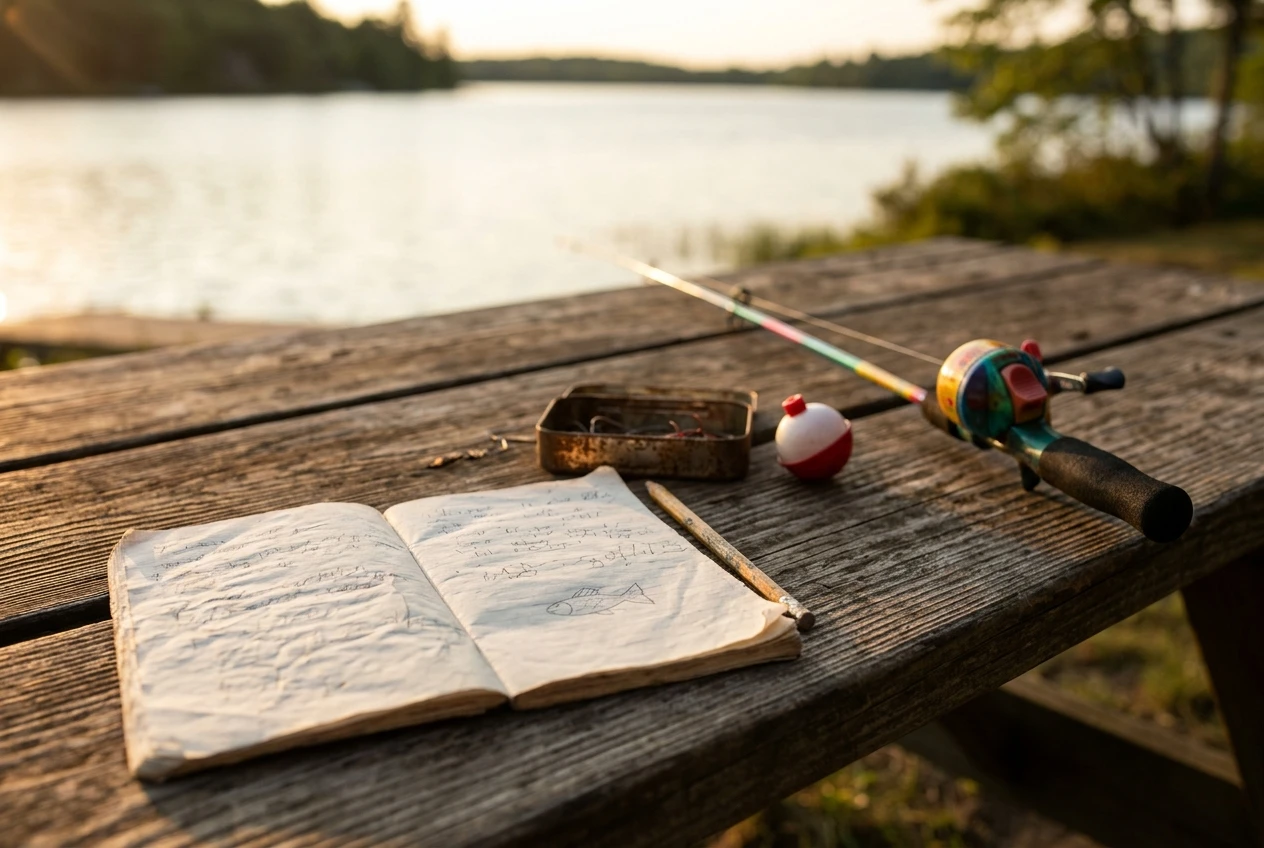
Pick the highest-scoring lake for your first trip, and treat that trip as a test. Afterward, write down what worked and what did not, while it is fresh. Note where you stood, how long the kids stayed happy, which bait drew bites, and what you wished you had brought.
Then improve one thing for the second trip. That might be a different spot on the same bank, a shadier time of day, a lighter pack, or a different bait. Changing one thing at a time shows you what made the difference. If you fish regularly, the best FIN lakes in Kentucky for beginners will turn out to be the ones you now understand well, because you know where to stand, why, and what to adjust.
If your kids want to switch baits as the day changes, this guide to reading the sun and the water is a good next read.
Ready to take the guesswork out of your first trip? Look at the Kentucky bank fishing ebooks and lake guides, which walk you through each lake: where to stand, why, and how to make the next trip better. Start with the five Kentucky bank fishing ebooks and the problem each one solves.