
You will probably hear the first “I caught something!” from your child before you have even set down the tackle box. On a Kentucky bank, what is on the end of the line is usually one of three fish: a bluegill, a largemouth bass, or a spotted bass, which Kentuckians call a Kentucky bass. Each one needs a slightly different grip, and each has a different spot that can poke, cut or scrape a small hand.
This guide covers how to tell the three apart by sight, where the sharp parts are, and a routine for practicing the hold before a fish is on the line. If you want to know how to hold a bass and bluegill safely with kids, the short version is wet hands, a calm grown-up, and a plan made before the bite. The details are below.
Three Fish Your Kid Will Probably Catch: Bluegill, Largemouth Bass and Kentucky (Spotted) Bass
Bluegill are sunfish. They are common in farm ponds, small lakes and the shallow edges of larger reservoirs, which makes them one of the likeliest first catches from the bank. Many are small enough to fit in a child’s hand, and they bite readily on a small hook with bait under a bobber.
Largemouth bass and spotted bass are both black bass. They are bigger, stronger and more likely to splash, jump or thrash when they reach the bank. A child who has only handled bluegill will find a bass a different experience.
Knowing which fish you have helps for two reasons. The hold differs a little, and rules, including size and limits, can differ by species. A quick identification takes about ten seconds once you know what to look at.
The Quick Look Test: Mouth, Body Shape and Markings You Can Check in Ten Seconds
Start with body shape, then the mouth, then the markings.
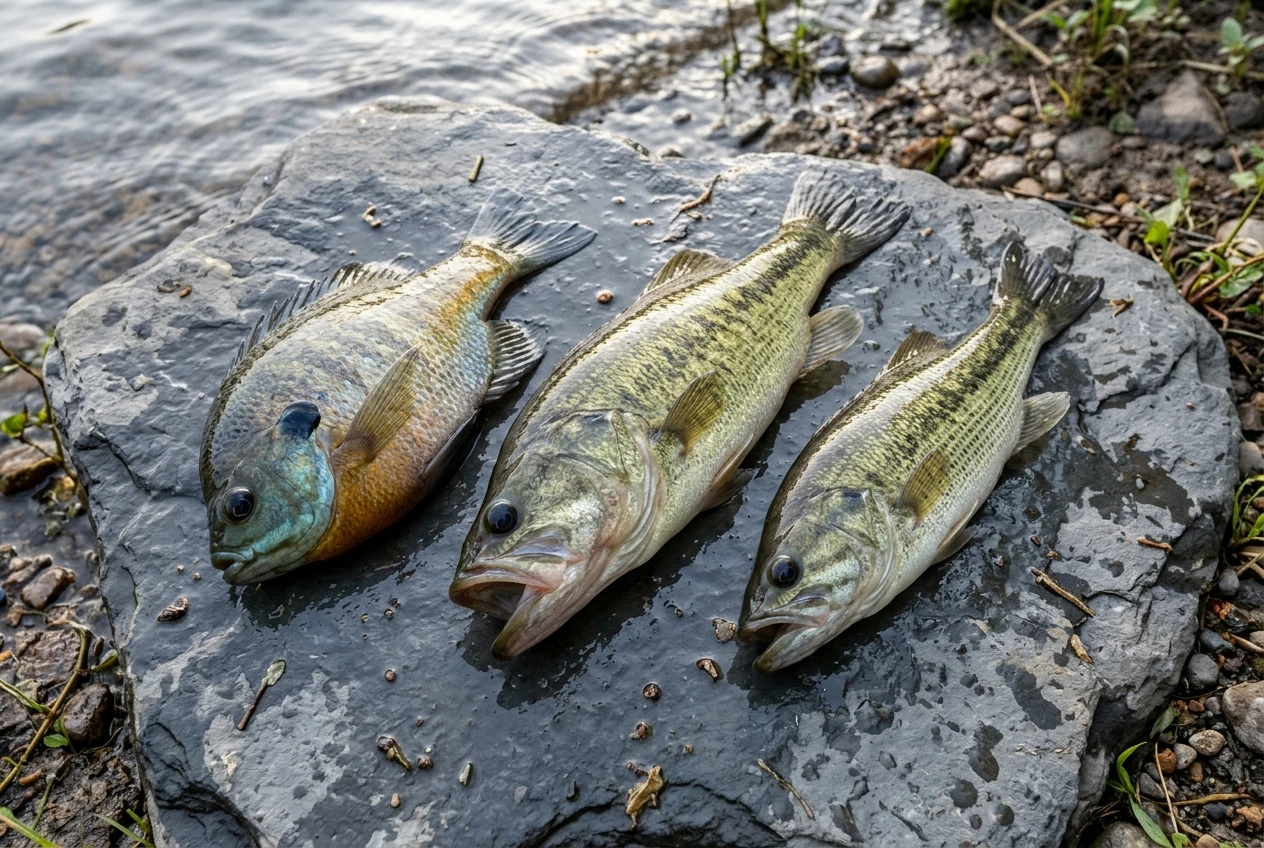
Bluegill
- Body: tall, flat and round, like a dinner plate stood on its edge.
- Mouth: small, well short of the eye.
- Markings: a dark, solid flap at the back of the gill cover (the “ear”), and often a dark blotch near the back of the soft part of the dorsal fin. The belly and gill area can have an orange or yellow tint, and the sides may show faint vertical bars.
Largemouth bass
- Body: long and torpedo-shaped, much slimmer than a bluegill.
- Mouth: large, and when closed the corner of the jaw reaches past the back edge of the eye. This is the most reliable check.
- Markings: a dark stripe along the side, often broken into blotches on bigger fish. The two parts of the dorsal fin (spiny in front, soft behind) are separated by a deep notch.
Kentucky (spotted) bass
- Body: also long and slim, and easy to mistake for a largemouth.
- Mouth: smaller than a largemouth’s. The jaw ends about even with the back of the eye rather than past it.
- Markings: a dark side stripe plus rows of small dark spots on the belly side, lined up like dotted lines. The dorsal fin notch is shallower than on a largemouth.
- Inside the mouth: a patch of tiny teeth on the tongue, which you can feel as a rough spot. A largemouth does not have one.
Teach your child a one-line version: “Round and flat is a bluegill. Long with a big mouth past the eye is a largemouth. Long with spots in rows is a Kentucky bass.” Kids enjoy being the one to call it.
Where It Can Hurt: The Bluegill’s Fin Spines, Hooks, and the Rough Patch Inside a Bass’s Mouth
Fish are not dangerous, but a few spots catch kids off guard. Show them where these are before any fish is in hand.
Bluegill spines. The front part of the dorsal fin and the fins on the belly side are stiff and pointed. A bluegill that flares them can prick a palm or a fingertip. The prick is usually minor, but it hurts, and a child who gets one often drops the fish.
Bass gill covers and fins. A bass’s gill cover has a hard edge, and the front dorsal fin has spines too. The gills themselves are delicate and damage easily, so fingers do not belong under the gill cover for the fish’s sake as well as yours.
The mouth. The inside of a bass’s mouth feels like coarse sandpaper because of the many tiny teeth. On a spotted bass the tongue patch adds to that. These teeth scrape rather than cut, but a child who is startled can pull away fast and scratch a thumb.
Hooks. This is the one that causes the real injuries. Treble hooks on lures and loose hooks on a swinging line can catch a child’s hand, a sleeve or a face. Keep the rod tip low and the hook in view while you handle the fish.
Dry-Run the Hold at Home: Teaching Your Child With Wet Hands Before a Fish Is on the Line
A child who is meeting a live, wet, flapping fish for the first time is already excited and a little nervous. Practice the movements beforehand, somewhere calm.
You need a rubber or plush toy fish, or a rolled-up washcloth, and a sink or bowl of water. Here is a short routine:

- Wet both hands. Dry hands strip the slimy coating that protects a fish’s skin, so wetting them first becomes a habit.
- Pick up the “fish” with one hand under the belly, fingers together and flat.
- Run the other hand gently from head to tail to feel how the body is shaped, the way you would smooth down fur.
- Practice holding still. Count to five with the toy in both hands and no squeezing.
- Practice putting it down on a wet towel, then back in the water, without dropping it.
Do it three or four times, and have your child say the steps out loud. Then swap: you hold the toy and your child tells you what to do. Kids learn the steps better when they teach them.
The key rule to rehearse is “No fingers in the gills, no squeezing, and ask a grown-up when it flaps.” Keep it short enough that your child can say it in one breath.
How to Hold a Bluegill, Step by Step, for Small Hands
A bluegill is a good first fish to practice on because it is small and its mouth is small too, so hooks usually come out with little trouble.
- Wet your child’s hand, and yours. Do this before the fish touches skin.
- Set the fish on a wet towel or your own wet palm and let it settle for a moment. A fish that has stopped flapping is easier to hold.
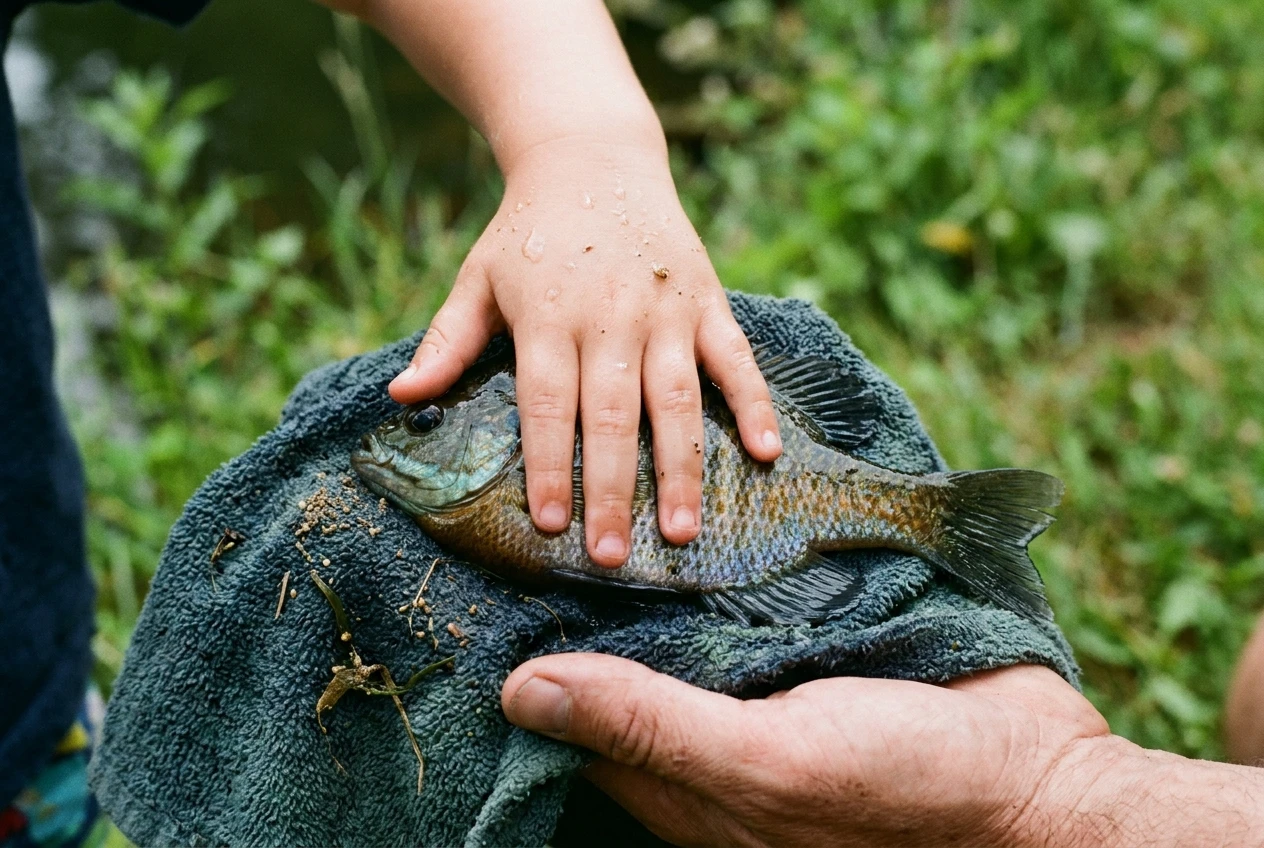
- Slide the child’s hand over the fish from the head toward the tail, palm over the back with fingers wrapped gently along the sides. This flattens the dorsal fin spines against the body instead of letting them stand up against the skin.
- Keep the grip gentle. A squeeze can injure the fish and makes it wriggle harder. The hand should feel like a cup, not a clamp.
- Keep fingers clear of the gill cover and well away from the eyes.
- Have the grown-up handle the hook. Use pliers or a hook remover to back the hook out, while the child holds the fish still or simply watches.
- Return the fish to the water by lowering it in headfirst and letting it swim out of your hand.
If a spine pricks your child, that is a sign to put the fish down and wash the hand, not to scold. Make it a normal part of fishing so they will tell you when it happens.
The steps after the hold are in what happens before the photo. This guide stays with the hands.
How to Hold a Bass, and When the Parent Should Take Over
Bass are stronger and bigger than bluegill, and a young child usually needs help with them. Here is how to split the work.
For a smaller bass, a grown-up can use the lip grip: with a wet hand, put the thumb inside the lower jaw and the index finger outside, and close lightly. A bass held this way usually goes calm. The sandpaper feeling inside the mouth is normal.
Support the body. A bass’s weight should rest on a second hand under the belly, not hang from the jaw. A bass held vertically by the lip puts strain on the jaw, and the bigger the fish, the more that matters. Hold it level.
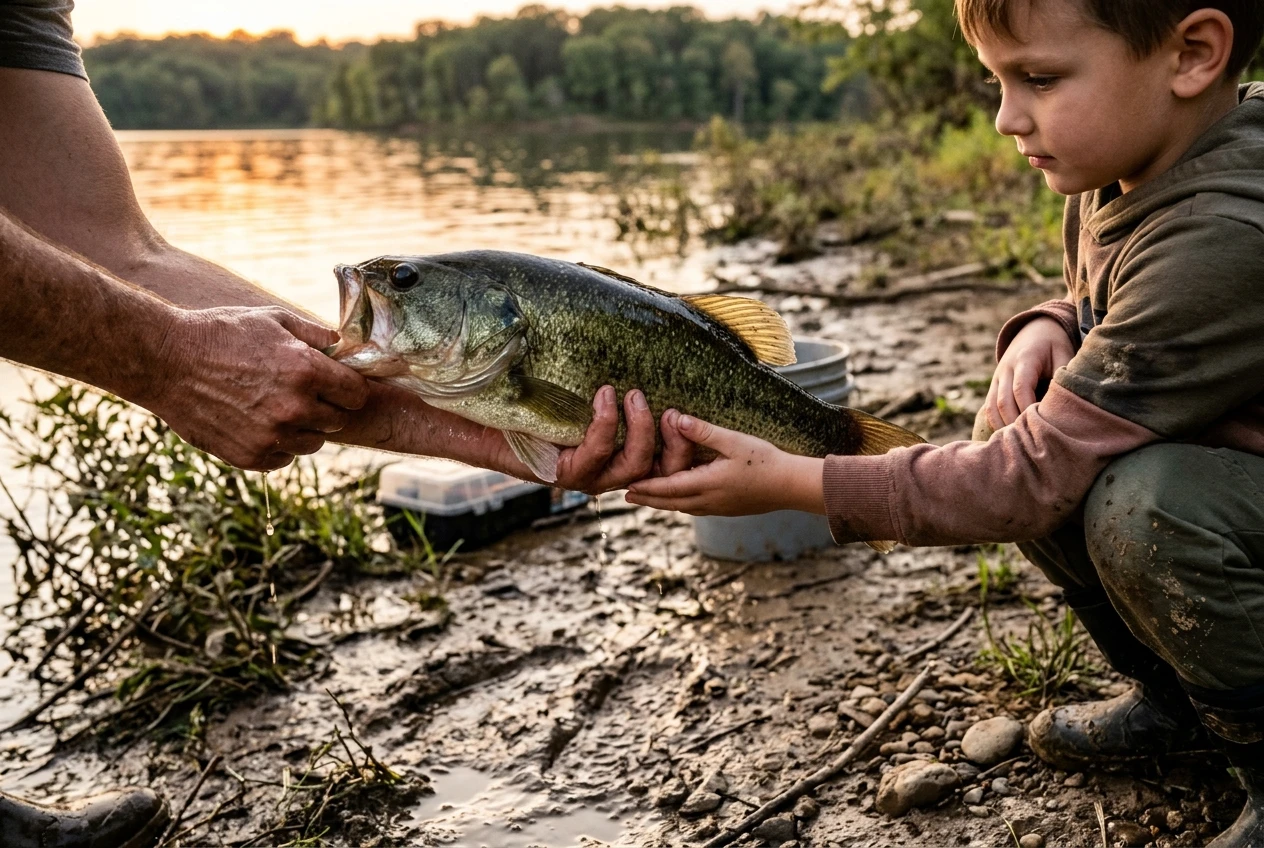
Where the child fits in. A child can place one hand under the belly while the parent holds the lip, or can steady the tail end of a smaller fish with a wet towel between the hand and the fish. That way the child is part of the hold without taking the sharp parts.
When the parent takes over:
- The fish is bigger than the child’s forearm and moving hard.
- A treble hook is involved or the hook is set deep.
- The child’s hands are dry, cold or shaking.
- The fish has flared its gill cover or spines and keeps twisting.
Taking over is not a failure. Say it ahead of time: “Big fish are my job, small fish are yours.” Children usually accept a clear rule and may feel proud when they earn the next step up.
What to Have on the Bank: A Wet Towel, Pliers or a Hook Remover, and a First-Aid Kit Within Reach
Set these three things out before the first cast so nobody has to dig for them with a fish in hand.
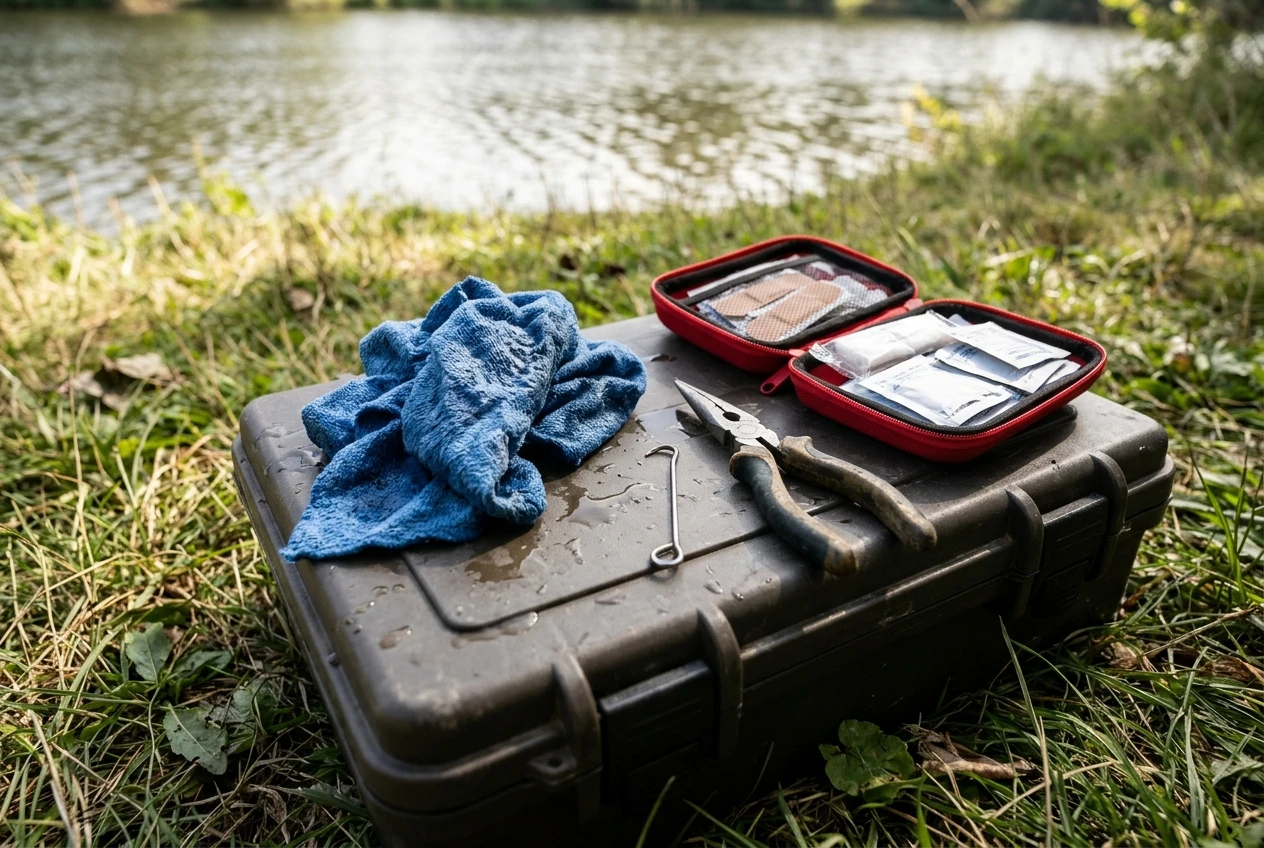
- A wet towel. It gives you a damp surface to rest the fish on and a way to calm a flapping fish. Soak it in the lake, since wet cloth is gentler on the fish than a dry one.
- Needle-nose pliers or a hook remover. These keep your fingers away from the hook and let you back it out cleanly. Pinching down the barb on the hook beforehand makes removal easier, and some anglers use barbless hooks for this reason.
- A small first-aid kit within arm’s reach, not buried at the bottom of the car. Bandages, antiseptic wipes, and a pair of clean tweezers cover most scrapes and pricks.
For a spine prick or a scrape, wash the spot with soap and clean water as soon as you can, press on it if it bleeds, and cover it. Watch it over the next few days for redness, swelling or warmth. A hook in the face or eye, or a hook buried deeper than the barb, needs a medical professional, not a pocket knife on the bank.
For a longer list of what to bring, see the bank-fishing safety gear families forget.
Check the Rules Before You Keep Anything
Identifying the fish matters most when you decide whether to keep it. Kentucky has size and daily limit rules, and they can differ by species and by water. Bluegill, largemouth bass and spotted bass are not always covered by the same rule, and individual lakes can have their own regulations on top of the statewide ones.
The place to check is the Kentucky Department of Fish and Wildlife Resources, which publishes the current fishing regulations and the rules for specific lakes on its website. Look at the current year’s version rather than an old printout, and check any signs posted at the lake. Also check whether anyone in your group needs a fishing license.
If you are unsure of the species, or the fish is near a size cutoff, release it. A fish put back in the water is never a mistake, and a wrongly kept one can be.
Before you head out, look at the fish photos and the regulation page together with your child. Spotting the difference between a largemouth and a Kentucky bass makes the rules feel like part of the game.
If you want lake-by-lake guidance for your family’s next trip, take a look at the Kentucky bank fishing ebooks and pick the one that fits your biggest question.