
Every Lake Guide · Clear-Water Bank Fishing
Clearer Water Can Make the Angler Part of the Pattern
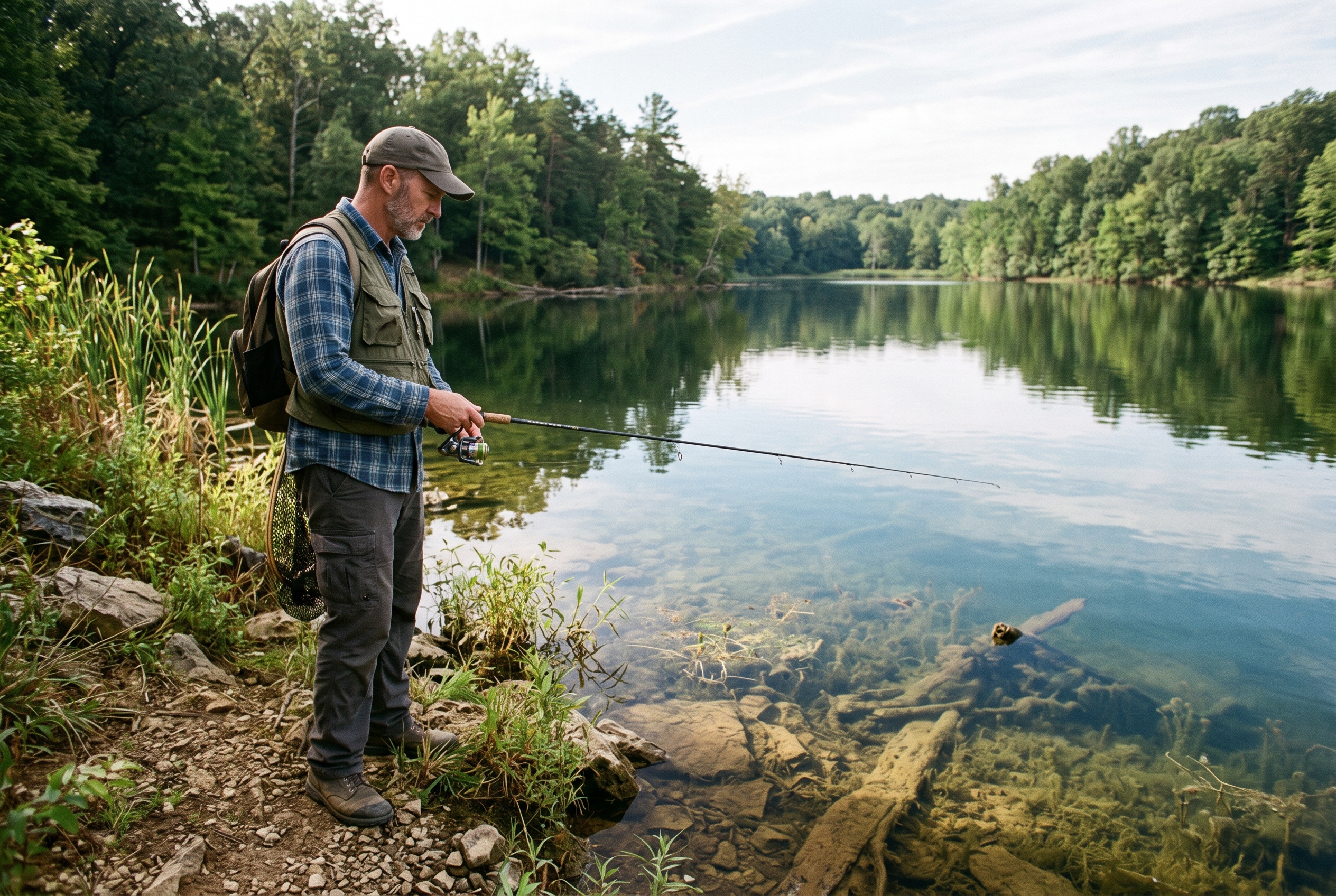
The rocks are easier to see. The weed edge looks sharper. Even the first drop seems less mysterious. But when the lake gives you a better view, fish may also have a better chance to detect shoreline movement, shadows, and splash—or respond to repeated angling pressure.
Do not begin with a smaller lure. Begin with a quieter first look.
Quick answer
Can fish see a bank angler in clear water?
Fish can detect movement and disturbance, and clearer, brighter, smoother water can make an exposed shoreline approach less forgiving. That does not mean every fish saw you, or that clear water automatically requires long casts and tiny lures. Stop several feet back, watch the closest useful water, control your shadow and footfalls, and make the first cast before walking to the edge.
Then compare one protected target—shade, vegetation, wood, rock, ripple, stain, or the first drop—with one exposed target. If the quiet approach produces follows, baitfish reactions, clean contact, or a bite, keep it. If the lake remains inactive, change angle or depth before replacing the entire presentation.
The Water Changed—But Do Not Let One Clue Make Every Decision
A familiar lake can look clearer after several dry days, lighter wind, less runoff, thinning plankton, settling sediment, or a change in sunlight and viewing angle. Sometimes the water truly cleared. Sometimes glare simply lifted and revealed what was already there.
Before changing the whole plan, compare visibility at the same kind of place. Look beside a fixed rock, dock post, ramp edge, or submerged branch. Check the sunny side and shaded side. Notice whether the bottom disappears at a different distance than it did on the last trip.
This does not require a scientific measurement. It requires a repeatable observation. The goal is to separate “I can see better from here” from “the fish are using the lake differently.”
Evidence before the first cast
Kentucky Fish and Wildlife advises anglers on small lakes and ponds that stealth matters around shallow fish: walk softly, keep low, and avoid careless shoreline disturbance. Its guidance for the clear-water Rockcastle River also recommends muted clothing and longer casts where fish may be wary. Those are useful starting points—not laws that force every cast away from the bank.
Read the official guidance for farm ponds and small lakes and the Rockcastle River.
Make Three Decisions Before You Touch the Tackle Box
Control the approach
Stop short of the water. Watch the near edge, lower your pace, and make the easiest close cast before stepping onto an exposed bank.
Choose the angle
Use a side angle, shade line, tree line, tall grass, dock edge, or ripple when it lets you reach the target without crossing the entire zone.
Protect the baseline
Keep one dependable presentation while testing distance, cover, depth, or speed. A single response should teach you what changed.
Clear, Lightly Stained, or Muddy: What Actually Changes?
Water color is not a verdict on whether fish will bite. It changes what fish, prey, and anglers can detect—and it changes how confidently you can read cover, depth, and presentation. Use the comparison below as a starting test.
| Condition | What the bank angler may notice | Best first decision | Avoid assuming |
|---|---|---|---|
| Clearer water | Visible bottom, sharper weed edges, exposed shallow fish, longer sight lines, brighter open water. | Stop back, use a quiet entry, test cover or shade, and keep casts controlled. | Every fish moved deep or every lure must be tiny. |
| Light stain | Some bottom detail remains, edges are softer, shallow cover may feel less exposed. | Follow visible transitions and place the presentation where stain meets cover, depth, wind, or food. | Color alone created a feeding area. |
| Muddy water | Short visibility, fewer visual clues, runoff plumes, floating debris, or newly hidden hazards. | Prioritize safety, nearby cover, edges, vibration or profile, and any cleaner-water boundary. | The muddiest water is automatically the best water. |
If rain caused the color change, revisit Fishing After Summer Rain. A clear-water reset is about visibility and approach; a runoff decision also has to account for current, debris, temperature, footing, and rapid water movement.
Six Ways to Stop Being the Loudest Thing on the Shoreline
1. Let the first cast happen before the last few steps
Stop where you can see the water without standing on top of it. Check the first strip of shade, grass, rock, wood, dock posts, or darker depth. If that close water offers food, cover, or a route, cast to its edge before moving forward.
This protects an opportunity many anglers erase with their approach. The lesson Are You Casting Past the Fish? shows how to inspect the nearshore edge before making another long cast.
2. Keep your shadow out of the target when practical
A low sun can throw a long shadow across shallow water. Move a few steps sideways, stand beside existing cover, or wait for the angle to change. Do not trade stable footing for a perfect shadow angle; safe access still comes first.
3. Reduce footfall without turning the trip into a whispering contest
The goal is not silence. It is avoiding unnecessary pounding, rock kicking, tackle-box dropping, and repeated trips to the water’s edge. Prepare the first rig before entering the most exposed part of the bank.
4. Use shoreline cover as part of the cast
Tall grass, a tree trunk, a dock rail, a bush line, shade, ripple, and even a steeper bank can make your outline less obvious. Stay within legal public access and never push through unstable vegetation, poison ivy, hidden holes, or restricted property for a better angle.
5. Control the entry—not just the distance
A long cast that crashes into the middle of a quiet pocket can be less useful than a shorter cast placed beside its edge. When possible, land beyond or alongside the target and bring the presentation into the zone with control. Around people, trees, and docks, accuracy and safety matter more than distance.
6. Leave one part of the water undisturbed
Do not fan-cast across every reachable angle before learning from the first one. Begin with the closest useful edge, then the outside edge or first depth change. Save a contrasting lane for the next test.
Use This 15-Minute Clear-Water Stealth Reset
The reset is designed for the moment when a familiar bank looks brighter, clearer, and less forgiving. It changes the approach before it changes the lure.
If the first depth change is difficult to identify, use Cast, Count, Compare to find the first drop-off without sonar. The point is to connect depth to a route or edge rather than cast toward an undefined middle.
Apply the L.A.K.E. Method to Clear Water
Clear water tempts anglers to stare at individual fish or individual lures. The L.A.K.E. Method pulls the decision back to the water around them.
Look Before You Cast
Check clarity, glare, shadow, wind ripple, shade, cover, baitfish, people, access, and the water nearest the bank.
Analyze Visibility
Separate what you can see from what fish may use. Identify exposed water, protected water, and the closest route between shallow and deep.
Key In on Overlap
Favor the smallest reachable zone where cover, shade, food, ripple, structure, or depth gives the fish more than one reason to stay.
Execute One Test
Make a controlled first cast, change one variable, and follow repeatable evidence instead of cycling through the tackle box.
For the complete clue-ranking system, examples, and printable field tools, explore How to Read Any Lake: A Beginner’s Fishing System.
Where Should You Cast First in Clear Water?
Clear water does not erase shallow opportunities. It makes the quality of the shallow opportunity more important.
Quiet cover close to shore
Begin beside grass, rock, wood, dock posts, a shadow edge, or a bottom transition. Cast along the feature instead of directly into its center when that keeps the presentation in useful water longer.
A shade-to-sun boundary
Shade can reduce glare and create a defined visual edge. It becomes more convincing when it also touches cover, deeper water, baitfish, or a bank shape that guides movement.
Wind ripple meeting structure
Ripple can soften the surface and move food, but do not chase texture by itself. A wind-touched point, corner, flat edge, or weed line offers a stronger test than featureless open water. Keep the Kentucky Wind & Structure Cheat Sheet available when the wind helps choose between banks.
The first reachable drop
When the shallow water looks empty and exposed, compare it with the first meaningful depth change. The target is the transition—not an arbitrary long cast.
A baitfish route, not just a baitfish cloud
When small fish are visible, watch their direction, spacing, and reactions. Larger fish may use the shade, depth, point, cover edge, or outside lane beside them. The Baitfish Are Near the Bank explains how to fish the route without repeatedly throwing into the school.
Should You Cast Farther, Fish Smaller, or Change Color?
Each can be a useful comparison. None should become an automatic clear-water rule.
- Fix the approach first. If you walked through the edge, cast your shadow across it, or made repeated splashes, a tackle change cannot restore the untouched opportunity.
- Fix the location and angle second. Put the presentation beside a useful feature before changing its size or color.
- Check one depth step third. Compare the shallow route with the outside edge or first drop.
- Then test profile, speed, or color. A compact or natural-looking presentation can be sensible in clear water, but it still needs to reach fish-holding water.
Kentucky Fish and Wildlife’s stream-fishing tips note that natural patterns can fit clearer water, while stronger contrast or vibration can help in muddier conditions. Treat that as a controlled presentation test after location—not a reason to retie after every quiet cast.
Build Clear-Water Stealth Into a Two-Hour Trip
A short trip does not need a complicated clear-water formula. Let the outing answer one useful question: Did a quieter approach improve the same reachable water, or did the fish favor a different edge?
| Time | Job | What to do | Decision |
|---|---|---|---|
| 0–10 minutes | Read before entering | Compare clarity, glare, shade, ripple, cover, activity, pressure, and two safe bank options. | Choose the bank that lets you test a protected edge without walking through it. |
| 10–40 minutes | Build a quiet baseline | Fish the near edge, outside edge, and one depth route with one dependable presentation. | Stay when the same angle produces evidence; otherwise protect one untested lane. |
| 40–70 minutes | Compare one contrast | Move from exposed to shaded, calm to rippled, flat to steeper, or bare to covered water. | Let the stronger feature—not the longer cast—win. |
| 70–100 minutes | Refine one variable | Change angle, depth, speed, or profile while holding the useful location steady. | Keep the change only when the evidence repeats. |
| 100–120 minutes | Finish with the lesson | Return to the best overlap or test one final matching feature. | Record clarity, approach, target, response, and next trip’s first test. |
For a reusable before-you-leave checklist, timed decision points, and a field-notes system, use The Two-Hour Kentucky Bank-Fishing Plan.
Planner integration
Use the Five-Box Visibility Note
Write one short phrase in each box before changing lures. This turns “the water looks clear” into a decision you can repeat.
Three Common Clear-Water Banks—and How to Test Them
The bright, shallow park cove
Stop before the mowed edge. Test the closest shadow, grass line, dock post, cove mouth, or first drop. If the cove offers no food, cover, ripple, shade, depth, or activity, let it lose quickly instead of bombarding the middle.
The shaded bank with overhanging trees
Shade improves the approach only when the cast remains safe. Watch for branches, other anglers, walkers, and hidden footing. Test the outer shade edge and any wood, rock, insects, or depth connected to it.
The clear point with wind on one side
Compare the rippled side with the protected side using the same presentation. Fish across the end or along one side rather than standing on the tip and casting randomly in every direction. A point earns more time when it joins ripple, food, cover, or a drop.
Five Clear-Water Mistakes That Erase Useful Evidence
- Walking to the lip before looking. You may disturb the exact water you needed to test first.
- Turning “stealth” into “cast as far as possible.” Distance helps only when it reaches a defined feature safely and accurately.
- Changing line, lure, color, size, speed, and depth together. One bite will not tell you which decision mattered.
- Staring only at visible fish. The better target may be the cover, shade, depth, or travel route beside them.
- Treating clear water as clean or safe water. Visibility does not confirm water quality, safe footing, legal access, or the absence of harmful algae and contamination.
Complete system
How to Read Any Lake
Rank clarity alongside food, comfort, safety, cover, depth, wind, edges, and movement before choosing the first cast.
Explore the Field GuideShort-trip planner
Two-Hour Kentucky Plan
Give observation, baseline testing, controlled adjustment, and final comparison their own place in a realistic trip.
Build the Two-Hour TripRelated lesson
Read the Nearshore Edge
Learn why the closest useful water deserves a quiet test before the first long cast crosses it.
Read the Free LessonClear Water Does Not Remove Shoreline Risk
Seeing the bottom is not the same as knowing that it is firm. Algae-coated rock, undercut banks, sudden drop-offs, fishing line, submerged wood, soft mud, and unstable riprap can remain dangerous. Stay on legal public access, keep children close, and wear an appropriate personal flotation device around steep banks, docks, current, or wading situations.
Check the current Kentucky Fishing and Boating Guide, posted site rules, licenses, seasons, size limits, daily limits, and bait restrictions before fishing. If thunder is heard, leave the bank for a substantial building or enclosed hard-topped vehicle. The National Weather Service advises waiting at least 30 minutes after the last thunder before resuming outdoor activity.
Prepare for the Fish Before a Quiet Approach Produces One
Have pliers and a wet rubberized net ready. Wet your hands, keep the fish in the water as much as practical, minimize air exposure, and remove the hook efficiently. If a fish has swallowed the hook and it cannot be removed safely, cut the line close instead of tearing it free.
The U.S. Fish and Wildlife Service’s responsible fishing guide recommends keeping fish wet, minimizing airtime, and cutting the line when a swallowed hook cannot be removed safely.
Sources and Review Note
- Kentucky Department of Fish and Wildlife Resources: Farm Ponds and Small Lakes
- Kentucky Department of Fish and Wildlife Resources: Rockcastle River
- Kentucky Department of Fish and Wildlife Resources: Stream Fishing Tips
- Kentucky Fishing and Boating Guide
- U.S. Fish and Wildlife Service: A Guide to Fishing for the First Time
- National Weather Service: Lightning Safety and Outdoor Sports
Reviewed August 27, 2026. Fishing conditions, public access, advisories, weather, and regulations can change. Verify the exact water and posted rules before each trip.
Four-question knowledge check
Can You Keep a Clear-Water Opportunity Intact?
Select one answer for each question, then check your score.
Frequently asked questions
Clear-Water Bank Fishing: Practical Answers
Are fish always harder to catch in clear water?
No. Clear water may make approach, placement, and fishing pressure more important, but it can also help you identify cover, bottom transitions, baitfish, and fish reactions. Species, season, light, wind, water temperature, depth, food, and pressure still shape the result.
Should I always use a smaller lure in clear water?
No. A smaller or more natural-looking presentation can be a useful test, but location comes first. Fix the approach, reach a defined feature, compare one depth step, and then change profile, speed, or color one variable at a time.
Should I use lighter fishing line in clear water?
Not automatically. Line choice must still match the species, cover, hook, lure, knot, and safe landing needs. If you test a lighter line, make it one controlled change and avoid going so light that fish are fought excessively or broken off around cover.
How far should I stand from the water?
There is no universal distance. Stop far enough back to inspect the near edge without stepping into the target area. The bank slope, vegetation, dock layout, other visitors, casting room, footing, and sun angle determine what is safe and practical.
Is shade always better than sunny water?
No. Shade is one visibility and comfort clue. It becomes stronger when it joins food, cover, depth, a point, vegetation, wood, rock, or fish activity. A shaded featureless bank can still lose to a sunlit bank with better structure and movement.
Does clear-looking water mean it is safe?
No. Clear-looking water can still contain contaminants, harmful microorganisms, algae toxins, submerged hazards, or unsafe depth changes. Follow official advisories, posted rules, and local access guidance. Do not drink untreated lake water.
What Gave You Away—or Helped You Stay Hidden?
Did the clearest trip of the season reward a longer cast, a quieter approach, a shaded edge, a wind ripple, or the first drop? Share the lake type, light, wind, cover, first target, and the one adjustment that changed the result. Your observation may help another bank angler approach the same condition with a reason.