
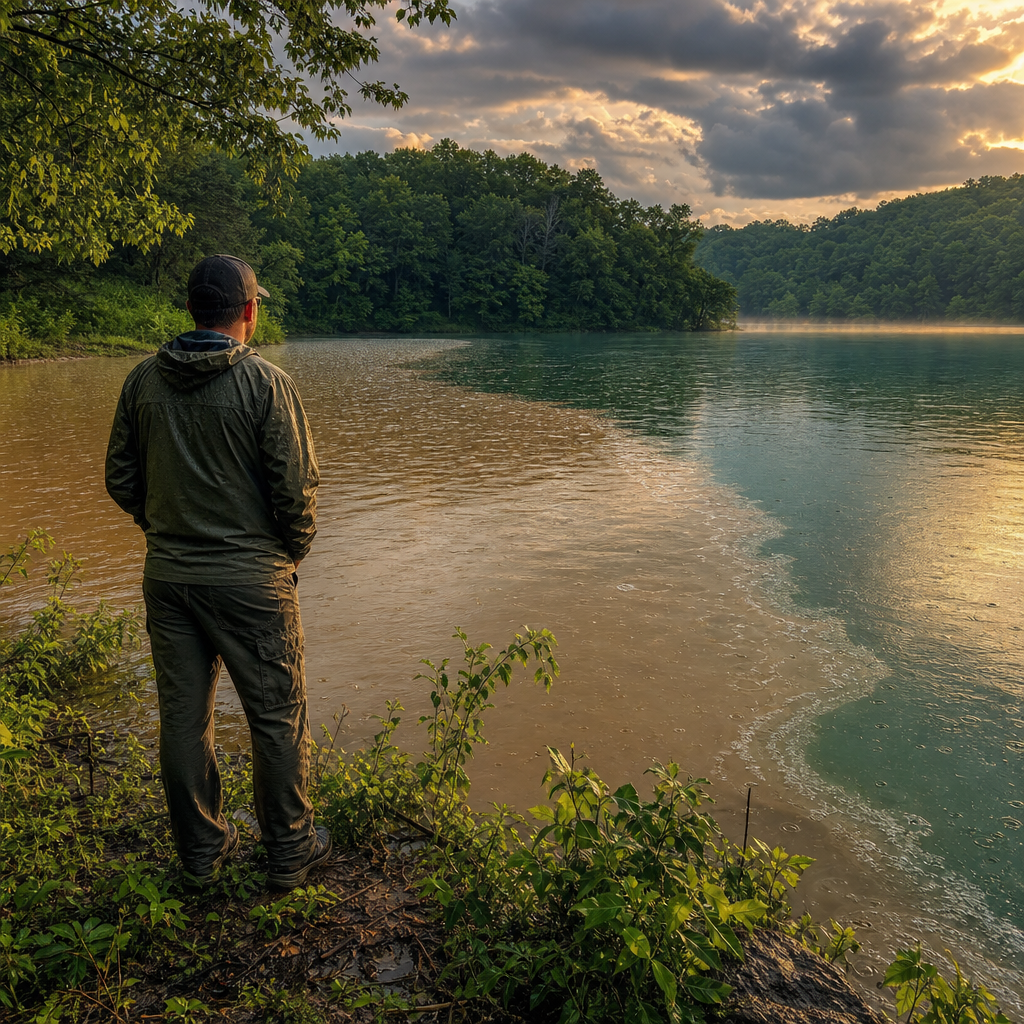
Rain can create feeding opportunities, muddy the water, cool a shallow cove, strengthen an inflow, or make the most obvious bank the wrong place to begin. The answer is not to cast everywhere. It is to read what the rain changed.
The Quick Answer
After a summer rain, begin by comparing safe inflows, drains, color seams, freshly covered shoreline, wind-blown banks, and the first nearby depth change. The strongest starting point is usually not the center of a muddy plume. It is an edge where food, cover, comfortable water, and an escape route overlap.
Light stain and gentle flow may help concentrate activity. Violent runoff, rapidly rising water, cold muddy water, floating debris, or unsafe footing are reasons to move elsewhere—or postpone the trip.
A summer storm can make a familiar lake look completely different. Yesterday’s clear pocket may be brown. A dry ditch may be moving water. Grass that sat above the shoreline may now be flooded. A quiet cove may have a visible current line running through it.
That change excites anglers for a good reason: new water can move food, create cover, reduce visibility, and give fish opportunities they did not have before the rain. But “fish the runoff” is too simple. Some runoff is useful. Some is cold, muddy, fast, debris-filled, or unsafe.
The better question is the one behind the entire Every Lake Guide approach: Why would a fish use this water now?
Before You Read: Test Your Lake-Reading Instincts
Open each question after choosing your answer. These are not trivia questions. They are the kinds of decisions bank anglers face when a storm changes the shoreline.
1. Is the center of the muddiest runoff plume always the best target?
No. The better target may be the outer edge where stained water meets clearer, calmer water and fish can move between conditions.
2. Can a small amount of stain help a bank angler?
Yes. Moderate stain can reduce visibility and help fish feel secure in shallower water, but extremely muddy water can make feeding more difficult for sight-oriented fish.
3. What matters more: the inflow itself or what surrounds it?
The surrounding combination matters more. Flow becomes more useful when it meets cover, a depth change, a quiet pocket, a current break, or a clear-to-stained transition.
4. Should you keep fishing when you can hear thunder?
No. Move immediately to a substantial building or enclosed hard-topped vehicle. Stay sheltered for at least 30 minutes after the last sound of thunder.
What Summer Rain Changes in a Lake
Rain does not create one universal fishing pattern. It changes several parts of the lake at once, and those changes may help one area while hurting another.
Water Movement
Runoff may enter through a creek, culvert, ditch, drain, or broad sheet flowing down a bank. Even mild flow can form a seam, eddy, current break, or narrow feeding lane.
Water Color
Suspended soil can turn clear water lightly stained, heavily stained, or opaque. The most useful place may be the transition—not the extreme at either end.
Temperature and Comfort
A warm rain may feel different from a cold downpour. Shallow water can change quickly, so compare the inflow with protected water, shaded water, and nearby depth instead of assuming all rain is beneficial.
Food and Fresh Cover
Runoff can wash insects, worms, organic material, and other food toward the lake. Rising water may also flood grass, roots, brush, rocks, and shoreline irregularities that were dry the day before.
One clue is rarely enough. A drain carrying lightly stained water into a shallow bowl with no cover or nearby depth may be less useful than a subtle color seam beside a laydown at the mouth of a cove.
Do not ask, “Where did the rain enter?” Ask, “Where did the rain create the best combination of food, comfort, safety, and movement?”
Use the L.A.K.E. Method After Rain
The Every Lake Guide L.A.K.E. Method keeps a changing lake from becoming a guessing game. It gives you a simple sequence without pretending that one rain pattern works everywhere.
Look Before You Cast
Check thunder, rising water, bank stability, runoff, clarity, debris, wind, cover, and visible life.
Analyze the Lake
Compare the inflow, color seam, cove mouth, first drop, flooded cover, and an unaffected bank.
Key In on Productive Water
Choose the reachable area where several useful clues overlap instead of chasing the most dramatic-looking water.
Execute a Simple Plan
Test the edge, change angle or depth, watch for feedback, and move when the evidence weakens.
The free article gives you the framework. How to Read Any Lake: A Simple Fishing System for Beginners goes deeper into ranking clues, comparing water, and building a decision you can carry to an unfamiliar lake.
Where Should a Bank Angler Cast First After Rain?
Start with the highest-quality reachable edge—not automatically the nearest inlet. The following order is a practical way to compare promising water.
The Outer Edge of a Manageable Inflow
A gentle inflow may carry food and create movement. Begin where the moving water slows, bends, or meets calmer lake water. Cast across the edge, along it, and just outside it instead of placing every cast into the strongest flow.
A Clear-to-Stained Color Seam
A visible color boundary gives fish access to two different light conditions. Predators may use the darker side for concealment while moving close enough to the clearer side to locate food. Work both sides before deciding which one matters.
Cover Beside Moving Water
A stump, laydown, rock, weed edge, dock post, or flooded grass line becomes more interesting when flow passes nearby. The cover offers a place to hold while the moving water brings opportunities within reach.
The Mouth of a Runoff-Stained Cove
The back of a cove may receive the most runoff, but the mouth often offers a better escape route and a more moderate blend of clarity, temperature, and depth. This becomes especially important when the inflow is colder or dirtier than the lake.
The First Drop or Break Outside Shallow Water
Fish that move shallow to investigate new food do not always stay there. A nearby depth change lets them slide between feeding water and more stable conditions without traveling far.
An Unaffected Bank for Comparison
Do not let dramatic runoff capture all your attention. A shaded bank, wind-blown point, dam corner, weed edge, or deeper shoreline away from the inflow may remain more comfortable and productive. Comparing two different areas protects you from forcing the rain pattern.
How Muddy Is Too Muddy?
Water color is evidence, not a verdict. The useful question is whether fish can still feed efficiently and move between the changed water and a more stable option.
| What You See | What It May Mean | Where to Begin | What to Avoid Assuming |
|---|---|---|---|
| Light stain with gentle flow | Reduced visibility, moving food, new shallow opportunity | Inflow edge, nearby cover, flooded grass, cove mouth | That every fish moved directly into the inflow |
| Distinct clear-to-stained seam | A boundary fish can patrol or cross | Cast parallel to and across both sides of the seam | That only the muddy side matters |
| Heavy opaque mud | Very limited visibility and potentially colder or harsher runoff | Outer edge, quiet pocket, nearby cover, first clearer water | That the center of the plume is automatically productive |
| Floating debris and rapidly rising water | Strong runoff and changing shoreline conditions | Choose safer, more stable water or leave | That fishing opportunity is worth unstable footing or flood risk |
| Little visible change | Rain may have affected only temperature, surface activity, or localized drains | Return to wind, shade, cover, and depth clues | That rain must create a special inflow bite |
Kentucky Fish and Wildlife’s guidance for murky or muddy farm ponds recommends small inline spinners or one-inch white or yellow curly-tail grubs near available cover. That advice points to a useful principle: in low visibility, give fish a compact target they can detect and place it close to something they can use.
Simple Presentations for Changed Water
You do not need to rebuild your tackle box after every storm. First choose the right water. Then select a presentation that fits the visibility, depth, cover, and speed of the current.
For Lightly Stained Water
Try a small spinner, paddletail, shallow crankbait, compact jig, or soft plastic that can cover water without becoming difficult to control.
For Muddy Water Near Cover
Use a compact presentation with vibration, contrast, or scent. Keep it close to wood, weeds, rock, or another target rather than racing through empty water.
For a Color Seam
Make one cast along the boundary, one from the clear side toward the stain, and one from the stained side toward clearer water. The angle may matter more than a quick lure change.
For a Quiet Pocket Beside Flow
Let the lure enter the calmer water naturally. Fish may hold out of the strongest current while watching food pass close by.
When nothing responds, change one thing at a time: casting angle, depth, retrieve speed, or distance from the edge. A disciplined adjustment teaches you more than changing the lure, location, speed, and color all at once.
What the Rain Pattern Can Mean for Common Kentucky Fish
Largemouth Bass
Bass may use stain, flooded cover, current breaks, cove mouths, and shallow-to-deep transitions. In extremely muddy water, they may hold tighter to cover or shift toward a more moderate edge.
Bluegill and Sunfish
Look for protected pockets, brush, flooded grass, dock edges, and calmer water near food washed from the bank. Repeat the same angle after one bite because several fish may be using a small target.
Channel Catfish
Rising and muddy conditions can create opportunity for channel catfish, especially around inflows, shallow feeding areas, and evening or nighttime banks. Keep safety and current strength ahead of the fishing pattern.
Stocked Trout
In a FINs lake, recent rain is only one clue. Stocking timing, water temperature, inflows, depth, pressure, and current regulations still matter. Do not assume trout will remain near the release area or move into every muddy inlet.
Turn This One Rain Pattern Into a Reusable Fishing Skill
This article helps you read one common situation. The Every Lake Guide ebooks go further by teaching the reasoning you can reuse when the weather, season, lake shape, or shoreline changes.
How to Read Any Lake
A Simple Fishing System for Beginners
Learn how to compare food, comfort, safety, edges, depth, wind, cover, and movement before choosing your first cast. It includes field-ready routines, practice examples, a lake scorecard, and printable tools.
Explore How to Read Any LakeKentucky Shore Fishing
How to Fish Coves, Flats, and Drop-Offs
Take a closer look at the shoreline features that become especially important before and after changing weather: protected coves, subtle flats, useful cover, and the first drop toward deeper water.
Explore Kentucky Shore FishingWhich guide should you choose? Start with How to Read Any Lake when you want the broad decision system. Choose Kentucky Shore Fishing when you want a more focused guide to coves, flats, cover, and drop-offs from the bank. Together, they connect the reasoning with the structure you can actually reach.
A Simple After-Rain Field Sequence
This is intentionally a starting sequence—not the complete lake-ranking system from the ebook. Its purpose is to stop random casting and help you gather useful information.
- Confirm that the trip is safe. Look for thunder, rising water, slippery slopes, unstable mud, floating debris, and blocked access before thinking about fish.
- Compare at least two different areas. Study the best inflow or color seam, then compare it with a bank that offers shade, cover, wind, or nearby depth without heavy runoff.
- Test the edge before the extreme. Begin where changed water meets more stable water. Work different angles before moving into the strongest flow or thickest mud.
- Let feedback—not excitement—choose the next move. A bite, follow, swirl, fleeing baitfish, repeated bottom contact, or visible fish is useful evidence. No response is evidence too.
- Return to the strongest explanation. Before leaving, revisit the area that best combined food, comfort, cover, and an escape route.
For a realistic short-trip framework, use the Every Lake Guide two-hour plan for busy bank anglers.
Five Mistakes That Waste an After-Rain Trip
- Fishing the drama instead of the edge. The roaring culvert looks exciting, but the quieter boundary beside it may be more usable.
- Ignoring the temperature of the runoff. A cold summer downpour can make shallow inflow water less comfortable even when it carries food.
- Standing too close before making the first cast. Fish may move into newly flooded grass or shallow stain. Approach quietly and fish close water first.
- Changing lures before changing the angle. A seam, laydown, or current break may only reveal itself when the lure travels with the edge instead of across it.
- Forcing the pattern all day. Rain does not erase shade, wind, cover, depth, fishing pressure, or seasonal movement. Keep comparing.
The Storm Is Never Worth the Cast
If you hear thunder, leave the water immediately. The National Weather Service and NOAA advise moving to a substantial building or an enclosed, metal-topped vehicle and staying sheltered for at least 30 minutes after the last sound of thunder.
After heavy rain, also watch for fast-rising water, soft banks, slick clay, damaged trails, submerged holes, floating debris, and strong current near spillways or culverts. A picnic shelter, open pavilion, tent, or isolated tree is not adequate lightning protection.
Before keeping fish, confirm the current license requirements, waterbody rules, size limits, daily limits, bait restrictions, and posted access rules. Conditions and regulations can change.
Frequently Asked Questions About Fishing After Rain
Is fishing better immediately after rain?
It can be, but the answer depends on water temperature, runoff strength, clarity, season, species, and how quickly the lake changes. A mild rain that creates light stain and gentle flow may help. A cold, violent storm that produces opaque mud and rapidly rising water may make fishing harder or unsafe.
Should I fish where a creek enters the lake?
A creek mouth can be productive when the flow is manageable and the area includes a seam, cover, depth, or a quiet pocket. Do not assume the center of the strongest current is best. Compare the edge and nearby stable water.
What color lure works in muddy water?
Contrast, vibration, scent, and accurate placement may matter more than choosing one universal color. Kentucky Fish and Wildlife suggests small inline spinners or one-inch white or yellow curly-tail grubs near cover in murky to muddy farm ponds. Use that as a starting point, then adjust to the fish and water in front of you.
Where do bass go after heavy rain?
Bass may move toward inflows, flooded cover, stain, current breaks, or shallow feeding areas, but they may also hold at a cove mouth, first drop, or clearer edge when the runoff is too cold, muddy, or strong. The best answer comes from comparing conditions rather than assuming one destination.
Is muddy water good for catfish?
Rising and muddy conditions can create good channel catfish opportunities, particularly around food-moving inflows and shallow feeding areas. Kentucky’s 2026 fishing forecast includes waters where channel catfish fishing is described as strong at night or when water is rising and muddy. Lake-specific conditions still matter.
How long should I wait after a thunderstorm before fishing?
Wait at least 30 minutes after the last sound of thunder before returning outdoors. Do not return merely because the rain has stopped.
Make the First Cast for a Reason
Rain gives you new clues, not a guarantee. Learn how to compare those clues, shrink unfamiliar water into a few sensible choices, and spend more of your trip fishing where the lake gives you a reason to stay.
Continue Learning
Helpful Official Sources
- Kentucky Department of Fish & Wildlife Resources: Farm Ponds and Small Lakes
- Kentucky Fish & Wildlife: Farm Pond Management and Muddy Water
- Kentucky Fish & Wildlife: 2026 Fishing Forecast and Tips
- NOAA: Lightning Safety
- National Weather Service: Lightning Safety Overview
Fishing reminder: Weather, access, water levels, fish behavior, stocking schedules, and regulations can change. Check current official information and posted signs before every trip. Never enter private property without permission.