
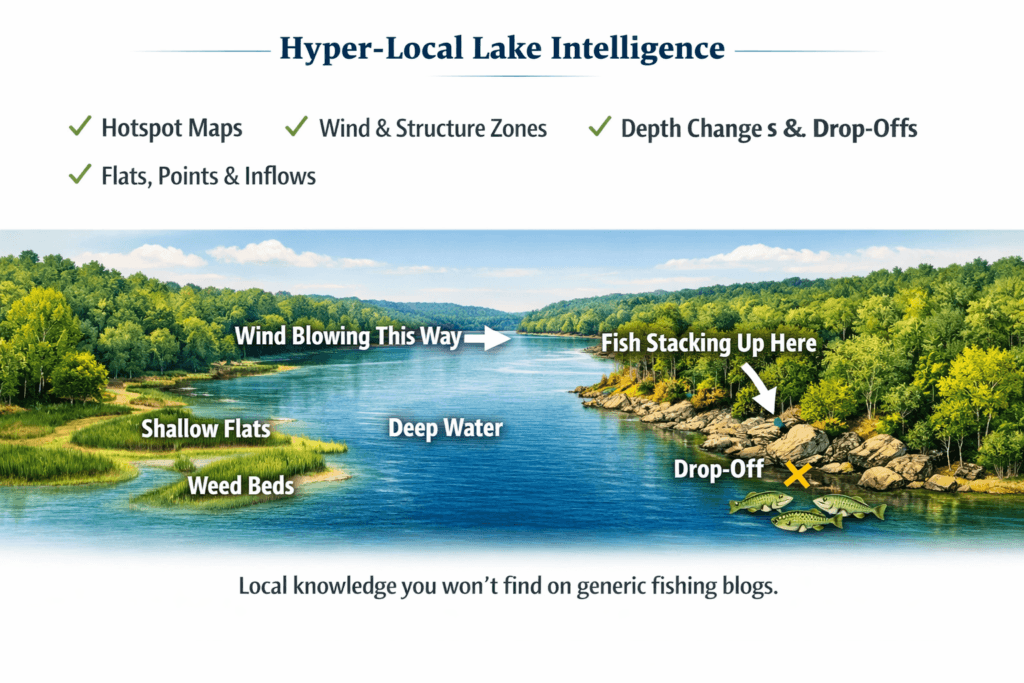
Early spring can make a small Kentucky lake feel unpredictable. The water may look quiet, but a protected cove, subtle flat, or nearby drop-off can reveal where fish are most likely to move next.
Start With the Lake, Not the Lure.
Early spring has a way of pulling anglers toward Kentucky’s biggest reservoirs. Those waters can be exciting, but they can also be difficult to read from the bank when much of the main lake is still cold.
That is why I often prefer smaller lakes, community fishing waters, and farm ponds when the season is just beginning. Their protected shallows may respond more quickly to a mild stretch of weather, and a bank angler can compare several promising features without needing a boat or electronics.
But smaller water does not automatically mean easier fishing. A random cast into a pond is still a random cast. Your odds improve when you understand why fish might use one cove, flat, or depth change while ignoring another.
Four Questions to Ask Before Your First Cast
When you reach the water, resist the urge to open the tackle box immediately. Give the lake a few quiet minutes first.
These questions do not tell you exactly where every fish is located. They do something more useful: they help you eliminate water that gives fish fewer reasons to stay.
For a wider introduction to Kentucky waters, species, and regulations, begin with the Every Lake Guide Kentucky Fishing Guide.
Why Smaller Kentucky Waters Can Shine in Early Spring
Small lakes and ponds do not warm evenly. A protected pocket with a darker bottom may respond differently from an exposed bank only a short distance away. A few mild days may pull fish closer to shallow cover, while a cold night or sharp front may send them toward the first nearby depth change.
Rain can change the picture too. Mild runoff may add color, food, and movement to a cove. A heavy dose of cold runoff can have the opposite effect.
The key is to notice the trend, not merely the air temperature when you arrive. One warm afternoon does not erase several cold nights. Stable conditions often matter more than a brief spike in warmth.
A Preview of the Every Lake Guide L.A.K.E. Method
The L.A.K.E. Method provides a simple framework for turning observations into a fishing decision. This article introduces the framework; the complete ebook goes deeper into how to rank clues when the lake gives you mixed signals.
Observe wind, water color, visible cover, shade, baitfish, runoff, and signs of feeding activity.
Identify the coves, flats, points, depth changes, inflows, vegetation, and other fish-holding features you can reach.
Narrow the shoreline to the small areas offering the strongest combination of useful clues.
Test the best-looking water deliberately, learn from the response, and move when the evidence tells you to move.
That is the basic framework. The real skill comes from knowing which clue should carry the most weight on a particular day.
Three Early-Spring Features Worth Understanding
A cove is a protected pocket extending away from a lake’s main body. Its back, sides, and mouth can offer different combinations of warmth, runoff, cover, and depth.
Useful clue: A cove becomes more interesting when shallow feeding water sits close to a deeper escape route.
A flat is a broad area where depth changes gradually. It may look featureless until you notice one weed clump, stump, dark patch, drain, or change in bottom material.
Useful clue: Fish often relate to the one thing that makes part of a flat different from everything around it.
A drop-off is a transition from shallow water toward greater depth. It may be a sharp ledge or a gradual slope that is difficult to see from shore.
Useful clue: The first depth change near a feeding area can become especially important when conditions cool or fish become cautious.
How to Read a Cove Without Fishing Every Inch
Do not assume the back of every cove is automatically the best place to begin. Read the cove in sections.
The Back
The back deserves attention when it contains mild runoff, flooded grass, brush, a darker bottom, slightly stained water, or visible baitfish activity. Approach quietly because fish in very shallow water can be sensitive to footsteps, shadows, and sudden movement.
The Sides
One side may receive more sun, hold better cover, or catch the useful part of the wind. Parallel casts can keep a lure in the same depth zone longer, but the larger lesson is to search for something different—one laydown, rock, weed edge, or shaded pocket.
The Mouth
The mouth connects shallow water to the lake’s deeper basin. It can become important after a cold night or front because fish can adjust their depth without abandoning the area completely.
This does not mean you should mechanically fish all three sections in the same order every time. The conditions should determine where you begin.
How to Recognize a Productive Flat
A flat is rarely productive simply because it is shallow. The better question is whether part of that flat gives fish a reason to stop, feed, or travel through it.
Look for a narrow drain, isolated cover, scattered stone, flooded vegetation, a darker patch, a subtle depression, or an outer edge leading toward deeper water. Those small differences can be more valuable than the flat’s total size.
A moving presentation can help you search open water, but slow down when you contact vegetation, wood, rock, or another change. A bite is not the only useful response. A follow, tap, swirl, fleeing baitfish, or repeated contact with cover can help you refine the next cast.
Finding a Drop-Off Without Electronics
The shape of the shoreline often hints at what continues below the surface. A steep bank, dam face, bluff, or rocky edge may indicate nearby depth. A consistent vegetation line can also reveal where the bottom falls beyond the plants’ preferred growing depth.
You can learn more by fan-casting a bottom-contact lure and comparing how long it takes to reach bottom. A sudden increase in fall time may indicate deeper water. Changes in bottom feel can reveal rock, mud, gravel, vegetation, or wood.
The goal is not to build a perfect underwater map. It is to discover whether fish can move from a shallow feeding area to more comfortable water without traveling far.
Knowing the Features Is Only the Beginning
Recognizing a cove, flat, or drop-off is helpful. The harder part is deciding which feature matters most on the day you fish.
Should you choose the sunniest bank or the windblown bank? Should you begin shallow after a warm afternoon, or stay closer to the first drop because the previous night was cold?
Those decisions are where lake reading becomes a system rather than a collection of isolated tips. The strongest clue can change with season, recent weather, water clarity, available cover, access, and the species you are targeting.
Learn the Complete “How to Read Any Lake” System
This article introduces the structural clues. The ebook shows you how to combine them, rank conflicting evidence, and build a repeatable plan at unfamiliar water.
- Original lake-reading illustrations
- Season and weather adjustments
- Practice-lake examples
- A lake scorecard
- Printable worksheets
- The complete two-hour field plan
- Common beginner traps
- Bank-ready reference tools
What These Features Can Mean for Common Kentucky Fish
Largemouth Bass
Early-spring bass may use shallow cover during favorable warming periods while keeping a quick path to deeper water. A cove mouth, flat edge, or isolated laydown near depth can be more useful than a long stretch of empty bank.
Bluegill
Bluegill may gather around brush, vegetation, protected pockets, dock shade, and subtle depressions. When one fish bites, repeat the same angle before leaving; nearby fish may be using the same small feature.
Channel Catfish
During a suitable warming trend, channel catfish may explore shallow flats, stained coves, runoff edges, flooded grass, and the first deeper water beyond a feeding area.
These are starting clues, not promises. The lake still gets the final vote.
A Useful Short-Trip Strategy—Without Fishing the Whole Lake
A focused shore trip does not require racing from one end of the lake to the other. It requires a clear sequence.
- Observe first. Compare wind, sunlight, water color, cover, access, and visible activity before choosing a spot.
- Test the strongest shallow clue. Begin where several advantages overlap instead of selecting a bank for only one reason.
- Check the nearby transition. If shallow water is quiet, investigate the first useful depth change or cover edge.
- Return to the best evidence. Revisit the area that produced a bite, follow, tap, swirl, visible fish, or other meaningful response.
The complete timing, adjustment rules, printable field card, and trip-review process belong in the ebook. For more free guidance on planning realistic outings, read the guide for busy Kentucky bank anglers.
Kentucky Access, Licensing, and Special Regulations
A shoreline that is visible from the road is not automatically open to public fishing. Use recognized public access, respect posted restrictions, and never cross private property without permission.
The Kentucky Department of Fish and Wildlife Resources maintains an online Fishing and Boating Access Guide. You can also explore our beginner-friendly overview of where to fish in Kentucky.
Waterbody-specific rules matter too. Kentucky’s Fishing in Neighborhoods lakes use special limits and bait restrictions; for example, possession or use of live shad is prohibited at FINs lakes. Learn more about the program in The History and Formation of FIN Lakes in Kentucky, and verify current regulations through Kentucky Fish and Wildlife before your trip.
- Check current Kentucky license information →
- Check current FINs regulations →
- Review statewide size and daily limits →
A Quick Fish-Friendly Release Reminder
Good handling protects the fishery that made your trip possible.
- Wet your hands before touching a fish you plan to release.
- Keep the fish close to the water.
- Use pliers or forceps to remove hooks efficiently.
- Avoid placing fish on dry grass, gravel, or pavement.
- Consider barbless hooks or crimping the barb.
- Support larger fish horizontally.
- Release the fish gently when it can swim away.
- Pack out line, bait containers, and other trash.
Common Questions About Early-Spring Shore Structure
Which side of a small lake should I fish first?
Begin with the accessible bank offering the best combination of recent warmth, wind, cover, food, and nearby depth. Do not select a bank because of sunlight or wind alone when another area combines several stronger clues.
Should I begin at the back or mouth of a cove?
The back can be appealing when it holds mild runoff, flooded vegetation, baitfish, stained water, or a darker bottom. The mouth may be stronger after cold weather or when fish need quick access to deeper water. Read the conditions before choosing.
How can I recognize a drop-off from shore?
Look for a steep bank, bluff, dam face, vegetation edge, water-color change, or a noticeable difference in how long a lure takes to reach bottom. Several clues together are more reliable than one visual cue.
What does the 80/20 rule mean in fishing?
It is a rule of thumb suggesting that much of the useful fish activity may be concentrated in a relatively small portion of the available water. The exact percentage is not important. The practical lesson is to spend more time where food, comfort, cover, depth, and movement routes overlap.
How long should I stay in an unproductive spot?
There is no universal time limit. Change your casting angle, depth, or presentation and look for any response. When an area provides no bites, follows, taps, visible fish, bait activity, or useful information, move to the next high-percentage target.
Read the Water Before Choosing the Lure
Early-spring shore fishing does not have to mean guessing along a featureless bank. Compare protected coves, shallow flats, isolated cover, wind direction, and the first nearby drop-off. Then choose the small area giving fish the strongest reason to be there.
You may arrive expecting shallow bass and find active bluegill instead. You may begin in the back of a cove and discover that every useful clue is closer to its mouth. You may learn that a windblown bank matters more than the warm-looking bank that day.
Those observations are not distractions from the plan. They are the plan.
Regulation note: Fishing rules can change by year, waterbody, species, and method. Always confirm current Kentucky regulations and site-specific restrictions before fishing.