
Every Lake Guide Beginner Series
How to Read Any Lake Before You Make the First Cast
Stop treating an unfamiliar lake like one giant mystery. Learn how to narrow it to a few promising areas by reading edges, wind, cover, depth, food, comfort, and fish movement.
Any Lake
How do you read a lake for fishing? Find the clearest transition or edge, check how wind and water are moving, identify nearby cover or depth, look for food activity, and compare that area with at least one alternative before casting. The best starting water usually satisfies more than one need at the same time.
The Question That Changes Fishing
Most beginners ask where the fish are. Lake readers ask why fish would use that water.
No, you do not literally need this ebook to survive. But it can become the guide you wish you had before making hundreds of hopeful casts at water that never gave you a good reason to fish it.
Beginning anglers are often handed answers: fish this dock, throw this lure, stand on this bank, or use this color. Those instructions may work for a day. They become fragile when the wind changes, the sun climbs, the water level moves, the season turns, or you visit another lake.
A more durable skill is learning how to build your own answer.
When you notice food, comfort, safety, movement routes, and edges, a lake stops looking like one enormous sheet of water. It becomes a set of smaller choices. That is the beginning of aquatic intuition: not magic, but pattern recognition built through observation, reasoned casts, and honest feedback from the fish.
The Golden Rule, Refined
Fish often favor the best available return
The memorable picture is a predator beside a comfortable chair, a snack table, and a nearby doorway. The more accurate principle is efficiency.
Gain food
Current, wind, vegetation, cover, or structure can bring prey within reach or concentrate it along a route.
Manage effort
A fish may hold beside a current break, weed edge, dock post, or depth change instead of chasing every meal across open water.
Keep an escape option
Cover, stain, shade, depth, or a travel route can make feeding water more useful because retreat is close.
Keep the model honest: Species, season, forage, spawning behavior, water quality, recent weather, and fishing pressure can change the answer. Lake reading improves your decision; it does not make fish perfectly predictable.
The Three Pillars of Location
Comfort, safety, and food narrow the lake
The strongest-looking areas often bring several fish needs together. Movement routes connect those areas and let fish adjust as conditions change.
Comfort: the living room
Temperature, dissolved oxygen, light, clarity, current, and depth affect whether an area is usable. Shade, inflows, or depth may help in hot weather, but deeper water is not automatically better because some lakes lose oxygen below the productive zone.
Safety: the fortress
Safety can mean weeds, wood, rocks, docks, shade, stained water, depth, or quick access to refuge. Cover is the physical material. Structure is the shape of the lake bottom.
Food: the kitchen
Look for baitfish, insects, crayfish, larvae, worms, or other forage. Wind and moving water can influence food and activity, but a windward shore is evidence—not an automatic command.
The overlap is the target. A shaded weed edge beside a drop-off may combine food, protection, comfortable light, and immediate access to deeper water. That combination is more meaningful than any clue by itself.
The Edge Principle
Life often concentrates where one condition changes into another
Do not look only at the weed bed, dock, point, or drop-off. Look at the boundary a fish can follow, patrol, hide beside, or use as a feeding lane.
The best edge may contain an even smaller difference: a gap in the grass, one dock post, a bend in the break, an isolated rock, a patch of hard bottom, or a branch reaching deeper water. That edge within the edge can turn a general target into a precise cast.
A Field Lesson From Kevin
Short fishing windows made observation more valuable, not less
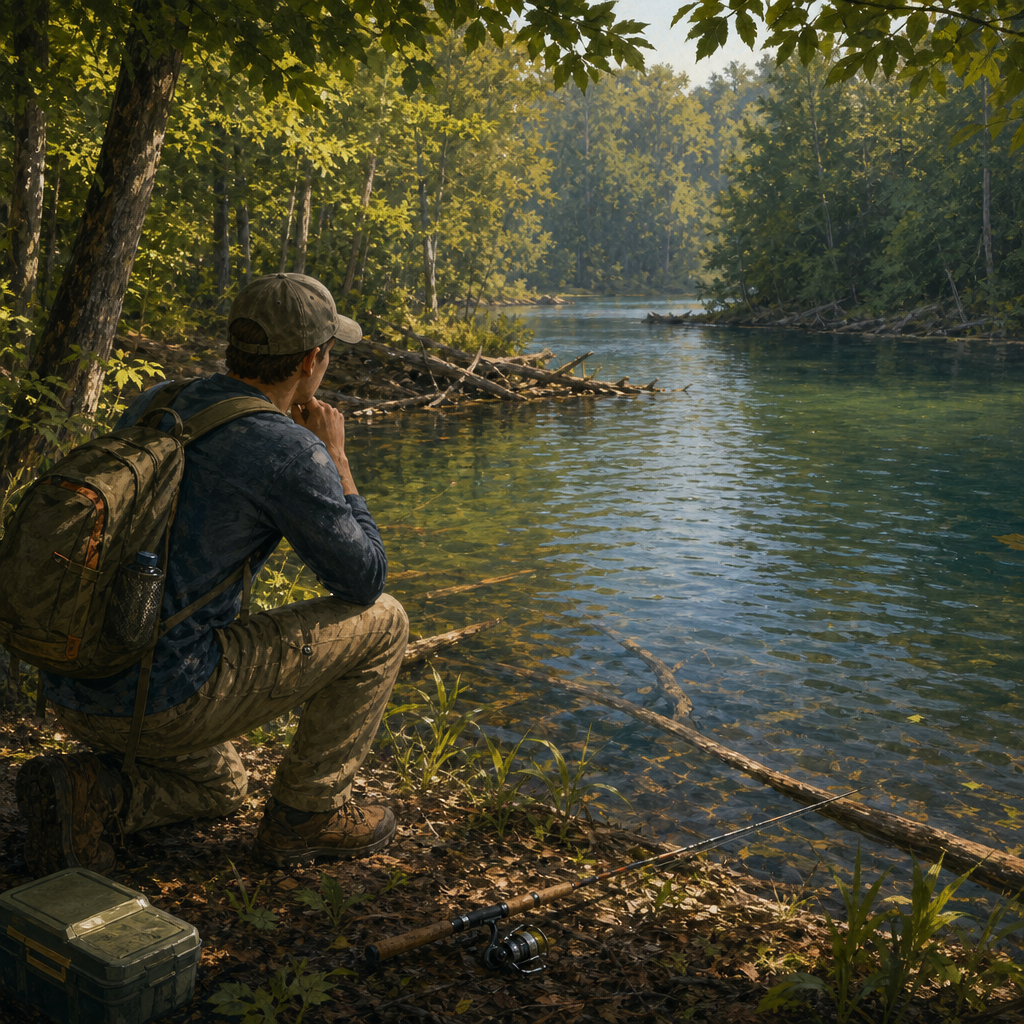
When fishing had to fit between work, family, and limited breaks, spending the first few minutes looking at the lake felt expensive. In practice, those minutes prevented far more time from being wasted on convenient but unconvincing water.
The lesson was simple: a short trip needs a better first decision. Watch first, compare two areas, then begin with the water that has the strongest explanation.
This same approach shapes the Every Lake Guide plan for busy bank anglers: use observation to protect the limited time you actually have.
From Understanding to Action
Use the L.A.K.E. Method to turn clues into a fishing plan
The ebook explains why fish may use certain water. The Every Lake Guide L.A.K.E. Method helps you act on those observations without turning a simple trip into a complicated project.
Look Before You Cast
Observe wind, clarity, cover, shade, baitfish, and visible activity.Analyze the Lake
Compare points, coves, flats, breaks, channels, inflows, and edges.Key In on Productive Water
Narrow the lake to the accessible water with the strongest explanation.Execute a Simple Plan
Test angles and depths, then move when the evidence does not support your choice.Inside the Ebook
A field guide that teaches the reasoning, not merely the answer
How to Read Any Lake is built for beginners, families, and bank anglers who want a reusable skill they can carry to unfamiliar water.
- A 60-second lake read for the moment you arrive
- A refined explanation of the law of least effort
- The comfort, safety, food, and movement framework
- Plain-English cover versus structure guidance
- The Edge Principle and edge-within-the-edge strategy
- Points, inlets, first breaks, flats, channels, and humps
- A map-free system using shoreline and cast-based clues
- Bright-day, cloudy-day, windy-day, and seasonal adjustments
- A ten-minute scouting routine
- An aquatic-intuition scorecard for comparing water
- Practice-lake examples that show the reasoning in action
- A printable field card and post-trip pattern builder
The guide does not promise that every intelligent-looking spot will hold active fish. It teaches you to choose water for a reason, test the idea, learn from the result, and improve the next decision.
Try This at Your Next Lake
Finish one sentence before you cast
A strong answer combines clues: “because the wind is moving food toward a rocky point with nearby depth,” or “because the shade line meets the outside weed edge beside the first drop-off.”
No explanation? Keep looking for another minute.
Continue Learning
Build the foundation around the ebook
Frequently Asked Questions
How to read a lake for fishing
What should a beginner look for first at a lake?
Start with the most obvious edge. Then check wind and visible water movement, nearby cover, access to depth, and signs of food such as baitfish, insects, birds, or surface disturbances. Compare at least two accessible areas before choosing the first spot.
Is the windy side of a lake always the best side?
No. Wind can move surface water, food, and activity, and it can reduce visibility in shallow water. It is still only one clue. Mud, unsafe waves, temperature, spawning behavior, access, or species preference can make another area better.
What is the difference between cover and structure?
Cover is physical material such as weeds, wood, docks, brush, or rocks. Structure is the shape of the lake bottom, including points, flats, channels, humps, ledges, and drop-offs. A location becomes especially interesting when useful cover sits on useful structure.
Can I read a lake without electronics or a contour map?
Yes. Shoreline slope, land points, creek valleys, water-color changes, wave lines, vegetation, lure sink time, and changes in bottom feel can all support a useful hypothesis. Maps and electronics add information, but careful observation and casts can teach a great deal.
Does reading a lake guarantee that I will catch fish?
No honest system can guarantee a catch. Reading the lake improves decision quality by helping you spend more time in water that offers a stronger combination of food, comfort, safety, edges, and movement routes.
Your Next Cast Should Have a Reason
Learn how to shrink a big lake into a few decisions that make sense
Open the tackle box after you have watched the wind, found the edge, identified safety, considered comfort, and traced a movement route. Then make the first cast for a reason.