
Every Lake Guide · Late-Summer Bank-Fishing Strategy
The Shallow Brush Went Quiet. The Crappie May Still Be Reachable.
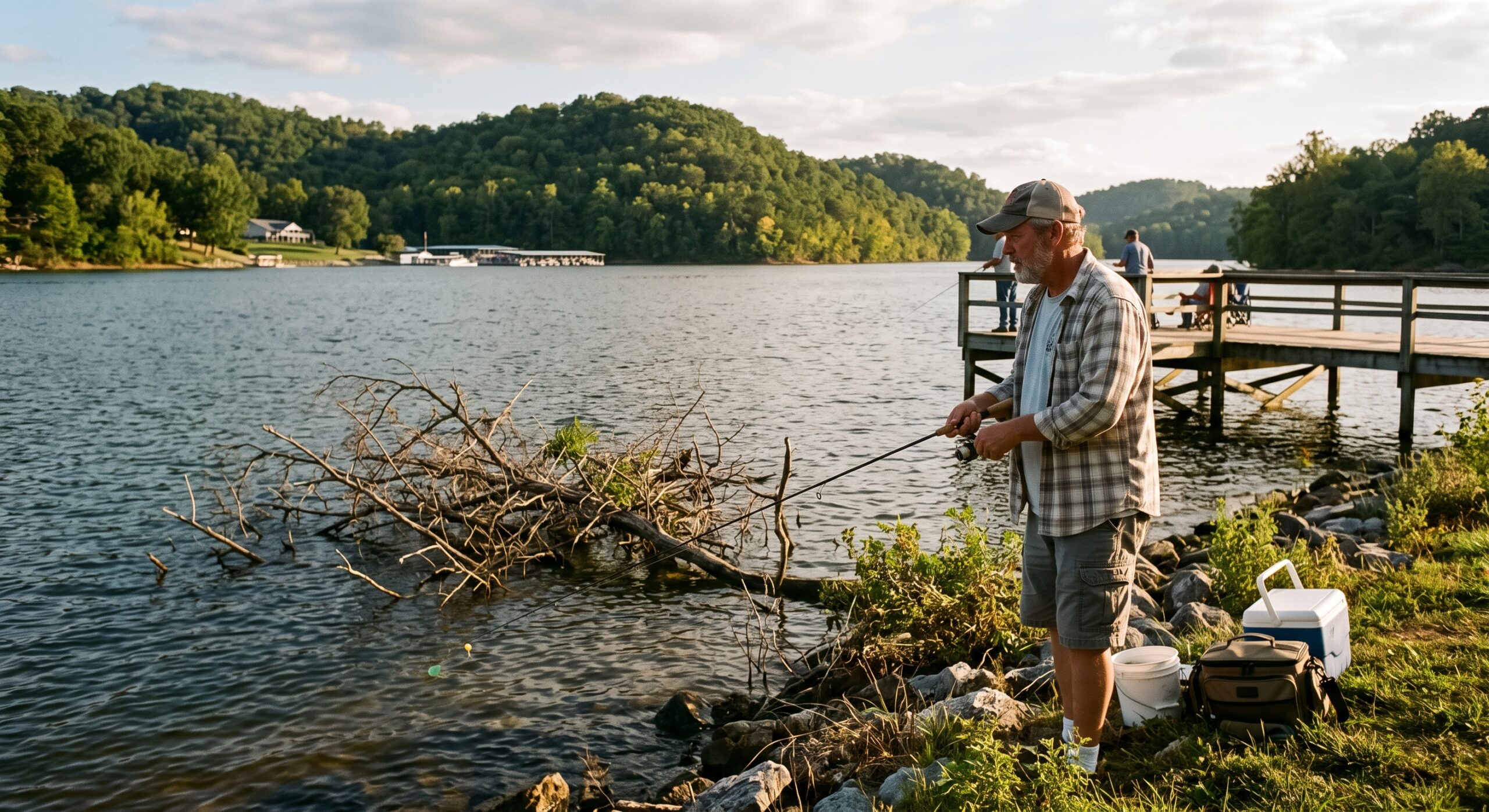
In spring, crappie can make bank fishing feel wonderfully simple. A shaded laydown, flooded bush, dock corner, or shallow pocket may put fish within one easy cast. By late summer, that same cover can look empty.
Do not assume the crappie vanished—or that every fish moved to water only a boat can reach. The better question is whether your public bank access still connects with the depth, vertical cover, shade, and travel routes crappie are using now.
Quick answer
Can You Catch Late-Summer Crappie From the Bank?
Yes—when the bank gives you access to the kind of water crappie can use after the obvious shallow bite fades. Start with a public fishing pier, dock edge, bridge piling, steep bank, cove mouth, point, or marked fish attractor that connects reachable cover with deeper water.
Fish above and beside brush or vertical cover before dragging through it. Compare depths with a slip float, counted jig, or controlled vertical presentation. If every promising feature lies beyond casting range, the honest answer may be that another access point—or another lake—is the better bank-fishing choice that day.
Late-summer crappie bank fishing is mainly a reachability problem. The fish may still relate to brush, timber, rock ledges, docks, or other cover, but the useful section can be deeper, more vertical, or farther from the easy spring shoreline.
The Kentucky Department of Fish and Wildlife Resources describes white crappie as a species associated with brush piles, standing timber, rock ledges, and other cover. Nearby state-agency guidance also describes summer crappie holding around deeper brush and standing timber, often suspended instead of resting on the bottom. Those are search clues—not a fixed depth rule for every Kentucky lake.
Quick comparison
Which Bank Deserves the First Crappie Cast?
| What you can reach | Why it may help | Best first test | Do not assume |
|---|---|---|---|
| Fishing pier or dock over deeper water | Vertical posts, shade, and depth can meet in one compact zone. | Lower a small presentation beside the outside posts and change depth in measured steps. | Every dock holds fish or permits fishing. |
| Steep bank, bluff, or riprap beside depth | Deeper water may lie close enough for a controlled bank cast. | Count the lure down and work parallel to the break or rock change. | The deepest cast is automatically the best one. |
| Brush, timber, or a fish attractor within range | Crappie commonly associate with woody and vertical cover. | Begin above and outside the cover, then tighten the path carefully. | You must bury the hook in the brush to get a bite. |
| Cove mouth or point touching the first drop | It can connect shallow feeding water with a deeper route. | Cross the depth change, note the fall time, and repeat the most useful angle. | All crappie are in the back of the cove. |
| Wide, shallow, featureless bank | It may still show baitfish or low-light activity, but offers little to narrow the search. | Give visible life one short test, then compare a bank with cover or depth. | Longer casts will create structure that is not there. |
Bank-access infographic
The Late-Summer Crappie Reachability Ladder
Rank access before changing lures. Start with the feature that lets a shore angler control depth beside cover.
Start with access, not optimism
Five Places Bank Anglers Can Still Reach Late-Summer Crappie
Use the vertical edge
A pier can put you over water that an ordinary shoreline cast cannot reach. Outside posts, shade boundaries, dock corners, and the deeper end deserve measured depth tests.
Confirm that fishing is allowed. Keep hooks clear of people, boats, cables, private slips, and swimming areas.
Let close depth replace casting distance
A safe steep shoreline, rock face, or riprap change may place the first break near your feet. Stand back and make the close cast before walking onto the edge. The nearshore-edge guide explains how to protect that first water before casting farther.
If clear water makes your approach obvious, use the quiet positioning routine in The Water Turned Clear—Can the Fish See You Before You Cast?
Fish around the cover before entering it
Begin above the top, beside the outside branches, and along the cleanest lane. Crappie may suspend beside cover, so a lure dragged underneath them can miss the useful level and collect snags.
Kentucky Fish and Wildlife maintains a partial list of lakes with fish attractors. Use the maps as planning clues, then confirm legal access and real casting range.
Cross the route instead of casting at open water
A point or cove mouth becomes more useful when brush, rock, shade, baitfish, or a first drop strengthens it. Cast across the depth change and track how long the lure falls before each retrieve.
If the break is not visible, use the Cast, Count, Compare method for finding the first drop-off without sonar.
Bank-angler reality: A productive crappie lake can still be a poor shore-fishing choice if its summer cover and depth lie beyond public casting access. Use Where to Fish in Kentucky to choose an exact access area—not merely a famous lake name.
Answer a depth question
Use a Presentation You Can Measure
The most useful crappie presentation is not automatically the one with the most color, flash, or action. It is the one that lets you repeat a depth and path after a bite, tap, follow, or missed strike.
| Presentation | What it helps you test | Simple adjustment | Common mistake |
|---|---|---|---|
| Small jig beneath a slip float | A repeatable level above brush, beside posts, or along a drop. | Change float depth in small steps. | Setting it so deep that the jig hangs inside cover. |
| Legal live minnow beneath a float | A controlled natural-bait position near cover. | Move the bait above, beside, then just outside the feature. | Assuming live bait can overcome a poor location. |
| Counted jig retrieve | Different levels through open lanes, steep banks, and cove mouths. | Count the fall before starting the same slow retrieve. | Changing weight, count, speed, and angle at the same time. |
| Vertical jig beside a public pier | Precise depth along posts or directly beneath approved access. | Lower in short increments and hold above visible cover. | Dropping blindly into cables, brush, or restricted areas. |
Use the Count–Hold–Repeat test
- Count: Track the lure’s fall or set the float to a known depth.
- Hold: Keep the presentation beside or above the feature long enough to test it.
- Repeat: After useful feedback, reproduce the same depth, angle, and position before changing anything.
One crappie can reveal a small school. Treat the response as a coordinate. Note the depth, cover edge, light level, cast angle, and whether the fish was above, beside, or away from the feature.
Every Lake Guide framework
Apply the L.A.K.E. Method to Summer Crappie
Notice legal access, shade, water clarity, baitfish, docks, bridge edges, timber, steep banks, and safe casting room.
Connect cover to the first drop, a channel edge, cove mouth, point, or deeper section that remains within range.
Choose the smallest reachable zone where cover, usable depth, food, shade, and a travel route overlap.
Test above and beside cover, compare depths, repeat feedback, and move when your bank no longer reaches the pattern.
For the complete clue-ranking system, practice examples, lake scorecard, and printable worksheets, explore the How to Read Any Lake ebook. When the difficult part is tracing points, coves, flats, and drops from shore, use the Kentucky Shore Fishing ebook.
Planner integration
A Two-Hour Late-Summer Crappie Plan
Do not spend the entire trip proving that one shallow brush pile is empty. Give each phase a question and let the answer guide the next move.
Two Hours · Five Decisions
Trip-note prompt: “The most reachable cover was __________ at __________. My best response came __________ the cover after a count or float depth of __________.”
The Two-Hour Kentucky Bank-Fishing Plan adds a reusable before-you-leave check, timed decision points, and field notes. The free Kentucky Wind & Structure Cheat Sheet can help you compare a protected dock, wind-touched point, steep bank, and cover edge before committing your time.
Safety, rules, and fish care
Reachable Does Not Mean Safe or Legal
Do not climb a bluff, cross private property, step onto an unapproved dock, lean over a bridge rail, or wade an unfamiliar drop to reach crappie. Keep casts clear of walkers, boats, swimmers, pets, other anglers, overhead lines, and dock cables.
Before keeping fish, check the current Kentucky size and daily limits and the special regulations for the exact water. Some Kentucky lakes have different crappie size limits, so a statewide assumption can be wrong at the lake in front of you.
If you release a crappie, prepare pliers before lifting it, wet your hands, support the fish, minimize air exposure, and avoid placing it on dry ground or hot concrete. If you keep legal fish, bring a suitable cooler and ice instead of leaving the catch in warm shoreline water.
Four-question knowledge check
Can You Build the Bank-Reachability Plan?
Choose one answer for each question, then check your score. The answers remain hidden until you submit all four.
Continue the system
Choose the Guide That Solves the Next Problem
How to Read Any Lake
Best when you want the complete food, comfort, safety, edge, cover, and movement framework.
Explore the ebookKentucky Shore Fishing
Best when you need to understand points, coves, flats, cover, and drop-offs from the bank.
Study shoreline structureTwo-Hour Kentucky Plan
Best when limited time makes deliberate comparisons and stopping points especially important.
Build the short-trip planFrequently asked questions
Late-Summer Crappie Bank-Fishing FAQs
Do all crappie move too deep for bank anglers in late summer?
No. Summer can move many crappie away from easy spring cover, but lakes differ. A pier, steep bank, bridge edge, dock, cove mouth, point, or nearshore brush pile may still provide access to useful depth. Let the access and fish response decide.
How deep should I fish for late-summer crappie?
There is no universal depth. Waterbody size, temperature, oxygen, clarity, cover, forage, weather, and time of day can change the answer. Test repeatable levels above and beside cover, then record the depth that produces useful feedback.
Should I fish on the bottom for crappie?
Not automatically. Crappie often suspend, especially around brush, timber, dock posts, and other vertical cover. Begin above or beside the feature and work downward in controlled steps instead of assuming the bottom is the target.
What is the simplest bank rig for finding crappie depth?
A small jig or legal minnow beneath a slip float makes depth easy to repeat. A counted jig retrieve also works when you can keep the fall rate and retrieve consistent. Match hook, weight, line, and bait to the cover and current rules.
Are Kentucky fish-attractor maps useful without a boat?
They can be, but only when a marked structure is reachable from legal public access. Compare its location with the bank, pier, ramp area, water level, casting room, and nearby hazards before building the trip around it.
When should I give up on one crappie spot?
Move after you have tested the best cover edge, two or three controlled depths, and a useful angle without a bite, tap, follow, baitfish response, or another reason to stay. Compare a second access area that changes one major variable—usually depth, cover, shade, or structure.
Help build the next field lesson
What Keeps Crappie Within Reach at Your Lake?
Is it a public pier, steep riprap, a bridge edge, a cove mouth, or brush close to shore? Share the lake type, time of day, water clarity, and feature in the comments—without giving away a private or sensitive spot. A specific observation may help another bank angler recognize the same opportunity.
Fact-Check and Planning Sources
- Kentucky Department of Fish and Wildlife Resources: White Crappie — Kentucky distribution and cover associations.
- Kentucky Department of Fish and Wildlife Resources: Lakes With Fish Attractors — planning maps and habitat locations.
- Kentucky Department of Fish and Wildlife Resources: 2026 Fishing Forecast — current fishery planning information.
- Kentucky Department of Fish and Wildlife Resources: Species Sizes and Limits — statewide and special-regulation reminder.
- Missouri Department of Conservation: Crappie Fishing Tips — regional summer depth, brush, and standing-timber guidance used as a comparison, not a Kentucky-specific rule.
Accuracy note: Reviewed August 29, 2026. Fish location, water level, water quality, access, weather, and regulations can change. This article provides a decision process, not a catch guarantee. Confirm current official information and posted rules for the exact water before every trip.
Final takeaway
The Boat Is Not the Question. Reachable Cover and Depth Are.
Late-summer crappie may stop using the shallow places that made spring fishing easy. That does not automatically end the bank opportunity.
Find legal access that reaches vertical cover or the first useful depth. Fish above and beside the feature. Measure each level. Repeat the first response. Move when the bank cannot reach the pattern.
Start with the lake, not the lure—and let access earn the cast.