
Every Lake Guide · Beginner-friendly, lake-specific fishing intelligence
You have a short window to fish a Northern Kentucky lake, perhaps with a child eager for the first bite. You choose an open stretch of bank, clip on a bobber, and cast.
Your rig lands cleanly. The bobber settles. The bait comes back intact. After several quiet casts, it is tempting to pack up and find another spot.
Before you move, ask one question: Have I tested another bait depth—or kept repeating the same cast at the same setting?
A float can look perfectly normal while your bait hangs above or below the water fish are using. A small, deliberate adjustment gives you something useful to compare.
This lesson helps you turn that adjustment into a plan for a particular lake. Use it alongside the Alexandria Community Park or Robert J. Barth Park lake guide—or record the same observations at your own local water.
Quick answer: how deep should bobber bait be?
There is no single best depth. For a simple bluegill or other small-panfish session, begin with a setting that keeps the bait clear of visible weeds and the bottom, then compare nearby depths in measured steps.
Where the water is clearly deep enough, a 2-foot setting followed by 3 feet is an easy practice comparison. Those are example settings, not a rule about where fish should be. In shallower water, start shorter.
Keep the bait, casting target, and rig the same while changing depth. If the hook repeatedly comes back fouled, solve that before counting the cast as a useful test.
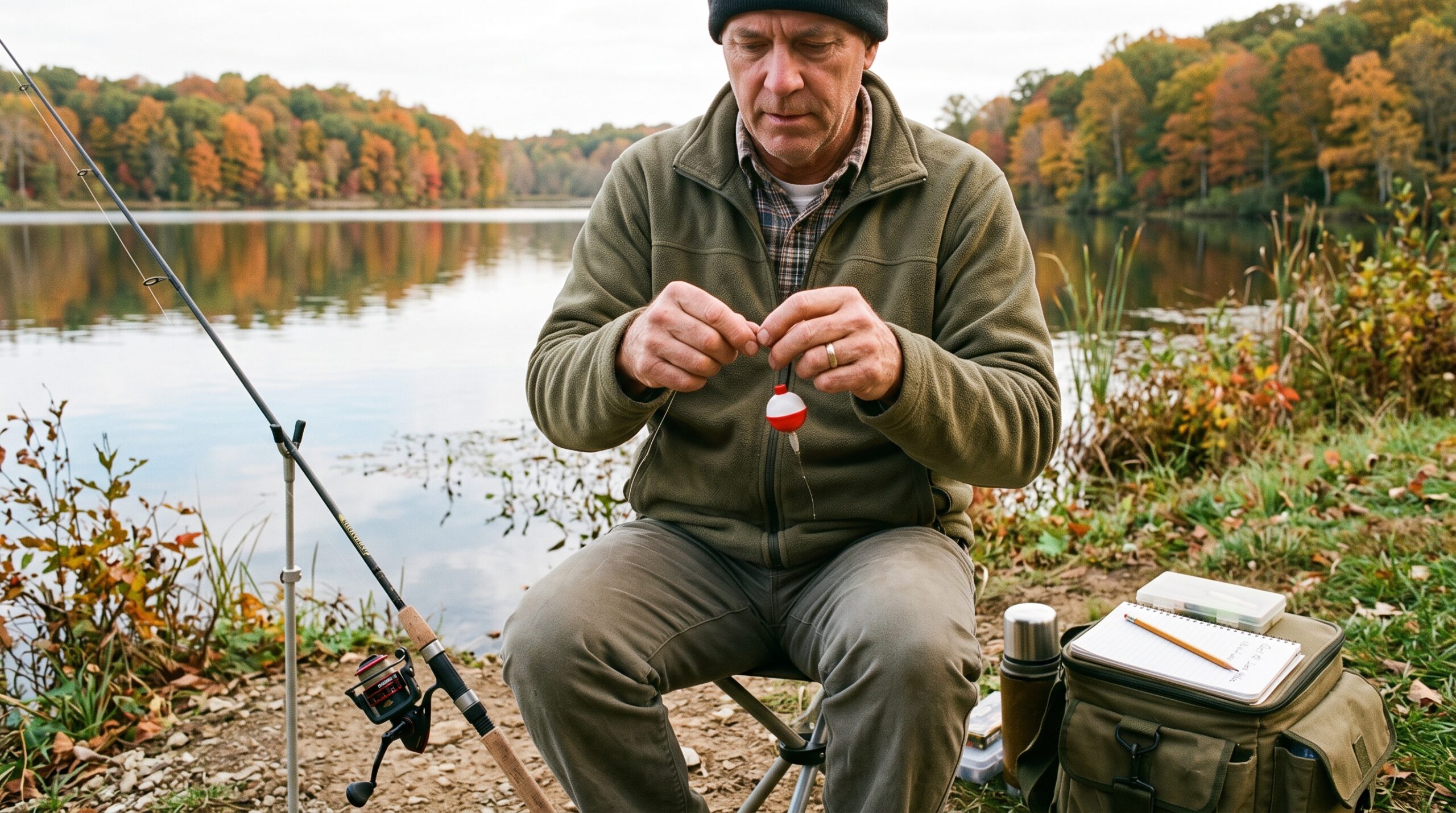
Start with your lake and the bank you can safely fish
Before choosing a bobber setting, name your destination and target species. This lesson focuses on a simple small-panfish presentation; a trout or catfish outing may call for a different approach.
A lake guide helps you prepare the visit. Your observations on arrival help you choose the exact casting lane and bait depth.
| Your destination | Prepare before leaving | Your field assignment |
|---|---|---|
| Alexandria Community Park Lake Alexandria, Kentucky |
Use the Alexandria lake guide to review access, shoreline choices, seasonal targets, and its trip planner. | Choose a safe, permitted bank position with room to cast. Record one visible clue, then compare bait depths in the same reachable lane. |
| Robert J. Barth Park Lake Cold Spring, Kentucky |
Use the Barth Lake guide for shoreline decisions, seasonal approaches, and a short outing plan. | Keep your casting area clear of walkers and other anglers. Select a second safe position to compare if the first provides little useful evidence. |
| Another local lake | Confirm permitted access and current rules. Use the free wind-and-structure reference linked below to organize your observations. | Write down the lake name and a recognizable bank feature so you can return and compare results. |
These are suggested learning exercises. They do not identify surveyed depths, current fish locations, or guaranteed productive spots at either lake. Check conditions and access before every visit.
First, separate bait depth from water depth
Water depth is the distance from the surface to the bottom. Your bobber setting is the length of line between a fixed float and the hook. They are different measurements.
In a hypothetical 5-foot-deep pocket, a 2-foot setting puts the bait roughly 2 feet below the surface and 3 feet above bottom—if the line hangs straight. Wind, drift, line tension, or a tangle can change its actual position.
You do not need to know every contour to begin. You do need to recognize that moving the float changes the presentation, and that a longer cast may also land over different water depth.
Make sure the depth test is real
Start with a short cast into open water. Retrieve and check that the hook, weight, and line are free of wraps. If they are not, work through these bobber-rig tangle checks first.
Use a bait and hook suited to the fish you are targeting. The Recreational Boating & Fishing Foundation’s bluegill guidance recommends small hooks and identifies worms and crickets as common bait options. Keep the bait amount consistent during the comparison.
If an upright float lies over repeatedly, do not assume the lake is exactly as deep as your setting. Poor loading, vegetation, bottom contact, or a rig problem can confuse the signal. See how to separate a flat bobber’s possible causes.
A simple three-setting depth test
- Choose one reachable lane. Try open water beside a visible weed edge, a dock where fishing is permitted, or another piece of cover. Avoid casting into an obvious snag.
- Record your starting setting. Measure from the fixed float to the hook. Use your rod or a small tape as a reference instead of guessing from memory.
- Make several comparable presentations. Keep the target, bait, and approximate waiting time similar. Let the rig settle and watch it closely.
- Change depth by 6–12 inches. Move the fixed float farther from the hook to fish deeper, or closer to fish shallower. Secure it correctly before casting again.
- Compare a third setting if needed. Continue only while the bait can fish cleanly and the rig remains manageable. Repeat the most promising setting before drawing a conclusion.
The step size is a practical way to keep track of changes. It is not a scientifically established interval, and a bite at one setting does not prove all fish are holding there.
One lane. One bait. Three deliberate settings.
- 1 · EstablishStart where the bait hangs clear.
- 2 · CompareChange depth in a measured step.
- 3 · ConfirmRepeat the setting that produces useful evidence.
A bite is useful evidence. A fouled hook is a reason to correct the presentation. Silence alone does not reveal the exact problem.
What the next retrieve can tell you
| What you notice | What it may mean | Your next test |
|---|---|---|
| Clean bait, no response | The presentation worked, but fish may be elsewhere or unresponsive. | Compare another depth before changing several things. |
| Weeds repeatedly on the hook | The bait contacts vegetation during the drift or retrieve. | Try a shorter setting or a cleaner lane; inspect again. |
| Repeated bites after one depth change | That setting deserves more attention at this target. | Repeat it and note the casting angle and drift. |
| One bite, then silence | A useful clue, but a weak pattern. | Replay the same presentation before starting over. |
| A longer rig becomes hard to cast | The fixed-float arrangement may exceed comfortable handling. | Choose accessible water you can fish safely or learn an appropriate slip-float setup. |
Use the L.A.K.E. Method to decide whether to move
- Look: Notice safe footing, wind, visible weeds, shade, and activity before settling in.
- Analyze: Ask whether your bait can hang cleanly in the selected lane and what you actually know about its depth.
- Key In: Pick a reachable edge that gives you a reason to test it.
- Execute: Compare settings, repeat a useful result, then try a contrasting edge when the first one gives you little to work with.
For context, Kentucky Fish and Wildlife’s small-lake guidance describes fishing redworms near cover, either on the bottom or suspended under a bobber. That article concerns spring conditions; it supports the presentation options, not a claim that the same depth works in October.
Keep that distinction in mind on an autumn trip. A calendar date cannot tell you the correct bobber setting for your exact bank. Compare the reachable water in front of you.
The free Kentucky Wind & Structure Cheat Sheet can help you choose a second edge when it is time to move.
Make it a simple family fishing activity
Give a young angler one question to investigate: “Does this bait fish more cleanly a little higher or a little lower?” An adult can handle the hook and float adjustment while the child watches, describes the result, and marks the field note.
Start with two settings if three feels like too much. A clean retrieve, a measured adjustment, or a useful observation is progress even when there is no bite. Keep sessions flexible, take breaks, and choose footing and casting space that allow close supervision.
Fit the test into a two-hour outing
- Minutes 0–10: Recheck access and conditions against your lake plan. Select two safe fishing positions and name the first visible clue.
- Minutes 10–45: Establish a clean presentation and compare depth settings at the first lane.
- Minutes 45–80: Repeat a productive setting or compare the second edge.
- Minutes 80–120: Follow the best evidence, leave time to pack up safely, and record what happened.
These are flexible planning blocks, not required waiting periods. Change course sooner if the bank becomes unsafe, the rig keeps fouling, or useful activity appears nearby.
Print or copy: my lake’s bait-depth field note
Lake / town: ____________________
Date / time: ____________________
Guide consulted / current rules checked: ____________________
Safe starting bank and recognizable feature: ____________________
Wind, shade, water clarity, or visible cover: ____________________
Target species / bait: ____________________
Starting float-to-hook setting: ____________________
Second / third setting: ____________________
Hook returned clean at each setting? ____________________
Bites and casting target: ____________________
Second bank compared: ____________________
What I will repeat or change next visit: ____________________
Save the lake name with your results. A useful note describes what happened at a particular bank, time, and setting; it does not turn one trip into a permanent rule.
Choose a field guide for your next visit
This free lesson gives you one skill to practice. A lake-specific ebook helps you fit that skill into a fuller plan for the destination you intend to fish.
- Going to Alexandria? View the Alexandria Community Park Lake ebook and purchase details for its local planning guidance, printable planner, and quick-reference section.
- Going to Barth Lake? View the Robert J. Barth Park Lake ebook and purchase details for its shoreline guidance and two-hour framework.
- Need a reusable short-trip routine? Explore The Two-Hour Kentucky Bank-Fishing Plan.
These are Every Lake Guide’s own digital guides. Review the contents and current price on the product page, then save your purchased guide to your phone or print it for the tackle bag. Your purchase supports this independent website, its free fishing lessons, and continued guide publishing.
Keep the test safe and the release gentle
Check the Kentucky Fishing and Boating Guide, the exact water’s restrictions, and posted park rules before fishing. Stay on stable, permitted shoreline and keep people clear of your hook when adjusting or casting.
Attend the rod closely. For fish you intend to release, consider a suitable single barbless hook or crimped barb, have pliers ready, wet your hands, and minimize time out of water. The National Park Service’s release guidance recommends cutting the line close to a deeply embedded hook when easy removal is not possible.
Four-question knowledge check
Choose your answer, then tap “Reveal answer” to check it.
1. Does a 3-foot bobber setting prove the lake is 3 feet deep?
A. Yes
B. No
Reveal answer 1
B. It describes your rig setting. The bottom may be much farther below, and angled line can make the bait shallower than the line length suggests.
2. What makes a depth comparison easier to interpret?
A. Changing bait, target, and depth together
B. Keeping bait and target similar while adjusting depth
Reveal answer 2
B. Changing one variable helps you judge what might have made a difference.
3. Your hook returns covered in weeds. What comes next?
A. Correct the presentation and check again
B. Declare that no fish are present
Reveal answer 3
A. Try a shorter setting or cleaner lane. Fouling tells you the bait contacted vegetation, not that the lake lacks fish.
4. A setting works during your visit to Alexandria. What should you record?
A. That this depth always works at every lake
B. The lake, bank feature, conditions, setting, and response
Reveal answer 4
B. Specific notes help you plan a return visit. Repeat the setting to investigate it, and recheck conditions each time.
Frequently asked questions
Should my bobber bait always touch the bottom?
No. Bottom contact is one presentation option, but a suspended bait needs to stay clear enough to fish as intended. Choose according to the species, cover, and response instead of making bottom contact the default.
Should I always go deeper after a quiet cast?
No. If the bait is contacting weeds or bottom, going shallower may be more useful. If it hangs cleanly, compare another plausible setting and watch what changes.
Can I use the same setting after moving?
You can start there, but recheck it. A nearby cast may land over a different bottom contour or a taller weed bed.
Does a lake ebook tell me exactly how deep to set my bobber today?
No. It helps you prepare for that destination and decide what to observe. Your bait-depth comparison tests the conditions you find on arrival; current rules and posted notices still apply.
Do I need a slip bobber?
Not for every trip. A fixed float is sufficient when your chosen depth is comfortable to handle. A slip float is an option for longer depth settings, but it needs correct rigging and its own checks.
What depth change made a difference for you?
Share the lake or town, the species, your starting setting, and what happened after you adjusted it. You do not need to disclose a private location. Did a shorter setting clear the weeds, or did a deeper one bring the next bite? Your details can help another bank angler make a more thoughtful next cast.
Start with the lake, not the lure.
Fact-checked October 8, 2026: The linked sources support the bait, presentation, rule-checking, and release guidance. The named-lake ebook descriptions were checked against their product pages. Local practice assignments, example depths, adjustment sizes, and time blocks are editorial suggestions, not on-site measurements, current fishing reports, or catch guarantees.