
EVERY LAKE GUIDE · READ THE FLOAT
Your bobber lands, rolls onto its side, and stays there. A few casts later, it stands normally—then suddenly lifts and tips over. Those moments look similar, but they deserve different questions.
Before buying another float or striking at every wobble, establish what your rig does when nothing is touching the bait. That normal position makes the next change much easier to interpret.
Quick answer: why does a bobber lie flat?
A float lying flat can reflect rig balance, contact with the bottom or weeds, a tangle, or—in some setups—a lift bite. First check whether that float is designed to stand upright. A round clip-on bobber does not behave like a weighted pencil float.
If an upright-style float lies flat immediately, inspect the rig and test it with the weight suspended clear of the bottom. If it settles normally and then rises, watch for further movement: a fish may have reduced the downward load, but waves, cover, and line movement can also change its position.
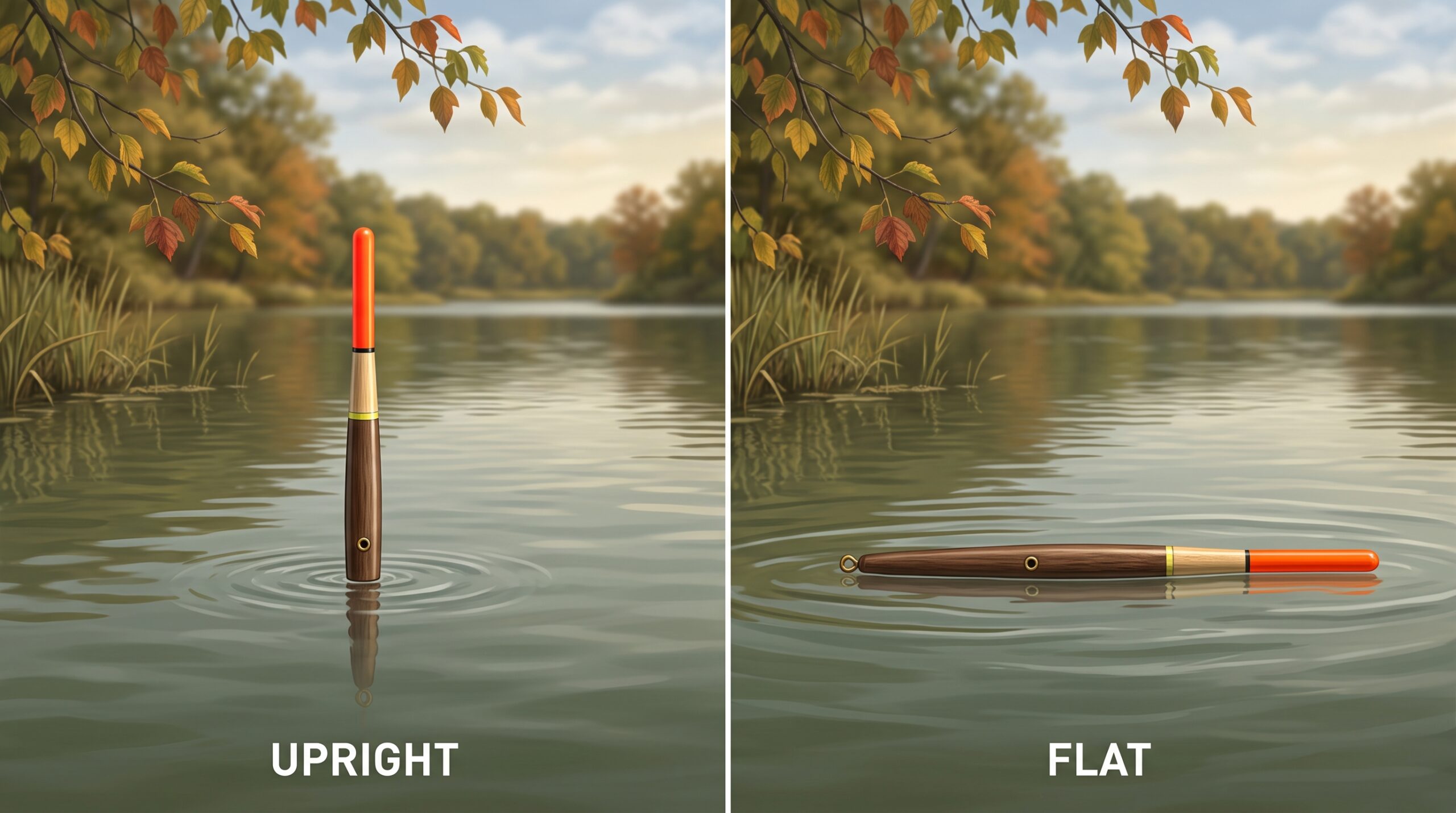
The useful clue is what happened before it tipped
“It was flat” leaves out the most useful part of the story. Did it never stand up? Did it tip at one patch of weeds? Or did it rise from a stable position and start traveling?
For a beginner’s suspended-bait rig, the first goal is a float that supports the tackle predictably. The Missouri Department of Conservation’s bluegill guidance recommends a small bobber with enough buoyancy to suspend the bait. Match it to the weight and bait you actually use.
Three moments. Three next checks.
Start with a short test beside a safe bank
- Identify the float. Is it a round bobber, a weighted upright float, or an unweighted float that needs shot to stand? Check the manufacturer’s setup instructions when available.
- Inspect the hanging rig. Look for line wrapped around the float, shot that has slipped, or a hook tangled above the weight. Keep the hook clear of your hands and other people.
- Test with the tackle freely suspended. In visible water from firm footing, use a shallow enough setting that the hook and weight are clear of the bottom. Observe its normal resting position without towing it with the rod.
- Adjust balance only if needed. For a float that requires shot, add or remove a small amount within its intended loading. Stop before it sinks under the rig’s own weight. Do not assume every bobber needs added shot.
- Return to the original casting lane. Keep bait, float, and casting distance steady. Change the depth setting alone and compare.
A good near-bank test does not measure the depth farther out. It simply tells you whether the rig can work before you ask the lake to explain an odd signal.
Compare the signs before changing the setup
| What you see | What it may mean | Try next |
|---|---|---|
| Upright-style float never stands, even with tackle freely hanging. | Underloading, a tangle, or a setup unsuitable for that float. | Inspect attachments and follow its loading instructions. |
| It stands nearby but lies flat in a shallower lane. | Bottom or vegetation may support the weight. | Shorten the float-to-hook distance slightly and repeat. |
| It tips at the same point during each drift. | Recurring cover contact or a depth transition. | Compare a neighboring clear lane at the same setting. |
| It rises after settling and travels independently of nearby ripples. | A lift bite is possible; line or cover effects remain possible. | Manage slack and respond to a clear take using the correct technique for your hook. |
| A round bobber rotates but stays buoyant. | Rotation alone may be normal for its shape. | Watch changes in travel or submersion rather than demanding an upright stem. |
Why a fish can make a float rise instead of sink
A float responds to changes in the load beneath it. In a deliberately arranged lift rig, a fish picking up the bait and supporting the nearby weight can let the float rise or tip.
In Bob Nudd’s first-person explanation of float fishing for tench, this is a feature of a specific bottom-oriented setup. It explains the mechanism; it does not mean every flat Kentucky panfish bobber is showing a fish.
For a simple suspended worm rig, establish the normal position first. Avoid converting it into a specialized lift rig merely because it tipped once, and do not wait for every clear bite to turn into a fully submerged bobber.
Depth problems can imitate bite signals
If the weight rests on the bottom or catches vegetation, the float may no longer carry the same load. With some upright float rigs, that can leave it riding higher or lying over.
Angling Direct’s depth-plumbing demonstration shows a float lying flat when a plummet-equipped rig is set too deep. That is a depth-measuring setup, so treat it as an illustration of the principle rather than a universal diagnosis.
Try shortening your float-to-hook distance by a small, repeatable amount—such as six inches—while keeping the casting lane consistent. If normal behavior returns, bottom or weed contact becomes a stronger explanation. Six inches is a convenient test increment, not a guaranteed fishing depth.
If bait keeps coming back stripped, compare that result with the guide to bait disappearing without a clear bite. A bare hook and a flat float still cannot identify the fish responsible.
Use L.A.K.E. to turn an odd float into a useful decision
- Look: Note the float’s resting position, the timing of the change, wind, cover, and safe casting room.
- Analyze: Compare a rig problem, supported weight, line movement, and a possible take.
- Key In: Pick one reachable lane where a short test can separate those explanations.
- Execute: Change one factor, repeat, and keep the result in your trip notes.
Use the free Kentucky Wind & Structure Cheat Sheet to choose a contrasting edge when the first lane remains confusing.
A two-hour plan for a float that will not behave
- Minutes 0–10: Check access, weather, posted rules, and two safe casting lanes.
- Minutes 10–25: Establish the float’s normal position with the tackle suspended freely.
- Minutes 25–60: Test the best lane. Record whether tipping happens immediately or after settling.
- Minutes 60–90: Compare one depth adjustment or a contrasting lane.
- Minutes 90–120: Fish the clearest presentation and save one useful observation.
Your float-test planner note
Lake/area: ____
Float type: ____ · Weight/bait: ____
Normal resting position: ____
Depth setting and casting lane: ____
When it tipped: ____ · Follow-up movement: ____
One change: ____ · Result: ____
Make your next short trip easier to compare
The Two-Hour Kentucky Bank-Fishing Plan is Every Lake Guide’s own digital field guide. Use it to give observation, testing, movement, and trip notes a place in your outing.
Keep the test safe and release fish carefully
Confirm licenses, bait restrictions, limits, and exact-water rules through Kentucky Fish & Wildlife and posted signs. Check park hours before planning an evening session.
Stay on firm ground, leave clear space behind your cast, and keep hooks away from children and paths. If you hear thunder, enter a substantial building or enclosed hard-topped vehicle and remain sheltered at least 30 minutes after the last thunder, following National Weather Service advice.
Have pliers ready. Use wet hands, support the fish near the water, and minimize handling and air exposure. Consider suitable single barbless hooks or crimped barbs; if a hook is deeply embedded, avoid forceful removal and follow National Park Service release guidance.
Four-question interactive knowledge check
Choose your answer, then tap each question to reveal the explanation.
1. A round bobber rotates on its side. Does that alone prove a problem?
A. Yes · B. No
Answer: B. Shape matters. Establish normal behavior for that float and watch meaningful changes in travel or submersion.
2. An upright float works nearby but lies flat in a shallow lane. What is the best first comparison?
A. Shorten the depth setting · B. Change all the tackle · C. Cast harder
Answer: A. Keeping the lane and tackle steady helps test whether bottom or weed contact supports the weight.
3. A float rises after settling. Is a fish the only explanation?
A. Yes · B. No
Answer: B. A lift bite is possible in suitable rigs, but contact, waves, and line movement also need consideration.
4. Why test with the weight clear of the bottom?
A. To guarantee a bite · B. To learn the rig’s normal position · C. To measure the whole lake
Answer: B. A freely hanging rig provides a baseline. It does not reveal every depth in the casting area.
Frequently asked questions
Should I add weight when my bobber lies flat?
Only after identifying the float and checking for tangles or supported weight. Some upright floats need loading; weighted floats and round clip-on bobbers behave differently. Excess shot can sink the rig.
Can a lift bite happen without the bobber going under?
Yes, in suitable float setups. A fish supporting weight can make the float rise. Interpret the change against the rig’s normal position and any follow-up movement.
Does a flat float mean my bait is on the bottom?
It can be a clue when the bottom supports the weight, but it is not proof. Float design, loading, tangles, and cover can produce similar behavior.
Should I strike at every tip or wobble?
No. Look for a meaningful change from normal behavior and use the response appropriate to your hook. A conventional J-hook and a circle hook require different techniques; do not automatically delay a clear take.
What did your flat bobber turn out to mean?
Did shortening the depth setting fix it—or did the float rise and travel before you connected with a fish? Share the float style, timing, and adjustment in the comments. You can describe the water without revealing a private spot.
Start with the lake, not the lure.
Reviewed October 2, 2026. The comparison sequence is a practical diagnostic framework. Float designs and local conditions vary; no individual signal guarantees a fish.