
Every Lake Guide · Observation-First Bank Fishing
The Lake Moved Before You Cast—Did You See It?
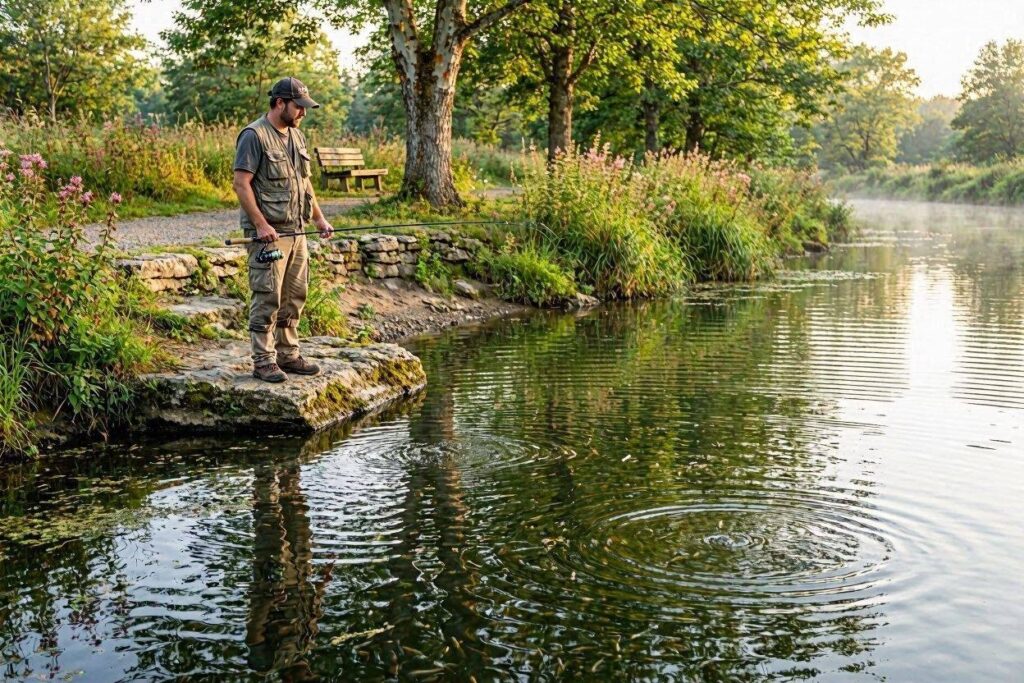
A ring, swirl, flicker, bubble trail, insect fall, or sudden patch of quiet water can tell you where food is moving and where fish may be using the bank. The goal is not to identify every splash perfectly. It is to notice which clues repeat, connect to cover or depth, and deserve a careful first test.
Start With the Lake, Not the Lure.
Quick answer
Which surface clues should a bank angler notice before casting?
Watch for repeated rings, fleeing baitfish, swirls beside cover, insect activity, bubble trails, moving seams, and areas that suddenly go quiet. One isolated splash may mean little. A clue that repeats in the same small area—and connects with shade, weeds, wood, rock, a dock, an inflow, or nearby depth—deserves a controlled first cast.
Do not chase every disturbance. Compare where it happened, how often it repeated, and what shoreline feature supports it.
Quick comparison
Which surface activity deserves the first cast?
Prioritize repeated activity connected to a usable edge—not the largest splash.
| Surface clue | What it may suggest | Best first test | Common mistake |
|---|---|---|---|
| Rings repeating beside shade or weeds | Insects, small fish, or feeding activity near an edge. | Make a quiet cast beside the rings. | Landing directly on the activity. |
| Baitfish flickering or skipping | Small fish may be feeding, moving, or escaping. | Cast beyond the flicker and retrieve through its path. | Assuming every flicker means a large predator. |
| One heavy splash with no repeat | A fish, bird, turtle, frog, branch, or random disturbance. | Watch briefly for a second clue. | Running down the bank after one splash. |
| Bubbles traveling in a line | An animal, feeding disturbance, mud, or bottom gas. | Compare with bottom type and repeated movement. | Treating bubbles as proof of a target fish. |
| Sudden quiet after steady activity | Bait, light, wind, pressure, or a predator may have shifted. | Check nearby cover, shade, depth, or a travel route. | Assuming the whole lake went dead. |
Read the surface with context
Seven clues to notice before the first cast
Repeated dimples or rings
Small rings may come from insects, minnows, bluegill, or other activity. Repetition in one defined area is the useful clue.
Try this: cast beside the rings, not through their center.
Baitfish flickers
Silver flashes, tiny skips, or nervous water can reveal a feeding lane or escape route.
Try this: cast beyond the movement and retrieve through it.
A swirl beside cover
A swirl near weeds, wood, a dock, rock, or shade can be more useful than a larger splash in open water.
Try this: fish the edge from an angle that keeps the bait near cover.
Insects touching the water
Flying ants, mayflies, moths, and grasshoppers can draw bluegill and small fish toward overhanging banks and calm pockets.
Try this: compare the insect fall with shade, grass, and casting room.
Bubbles that move
Moving bubbles may follow an animal or feeding disturbance. Stationary bubbles can rise from mud or decaying vegetation.
Try this: wait for movement, a swirl, or a second clue.
A seam between smooth and rippled water
A wind line, current seam, or protected edge can collect floating food and create a visible boundary.
Try this: cast along the seam where conditions meet.
Activity that suddenly stops
Light, wind, bait movement, shoreline pressure, or a predator may have shifted the pattern.
Try this: check the nearest shade, cover, depth, or escape route.
Surface clues grow stronger when they connect to a readable edge. Continue with How to Fish Grass Lines and Weed Edges From the Bank and Kentucky Shore Fishing: Coves, Flats, and Drop-Offs.
A useful beginner rule
Repetition plus location is stronger than drama
A large splash gets attention. A small ring that repeats five times beside a shaded weed opening gives you a better fishing explanation.
Ask: Did it repeat? Did it happen near a useful edge? Can I reach that edge safely?
Use the Every Lake Guide framework
Apply the L.A.K.E. Method to surface activity
Look Before You Cast
Watch for rings, swirls, baitfish, bubbles, insects, seams, shade, wind, water color, and safe casting lanes.
Analyze the Lake
Connect the activity to weeds, wood, rock, a dock, point, inflow, cove mouth, shade, or depth.
Key In on Productive Water
Choose repeated activity beside the strongest reachable edge. Do not treat every disturbance equally.
Execute a Simple Plan
Cast beside the activity, test one angle or depth, and compare a second clue if the first explanation produces no evidence.
Build the complete system with How to Read Any Lake: A Beginner’s Fishing System. For shoreline routes and depth transitions, explore Kentucky Shore Fishing.
A focused observation-first trip
A two-hour surface-clue plan
Watch two banks
Compare a calm or shaded area with a wind-touched or structured area. Note what repeats and where it connects to cover or depth.
Test the strongest clue
Make a quiet cast beside the activity and keep the presentation close to the supporting edge.
Change one variable
Adjust angle, depth, speed, bait size, or distance without abandoning the explanation too quickly.
Compare the second bank
Use a similar presentation so the different clue receives a fair test.
Return to the best evidence
Finish where you saw repeated activity, baitfish, a follow, a bite, better cover, or a clearer route.
Record the lesson
Write down the clue, supporting edge, time, wind, and what happened after the cast.
For a broader short-trip routine, read the Kentucky Fishing Guide for Busy Bank Anglers.
Reader engagement
Use the 60-second surface scan
Before rigging, count how many clues repeat, which clue is closest to cover or depth, whether the activity moves, and whether another bank shows a stronger pattern.
Complete this sentence: “My first cast is going there because the activity repeated beside ______.”
Safety and responsible observation
Do not let a splash pull you into an unsafe position
- Keep a safe route behind the cast near trails, docks, and picnic areas.
- Do not climb onto slick rock, steep mud, unstable banks, or submerged structures.
- Avoid suspicious scum, strong odors, dead fish, and posted advisories.
- Leave for substantial shelter when thunder is heard.
- Wet your hands, prepare pliers, and release unwanted fish promptly.
- Confirm current licenses, access rules, park hours, and regulations.
Verify current Kentucky fishing information through Kentucky Fish & Wildlife.
Interactive knowledge check
Can you choose the strongest surface clue?
Continue learning
Related Every Lake Guide resources
The First 10 Minutes at Any Lake
Build a calmer arrival routine before opening the tackle box.
Read the GuideHow to Read Any Lake
Learn how food, comfort, safety, edges, depth, wind, cover, and movement work together.
Read the Free GuideHow to Read Any Lake Ebook
Use the complete L.A.K.E. Method, practice examples, scorecard, and printable tools.
Explore the EbookKentucky Shore Fishing Ebook
Study coves, flats, first drop-offs, shoreline cover, and reachable routes.
Explore the EbookFrequently asked questions
Surface-activity FAQs
Does every surface ring mean a fish is feeding?
No. Insects, debris, frogs, turtles, and small fish can all disturb the surface. Repetition and location make the clue useful.
What does it mean when baitfish jump?
They may be feeding, traveling, or escaping. Watch whether the flicker repeats and follows a point, weed edge, dock, or shoreline route.
Do bubbles always mean carp or catfish?
No. Bubbles may come from animals, feeding activity, mud, vegetation, or bottom gas. Look for movement and supporting clues.
Should I cast directly at a swirl?
Usually cast beside or beyond it so the bait enters naturally without landing on the activity.
What if the surface is completely quiet?
Quiet water can still hold fish. Compare shade, cover, depth, wind, vegetation, color, and timing.
How long should I watch before casting?
Even 60 seconds can reveal repeated rings, baitfish, seams, insects, or a stronger bank.
Final takeaway
Let the surface earn the first cast
Do not chase every splash. Look for activity that repeats, connects with a useful edge, and can be reached safely. A small clue in the right location is often more useful than a dramatic disturbance in open water.
Start With the Lake, Not the Lure.
Build the Complete Lake-Reading System