
Every Lake Guide · Late-Summer Food Clue
The trees may be loud, but the water makes the decision. Cicadas and other land insects can turn an ordinary shaded bank into a temporary feeding lane. The useful question is not simply whether you hear buzzing. It is whether insects are actually reaching the water—and whether fish, cover, shade, wind, and nearby depth support the same explanation.
Quick answer: Should you cast under trees where cicadas are buzzing?
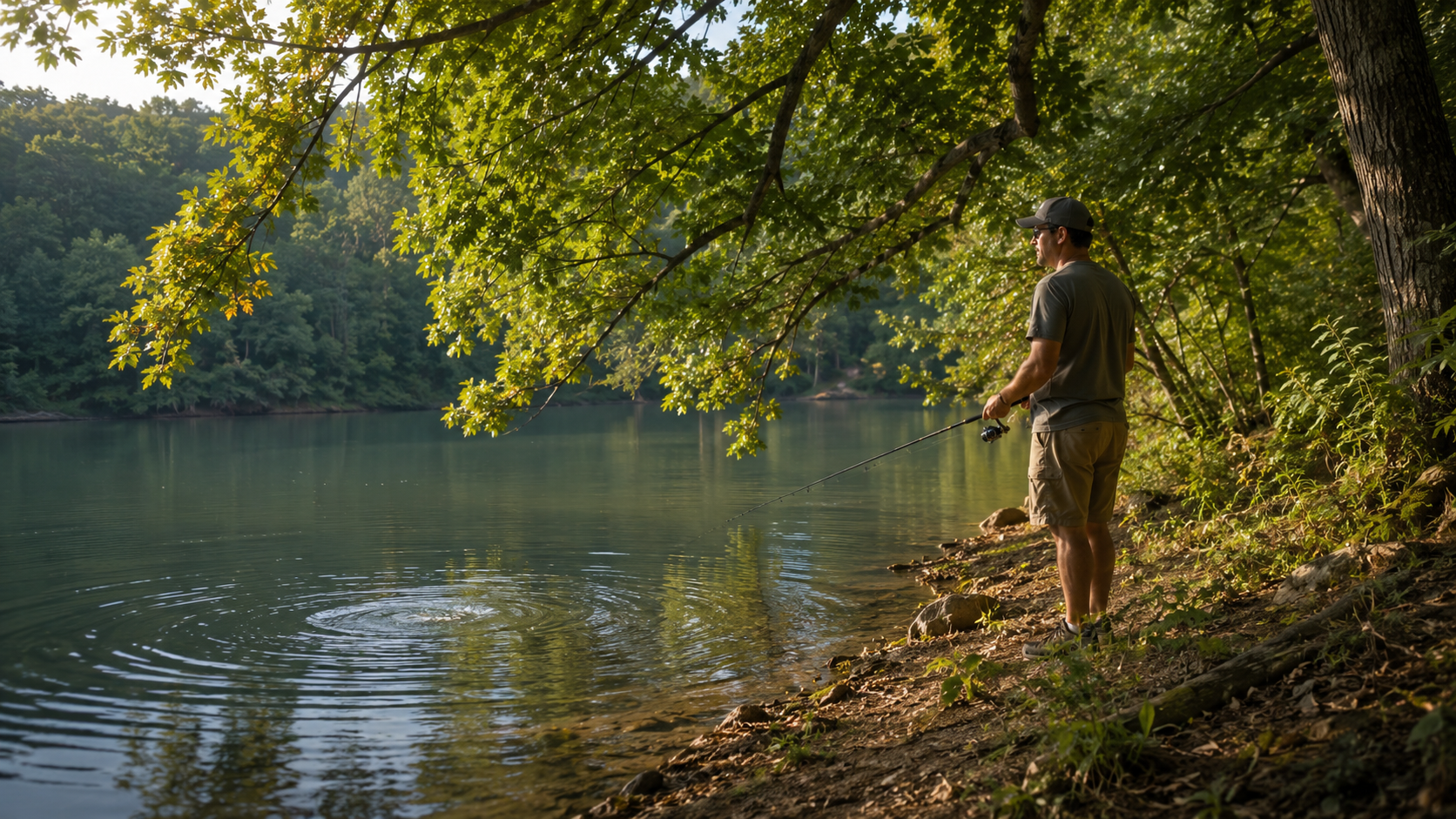
Yes—when the sound is joined by evidence in the water. Start under or beside the canopy when you see insects falling, small surface rings, bluegill or baitfish activity, useful shade, a clean casting lane, and nearby cover or depth. Make the first cast quietly into reachable close water, then work the shade edge and the first outside break.
Buzzing by itself is only a seasonal clue. If no insects reach the water, no fish respond, and the bank lacks cover or an escape route, compare another tree line, point, weed edge, dock shade, or first drop-off instead of waiting under one loud tree.
Why buzzing trees can matter to a bank angler
Late summer changes where food enters a lake. Dying vegetation may weaken one shallow pattern, while healthy shoreline trees continue to create shade, drop leaves and insects, and hold cooler-looking cover along the bank. That does not make every overhanging branch productive. It gives you another visible source of food to test.
The University of Kentucky notes that annual cicadas commonly emerge during July and August. Research summarized by the U.S. Geological Survey also shows that terrestrial insects can connect wooded shorelines with aquatic food webs. That research focused on streams and trout, so it should not be treated as proof that every Kentucky lake fish is eating cicadas. It supports the broader observation: insects falling from land can become a real food input, and fish response must confirm whether it matters at the water in front of you.
The tree supplies more than sound
A useful canopy may provide shade, a delivery point for insects, roots or wood near shore, and a boundary between bright and darker water.
The lake still needs an escape route
A shaded pocket becomes more convincing when it touches a weed edge, submerged wood, a point, a steeper bank, or the first drop toward deeper water.
Fish response separates sound from pattern
Look for repeated rings, dimples, quick swirls, bluegill pecking at the surface, a missed strike, or activity that begins soon after something falls.
Safe casting decides whether you can use it
The most insect-rich branch is not useful when roots, poison ivy, people, steep mud, or low limbs make the position unsafe or impossible to fish cleanly.
A bluegill is especially worth watching around small surface food. The Missouri Department of Conservation describes adult bluegill as insect eaters and recommends small hooks, small baits, tiny jigs, small flies, and poppers. That is a good reminder to match the size of the visible food instead of throwing the largest lure in the box.
Quick comparison: Is the buzzing bank worth your first cast?
| What you notice | What it may mean | Best first test | Avoid assuming |
|---|---|---|---|
| Loud cicadas, but nothing touches the water | The seasonal food is nearby, but it may not be entering the lake at this tree. | Watch for five minutes, then compare a lower canopy or wind-touched tree line. | Every buzzing tree creates a feeding spot. |
| Insects fall and small rings appear beneath them | Fish may be sampling food in reachable nearshore water. | Make a quiet cast beside the newest ring without landing directly on it. | Every ring belongs to a large game fish. |
| Shade, falling insects, and a first drop overlap | Food, lower light, and an escape route meet in one compact area. | Fish close shade, the shade edge, and the outside break in that order. | The farthest cast is automatically best. |
| Wind pushes insects toward one side of the canopy | The useful delivery zone may shift along the bank. | Watch where insects land, then cast along the downwind shade edge if footing is safe. | The trunk marks the center of the pattern. |
| Branches hang low over shallow, stagnant-looking water | The food clue may exist without comfortable or fishable water. | Compare the outside shade line, nearby depth, or another bank. | Shade alone is enough. |
| No response after several angles and depths | The clue may be inactive, too brief, or unsupported by structure. | Move to a contrasting edge and test whether shade, depth, wind, or cover matters more. | Changing colors repeatedly will rescue the spot. |
Where should you cast first under a cicada-filled tree?
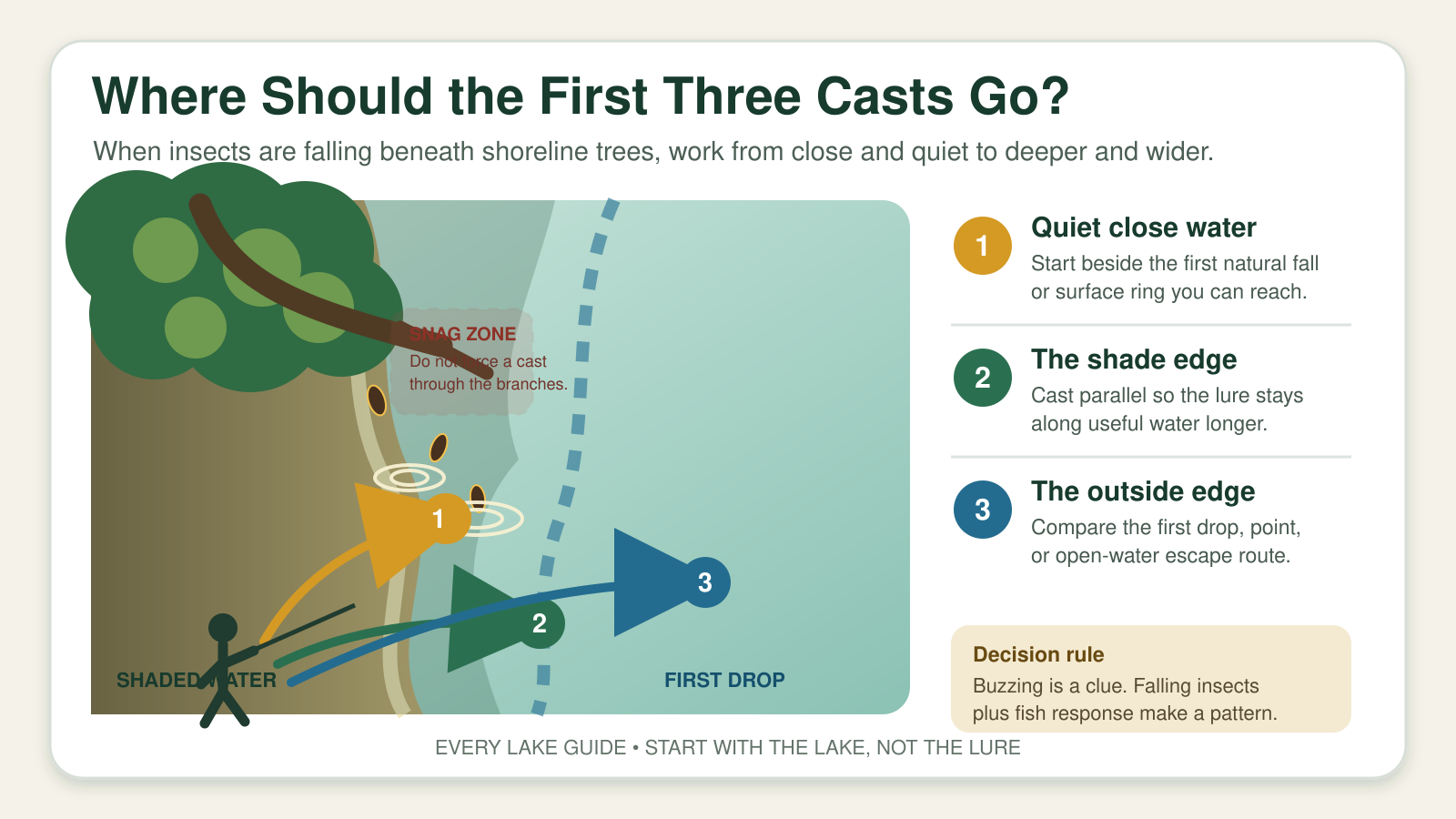
Do not begin by throwing through the deepest part of the branches. Start where you can present a lure cleanly and learn what the fish are using. This three-cast sequence protects the close water before your line, footsteps, or lure disturb it.
- Cast beside the newest surface clue. If an insect falls and a ring appears, land the lure a short distance beyond or beside it. A direct splash on top of the ring can scatter the fish you are trying to test.
- Run parallel to the shade edge. A parallel cast keeps a small lure, popper, fly, or float along the light transition longer than a cast that crosses the shade in one second.
- Compare the outside edge. Count a small jig or soft plastic down beside the first drop, submerged limb, weed point, or open-water edge. Fish may use the tree as a feeding station but hold one step outside it.
Match the presentation to the clue
Small rings and visible bluegill
Try a small hook and legal bait beneath a light float, a tiny jig, a small fly, or a compact popper. Use tackle light enough to show subtle bites.
A loud surface plop
A small topwater or soft insect-shaped presentation can test whether fish are reacting to the entry sound. Keep it controllable around branches.
Activity stops at the shade edge
Use a small moving bait or jig along the boundary. Let the lure travel with the edge before changing size, color, speed, and location at once.
No surface response
Fish the first reachable depth change or outside cover. The tree may still identify a useful shaded route even when the fish are not eating from the surface.
Do not collect or use live insects without checking the current rules for the exact water and access area. Artificial patterns, small jigs, and ordinary legal baits let you test the same location without assuming every natural bait is permitted everywhere.
Use the L.A.K.E. Method beneath the trees
The L.A.K.E. Method keeps a promising sound from becoming a two-hour guess. The tree begins the investigation; the water decides whether you stay.
Look Before You Cast
Listen for active trees. Watch where insects fall, where rings appear, how wind moves the surface, and whether the bank is safe.
Analyze the Lake
Connect the canopy to shade, roots, wood, weeds, a point, the shoreline slope, or the first reachable drop.
Key In on Productive Water
Choose the small zone where food entry, fish response, lower light, cover, and an escape route overlap.
Execute a Simple Plan
Fish close, then parallel, then outside. Change one variable, compare another tree line, and move when evidence weakens.
For the complete clue-ranking process, practice examples, scorecard, and printable tools, continue with How to Read Any Lake: A Beginner’s Fishing System. For coves, flats, drop-offs, and shoreline routes, explore Kentucky Shore Fishing.
A two-hour late-summer plan for following falling food
Before you leave home
Choose a lake with legal public access, safe shade, and at least two reachable shoreline types. Check weather, heat, park hours, current regulations, and the time you need to pack before dark. Bring water, pliers, a small first-aid kit, sun protection, and one or two simple presentations.
For a reusable trip worksheet and timed decision system, use The Two-Hour Kentucky Bank-Fishing Plan.
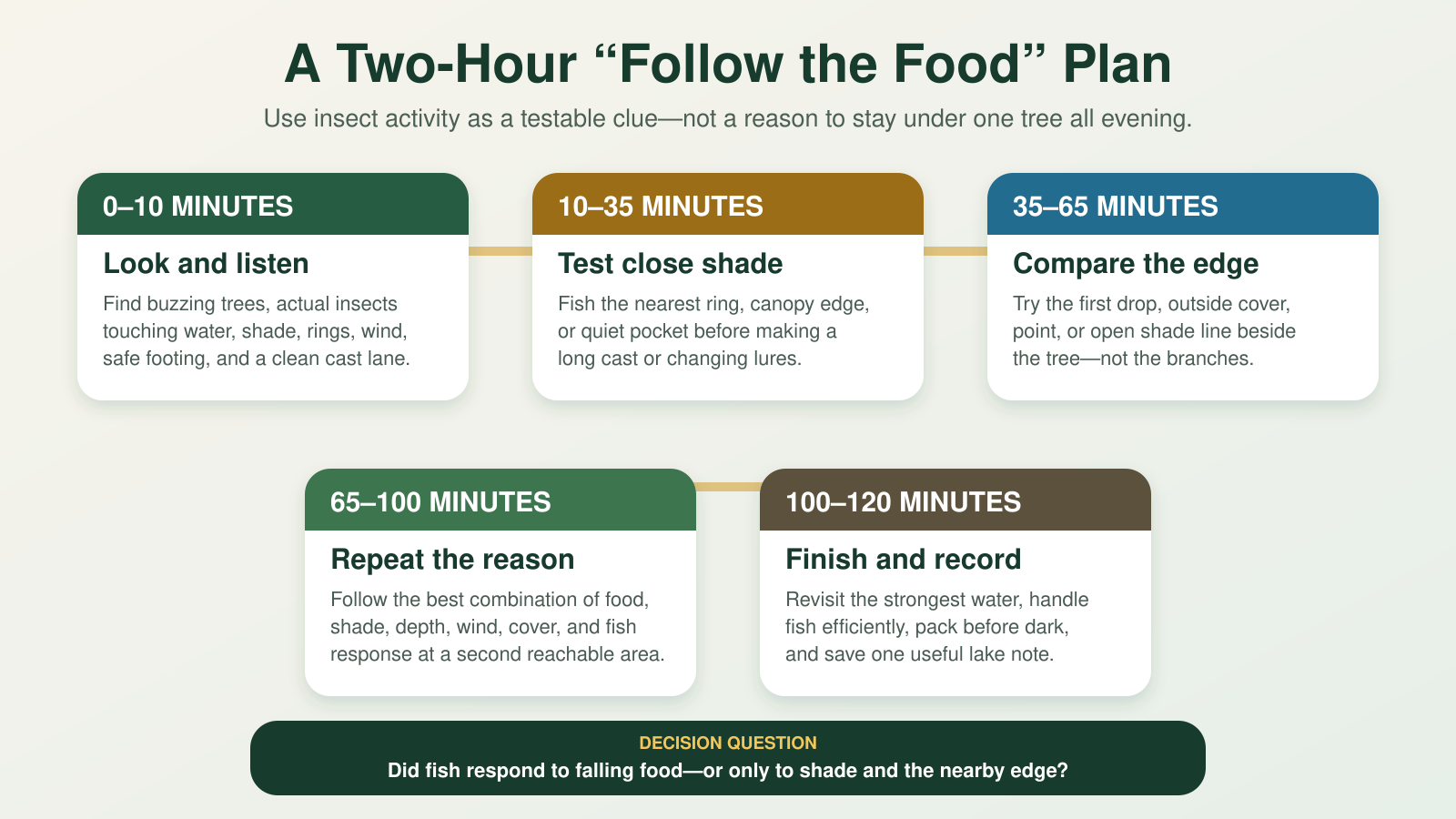
Minutes 0–10: Look, listen, and compare
Stand back from the edge and compare at least two tree lines. Which one has actual insects entering the water? Where are the surface rings? Which canopy touches a point, shade line, weed edge, submerged branch, or first drop? Confirm a clean casting lane before choosing the bank.
Minutes 10–35: Test the quiet close water
Fish the strongest nearshore clue with one small, controlled presentation. Begin beside the newest ring, then work the shade edge. Adjust angle or depth before replacing everything. Record whether fish respond to the fall, the shade, or the nearby cover.
Minutes 35–65: Compare the outside edge
Move one step away from the canopy. Test the first drop-off, point, outside weed edge, open lane beside wood, or steeper bank. This tells you whether fish are feeding directly under the tree or holding along the safer route beside it.
Minutes 65–100: Repeat the reason elsewhere
Find a second reachable area with the same useful combination. If the first spot produced rings under low branches beside a drop, look for another low canopy beside depth. A repeat turns one lucky observation into a pattern.
Minutes 100–120: Revisit, release, and record
Return to the strongest water for a deliberate final test. Pack before the bank becomes difficult to navigate. Note the tree type if known, time, wind, water clarity, surface activity, bank feature, presentation, and where each response occurred.
Five mistakes that waste the cicada clue
- Fishing the sound instead of the water. Cicadas may be loud high in the canopy while no insects reach the surface beneath you.
- Walking onto the edge before the first cast. Bluegill and other fish may be close enough to see your movement or shadow.
- Throwing into the branches first. A lure lost above the water teaches nothing about the fish. Work the clean lane and outside edge.
- Using a lure much larger than the visible food. Begin compact, especially when the response comes from small rings or bluegill.
- Staying after the explanation fails. No insects, no response, no useful edge, and no nearby depth are four reasons to compare different water.
If the vegetation beneath the tree is thinning or turning brown, use The Weeds Are Turning Brown—Where Did the Fish Go? to decide whether the most useful edge shifted toward healthier cover or open water.
Late-summer safety and fish-friendly handling
Overhanging banks can hide roots, holes, poison ivy, wasps, ticks, unstable soil, and low branches. Do not push through vegetation or step onto a steep edge merely to reach one surface ring. Choose a clean legal position and keep enough room for the cast and hook-set.
- Carry drinking water and take shade breaks during hot, humid weather.
- Leave immediately for a substantial building or enclosed hard-topped vehicle when thunder is heard.
- Confirm park hours before planning to stay into low light or darkness.
- Wet your hands before touching a fish you intend to release.
- Keep the fish in the water when practical and use pliers or hemostats for quick hook removal.
- Consider a single-hook or barbless option around small fish and snag-prone cover.
- Do not drag fish across roots, gravel, dry soil, or hot pavement.
Check the current Kentucky Fishing and Boating Guide and posted signs for the exact water before fishing. Licenses, bait rules, limits, access, and waterbody-specific regulations can change.
Interactive knowledge check: Would you fish the buzzing bank?
Choose the best lake-first answer for each situation, then check your score.
Continue building the complete bank-fishing system
How to Read Any Lake
Learn how food, comfort, safety, edges, depth, wind, cover, and movement work together on unfamiliar water.
Explore the ebookKentucky Shore Fishing
Study coves, flats, drop-offs, cover, and the shoreline routes a bank angler can actually reach.
Explore the field guideWind & Structure Cheat Sheet
Use one compact reference when the breeze changes where falling food and surface activity collect.
Get the free cheat sheetCicada bank-fishing FAQs
Do fish really eat cicadas?
Some fish will eat terrestrial insects that enter the water, but a cicada sound does not prove that fish are feeding beneath that exact tree. Watch for insects reaching the surface and fish responding before calling it a pattern.
What fish should I expect under overhanging trees?
Bluegill and other sunfish are practical first targets because adult bluegill eat insects and often reveal themselves with small surface rings. Bass, trout where present, and other opportunistic fish may also use shaded cover or feeding activity, but species, water temperature, depth, and lake type matter.
What is the best lure for cicada bank fishing?
There is no universal best lure. Begin with a small popper, artificial insect, fly, tiny jig, or compact soft plastic that matches the size and position of the visible food. For bluegill, a small legal bait under a float can quickly test the water.
Should I use a real cicada as bait?
Do not assume collecting or using live insects is lawful at every water or access area. Check current statewide and waterbody-specific rules. An artificial insect pattern or another legal small presentation can test the same zone without that uncertainty.
Is wind helpful when fishing beneath trees?
A light, safe breeze can move insects and surface activity toward one section of the canopy or shade edge. Strong wind can make casting unsafe, drive hooks into branches, or make footing difficult. Treat wind as evidence, not an instruction to fish the roughest bank.
How long should I stay if the trees are buzzing but nothing bites?
Give the strongest close water, shade edge, and outside break a deliberate test. If no insects enter the water, no fish respond, and no supporting structure improves the explanation, compare another bank within 20 to 30 minutes rather than changing everything in place.
Is this only a late-summer pattern?
Cicadas make the clue especially noticeable in late summer, but the transferable lesson lasts longer: watch for any land insect, seed, berry, or other food entering the water beneath shoreline vegetation, then require fish response and supporting structure before staying.
Sources used for this guide
- University of Kentucky Entomology: Cicada Killer Wasps — documents annual cicadas emerging in Kentucky during July and August.
- U.S. Geological Survey: Fish Diets Switch From Aquatic to Terrestrial Insects — supports the connection between riparian insect inputs and aquatic food webs.
- Missouri Department of Conservation: Tips for Bluegill Fishing — identifies insects as adult bluegill food and recommends appropriately small tackle and presentations.
- Kentucky Department of Fish & Wildlife Resources: March 2026–February 2027 Fishing and Boating Guide — current statewide and special-regulation planning resource.
Reviewed August 17, 2026. Fishing conditions, access, park hours, bait rules, advisories, and regulations can change. Verify current official information and posted signs for the exact water before every trip.
The sound gets your attention. The water earns the cast.
Listen for the cicadas, but look for the fall. Look for the ring, but connect it to shade, cover, wind, and nearby depth. Fish the quiet close water first, compare the outside edge, and repeat the reason somewhere else before calling it a pattern.
Start with the lake, not the lure.
What is falling into the water at your lake?
Have you seen bluegill, bass, or another fish respond beneath cicadas, beetles, grasshoppers, or other shoreline insects? Share the lake type, time of day, wind, and the edge you fished in the comments. A specific observation can help another bank angler recognize the same clue.