
The Weed Bed Changed. Your Best Casting Lane May Have Changed With It.
Green summer vegetation can turn brown, thin out, flatten, or break apart as conditions change. Do not assume the fish vanished—and do not keep casting to yesterday’s edge. Compare what is still alive, what is opening up, and how the remaining cover connects to depth.
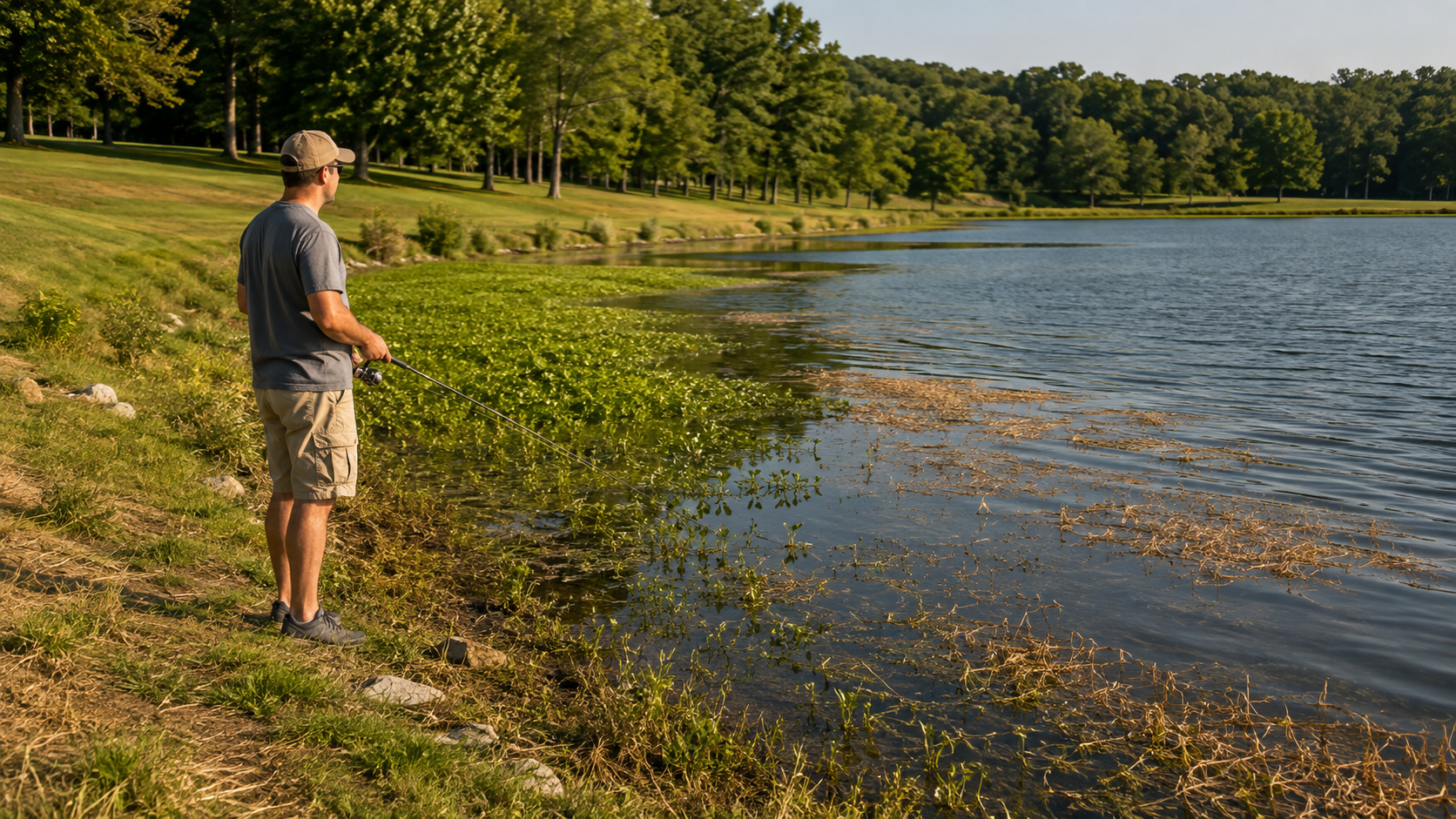
Where should you cast when lake weeds turn brown?
Begin beside the healthiest remaining green vegetation—especially where it forms a clean outside edge, opening, point, or lane near deeper water. Then compare that edge with the first drop-off or another form of cover. Brown weeds alone do not prove that fish left or that oxygen is low, but a large declining patch gives you a reason to test cleaner, living cover and open-water transitions before making repeated casts into the old bed.
What do the weeds show—and what should you test first?
| What you see | What it may mean | Best first test | What to avoid |
|---|---|---|---|
| Upright green weeds with baitfish, insects, or bluegill activity | The cover still supports life and offers a defined edge. | Cast along the outside wall, opening, or point nearest depth. | Throwing directly into the thickest growth first. |
| A mixed patch of green and brown vegetation | The most useful part of the bed may be shrinking or shifting. | Target the greenest clump, cleanest lane, or boundary between living weeds and open water. | Treating the entire patch as equally productive. |
| Flattened brown weeds with little visible activity | Former cover may offer less shade, food, or security. | Follow the old bed toward remaining green cover, a point, cove mouth, or first drop. | Staying only because the spot worked earlier in summer. |
| Loose plant fragments collected by a breeze | Wind may have gathered debris away from where it grew. | Check the upwind source, the edge of the collection, and any nearby living cover. | Assuming every floating fragment proves a local die-off. |
| Strong odor, unusual scum, dead fish, or fish repeatedly gulping at the surface | The area may have a water-quality problem or stressed fish. | Stop fishing that area, respect advisories, and notify the responsible lake or park manager if a die-off is present. | Treating stressed fish as a feeding opportunity. |
Healthy vegetation is habitat. Declining vegetation changes the edge.
Kentucky Fish & Wildlife explains that submerged plants protect small fish, support aquatic invertebrates eaten by bluegill and young bass, and release oxygen through photosynthesis. That makes a healthy weed bed more than a place to hide—it can combine food, cover, shade, and a travel boundary.
When a large amount of plant material dies and decomposes, bacteria can consume dissolved oxygen. The U.S. Geological Survey also notes that warm water holds less oxygen than cooler water, making hot, stagnant conditions more demanding for aquatic life. That does not mean every brown leaf creates an oxygen problem. It means a visible vegetation change deserves comparison with fish activity, water movement, odor, clarity, nearby depth, and the condition of the next weed patch.
Depth is not an automatic answer either. Kentucky’s summer fishing guidance notes that some fish may hold above a thermocline because deeper water can have insufficient oxygen. A bank angler’s better question is: Where is the nearest usable combination of living cover, food, movement, and comfortable water?
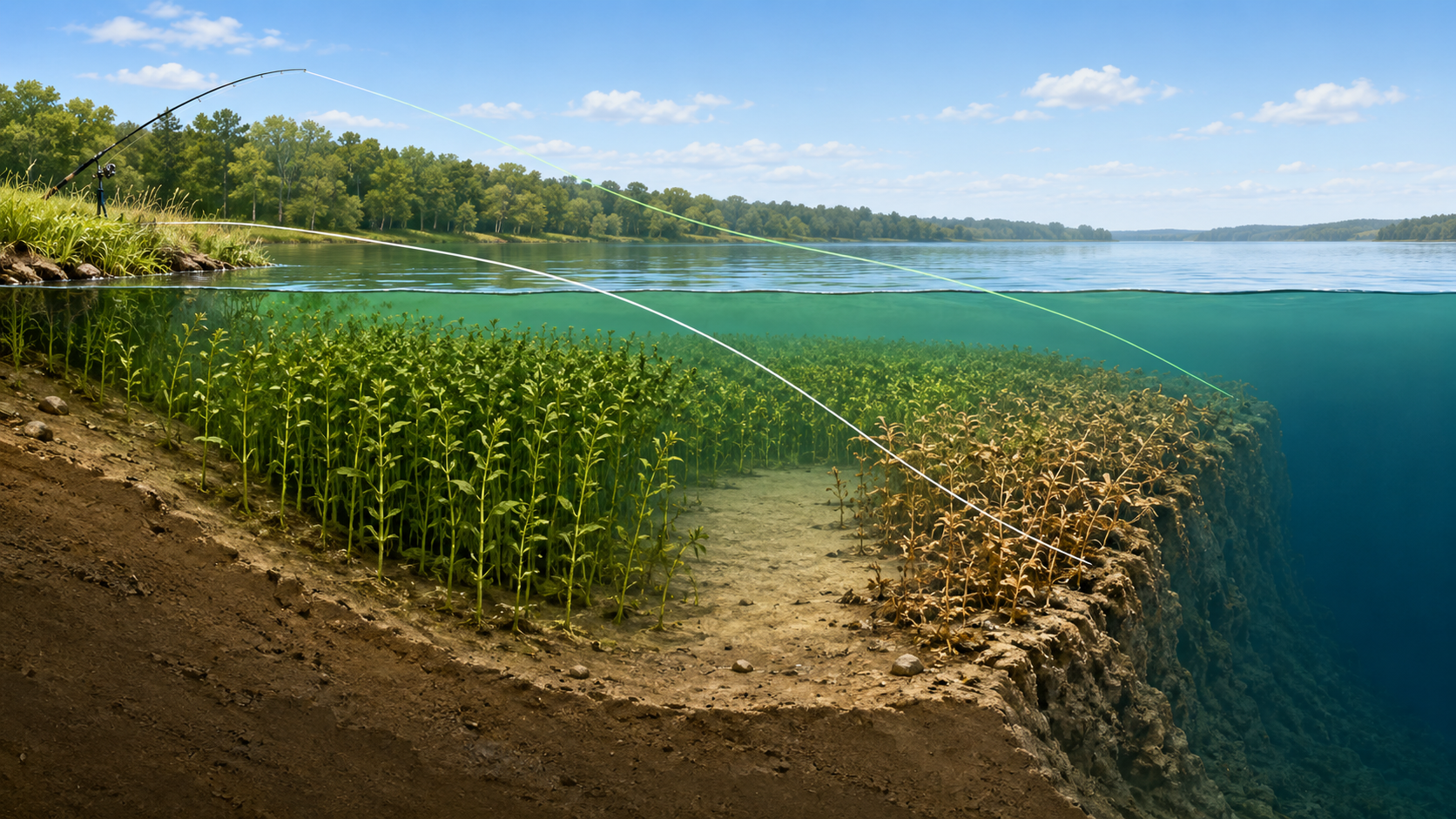
Do not search for perfect weeds. Search for the best remaining edge.
The last healthy green point
A point or tip in the vegetation creates more casting angles than a straight wall. Test the side facing wind or activity, then the side closest to deeper water.
A clean opening inside mixed weeds
A pocket can remain useful when living vegetation surrounds it and the lane connects to open water. Make a controlled cast through the opening instead of across every stalk.
The outside edge nearest the first drop
As shallow weeds decline, the cover-to-depth connection may matter more. Count a presentation down beside the edge and compare the shallow end with the deeper end.
Living cover touched by safe wind
A manageable breeze can move surface food and create a visible seam. Fish the boundary where moving water meets the healthy edge—only when footing and casting remain safe.
Start with How to Fish Grass Lines and Weed Edges From the Bank if the vegetation is still mostly healthy. If the cover now ends beside deeper water, use the Cast, Count, Compare test for finding the first drop-off without sonar.
Apply the L.A.K.E. Method when the weed bed changes
Look Before You Cast
Compare green and brown patches, openings, floating fragments, water color, odor, wind, baitfish, insects, and safe footing.
Analyze the Lake
Connect the healthiest remaining vegetation to a point, cove mouth, shade line, wind seam, first drop, or another reachable route.
Key In on Productive Water
Choose the smallest zone where living cover, food activity, clean water, depth, and casting control overlap.
Execute a Simple Plan
Test the green edge, compare the opening or first drop, change one variable, and move when the old weed bed gives no reason to stay.
For the full clue-ranking system, field examples, scorecard, and printable tools, explore the How to Read Any Lake ebook. To understand how vegetation connects with coves, flats, and depth changes, use the Kentucky Shore Fishing field guide.
A two-hour plan for changing weed beds
Find one healthy green edge, one mixed or declining patch, and one nearby open-water or depth alternative. Note wind, activity, odor, clarity, and bank safety.
Make parallel and slightly diagonal casts. Keep the presentation close to the living cover without burying it in the thickest vegetation.
Use one clean pocket, indentation, or vegetation point. Change angle or depth once before abandoning the test.
Fish where the old bed leads toward a first drop, cove mouth, steeper bank, dock corner, rock, or wood. Do not assume the deepest reachable water is best.
Return to the area with a bite, follow, baitfish, repeated bluegill activity, cleaner retrieve, healthier plants, or the clearest cover-to-depth connection.
Record whether fish related to the green edge, opening, wind seam, or nearby depth. That note becomes your starting comparison on the next trip.
For a reusable short-trip routine, download The Two-Hour Kentucky Bank-Fishing Plan. If wind is deciding which edge stays active, keep the free Kentucky Wind & Structure Cheat Sheet on your phone or in the tackle bag.
Use the five-box weed-change note
Write one short phrase in each box before changing lures. The goal is to make the next move explainable.
Complete this sentence: “The old weed pattern weakened, so my next cast follows the healthiest ______ toward ______.”
Brown weeds are a fishing clue. Distressed fish are a warning.
- Do not enter soft mud, algae-coated rock, hidden holes, or unstable banks to reach a better-looking edge.
- Avoid contact with suspicious scum, strong odors, dead fish, or water under an official advisory.
- Fish repeatedly gulping at the surface may be stressed. Do not treat them as an easy feeding pattern.
- Thunder ends the trip. Move immediately to a substantial building or enclosed hard-topped vehicle.
- Control hooks and loose line when removing vegetation from a lure.
- Wet your hands, keep fish off dry ground, remove the hook efficiently, and limit air exposure—especially in warm weather.
- Confirm current licenses, access, posted rules, species limits, and waterbody-specific regulations before fishing.
Review current information through the Kentucky Department of Fish & Wildlife Resources and follow National Weather Service lightning safety guidance.
Can you read a changing weed bed?
Use the resource that matches the next decision
How to Read Any Lake
Learn how food, comfort, safety, cover, depth, wind, and movement combine before the first cast.
Read the free guide →Kentucky Shore Fishing
Study coves, flats, first drop-offs, cover, and the shoreline routes bank anglers can reach.
Explore the field guide →The Evening Bite
See how expanding shade, softer light, baitfish, and reachable cover can start the August transition before sunset.
Read the August guide →Late-summer weed fishing FAQs
Do fish leave as soon as aquatic weeds turn brown?
No. A changing weed bed can reposition the most useful cover, but fish may remain beside living clumps, openings, outside edges, nearby wood or rock, or the first drop-off. Compare activity and structure before deciding the entire area is empty.
Are green weeds always better than brown weeds?
Healthy living vegetation usually offers a stronger habitat clue, but color varies among plant species and conditions. Use texture, upright growth, baitfish, insects, water movement, clean edges, and nearby depth as supporting clues rather than relying on color alone.
Should I cast into dying weeds or beside them?
Start beside the best remaining living edge or through a clean opening. If the old bed is mostly flattened or fouling every cast, follow it toward open water, the first drop, or another type of cover.
Does dying vegetation mean the lake has low oxygen?
Not by itself. Decomposition can consume dissolved oxygen, and warm water holds less oxygen, but an angler cannot diagnose dissolved oxygen from one brown patch. Strong odor, dead fish, unusual scum, or fish repeatedly gulping at the surface are more serious warning signs.
Should I automatically move deeper in late summer?
No. Deeper water may help when it provides temperature, cover, or a travel route, but some deep water can contain less oxygen. Begin with the nearest useful depth connected to living cover, food, and activity rather than casting as far or deep as possible.
Which Kentucky fish may use healthy weed edges?
Bluegill, other sunfish, largemouth bass, crappie, and small forage fish may all use vegetation when the water, season, and structure fit. Kentucky Fish & Wildlife recommends weeds, wood, or rock as summer bluegill locations, with larger fish sometimes found deeper.
What changed at your lake this week?
In the comment section, tell us what you saw: mostly green weeds, mixed green and brown growth, a new opening, floating fragments, or a clean outside edge. Then add the second clue—wind, shade, baitfish, depth, or water clarity—and what happened after your first test. Your observation may help another bank angler recognize the same transition.
Sources used for this guide
- Kentucky Fish & Wildlife: Farm Pond Management—Vegetation Control
- Kentucky Fish & Wildlife: Solving Pond Problems
- Kentucky Fish & Wildlife: Summer Fishing Tips
- U.S. Geological Survey: Dissolved Oxygen and Water
Reviewed August 10, 2026. Fishing conditions, public access, advisories, and regulations can change. Verify the exact water before each trip.
The weeds did not ruin the pattern. They revealed that the pattern moved.
Find the healthiest remaining edge, add a second clue, and connect it to the nearest usable route. Test that explanation before replacing the whole tackle plan.
Build the Complete Lake-Reading System