
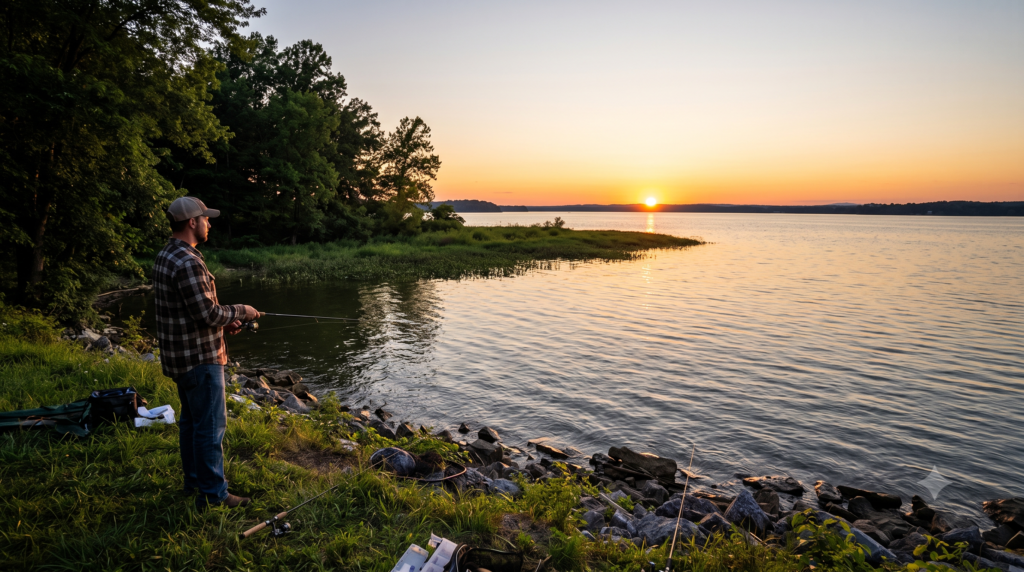
Every Lake Guide · August Evening Transition
Do Not Wait for Sunset to Start Reading the Evening Bite.
The useful evening window can begin while the sun is still above the horizon. Expanding shade, softer glare, a manageable breeze, moving baitfish, rising insects, and fish returning to reachable cover may matter more than the clock.
Start With the Lake, Not the Sunset Time.
Quick answer
When does the August evening bite begin?
It begins when the shoreline gains a better combination of comfort, food, cover, and movement—not at one universal clock time. Watch for shade reaching a point or weed edge, glare fading from shallow water, baitfish moving closer to cover, insects appearing, a safe breeze organizing one bank, or fish repeating a shallow route.
Arrive early enough to compare the lake in daylight. Fish the first useful transition, then follow the activity instead of waiting for darkness to make the decision for you.
Quick comparison
Clock watching versus lake watching
| What happens | What it may mean | Best response | Avoid |
|---|---|---|---|
| Shade reaches a point or weed edge | Reachable cover may become more comfortable before sunset. | Test the new shade boundary and nearby depth. | Waiting until the whole bank is dark. |
| Baitfish begin flickering near shore | Food and movement may be shifting into reachable water. | Fish beside the activity and its supporting edge. | Casting directly into every disturbance. |
| A breeze starts touching one bank | Wind may organize insects, plankton, or baitfish. | Compare the wind-touched point, corner, or cover. | Fishing unsafe waves or poor footing. |
| The lake remains bright and inactive | The evening transition may not have reached that bank yet. | Compare earlier shade, cover, or nearby depth. | Assuming sunset alone will fix weak water. |
| Activity begins, then fades quickly | You may have seen a short feeding window or moving group. | Follow the route toward cover, depth, or the next edge. | Staying because one splash occurred. |
Let the shoreline tell you
Five clues that the evening window has started
1. Expanding shade reaches useful structure
Shade becomes more meaningful when it touches weeds, wood, rock, a dock, a point, or a first drop.
First test: cast along the shade boundary rather than into featureless darkness.
2. Surface activity becomes organized
Repeated rings, swirls, baitfish flickers, or insects along one edge are stronger than one random splash.
First test: work beside the pattern and watch whether it travels.
3. Wind and structure work together
A light breeze may push food toward a point, corner, weed line, or cove mouth.
First test: fish the overlap instead of the whole windy bank.
4. Shallow water gains an escape route
A flat or shelf becomes more useful when a drop, channel, cove mouth, or steeper bank is close.
First test: cast across the shallow-to-deep transition.
5. The same route produces repeated evidence
Bites, follows, swirls, bait movement, or line activity along one path can reveal how fish are entering the bank.
First test: repeat the angle before changing everything.
What sunset does not guarantee
Sunset does not make every shallow bank productive. Cover, food, wind, depth, access, and water quality still matter.
First test: choose the best explanation, not the darkest water.
Use Was That a Fish? 7 Surface Clues Bank Anglers Should Notice Before Casting to separate random movement from useful activity. For a direct bank comparison, read Wind-Blown Bank or Shaded Bank?
The evening trigger rule
Do not ask, “Is it late enough?” Ask, “What improved?”
A strong evening move has a reason: shade reached cover, baitfish arrived, wind organized an edge, insects appeared, glare softened, or a shallow route connected with nearby depth.
The clock can tell you when to look. The lake tells you when to move.
Use the Every Lake Guide framework
Apply the L.A.K.E. Method before sunset
Look Before You Cast
Watch the shade line, glare, wind, insects, baitfish, surface activity, water color, other anglers, and your safe exit route.
Analyze the Lake
Connect improving light with points, flats, weed edges, docks, wood, cove mouths, and nearby depth.
Key In on Productive Water
Choose the smallest reachable area where food, comfort, cover, movement, and safe casting space overlap.
Execute a Simple Plan
Test the first useful transition, adjust one variable, follow repeated activity, and leave before darkness or park closing weakens safety.
Use How to Read Any Lake for the complete clue-ranking system, practice examples, lake scorecard, and printable tools. For points, coves, flats, cover, and drop-offs, explore Kentucky Shore Fishing.
A daylight-first evening trip
A two-hour August evening plan
Arrive before the change
Identify one bank likely to gain shade and one wind, cover, or depth alternative. Confirm park hours and the route back.
Fish the strongest existing edge
Begin with the best current explanation instead of waiting for sunset.
Watch for the trigger
Look for expanding shade, softening glare, insects, baitfish, wind, or repeated surface activity.
Move with the improving water
Shift toward the point, weed edge, dock, flat, cove mouth, or first drop that gained the strongest second clue.
Finish safely with the best evidence
Repeat the most useful angle, save one observation, and leave while footing and access remain clear.
For the full timed framework, use The Two-Hour Kentucky Bank-Fishing Plan. If summer heat still controls the trip, read How to Find Cooler Water From the Bank.
Reader engagement
Build a three-line evening note
- Before the transition: Which bank has the best current reason?
- At the transition: What changed—shade, wind, activity, insects, baitfish, or glare?
- After the transition: Which route produced repeated evidence?
Complete this sentence: “The evening window started when ______ reached ______.”
Example: “The evening window started when shade reached the outside weed edge beside the first drop.”
Evening safety
Plan the return before the light disappears
- Confirm park closing times and posted access rules before fishing.
- Inspect banks, roots, rocks, mud, docks, and trails while daylight remains.
- Carry a working light even when you plan to leave before dark.
- Keep rods, lines, tackle, children, and pets out of public walkways.
- Leave for substantial shelter when thunder is heard.
- Avoid suspicious water, strong odors, surface scum, distressed fish, and unsafe footing.
Review the current Kentucky Fishing and Boating Guide before the trip.
Interactive knowledge check
Can you recognize the evening transition?
Continue learning
Related Every Lake Guide resources
How to Read Any Lake
Learn how food, comfort, safety, edges, depth, wind, cover, and movement work together.
How to Read Any Lake Ebook
Use the full L.A.K.E. Method, practice examples, scorecard, and printable tools.
Kentucky Shore Fishing Ebook
Study points, coves, flats, cover, and first drop-offs from the bank.
Two-Hour Kentucky Bank-Fishing Plan
Turn limited time into a complete trip with timed decisions and a simple observation record.
Frequently asked questions
August evening bank-fishing FAQs
Does the evening bite always begin at sunset?
No. Fish activity may improve earlier when shade, wind, insects, baitfish, cover, and nearby depth create a useful shoreline transition.
How early should I arrive for an evening trip?
Arrive early enough to inspect the bank in daylight and observe the water before the transition. For a two-hour trip, that often means beginning well before sunset rather than at it.
Which bank should I fish first?
Start with the strongest current overlap of shade, wind, cover, food, nearby depth, visible activity, and safe casting access.
Is a shaded bank always better in the evening?
No. Shade becomes stronger when it touches useful cover, food, activity, or depth.
Should I stay after dark if the bite improves?
Only where night access is legal and the bank, return route, equipment, and conditions remain safe.
What if nothing changes before sunset?
Compare a different bank with earlier shade, safe wind, healthier cover, more activity, or better access to depth.
Final takeaway
The evening bite begins with a change—not a number on the clock
Arrive before the transition, watch what improves, and move when shade, wind, food, cover, activity, and nearby depth begin working together.
Start With the Lake, Not the Sunset Time.