
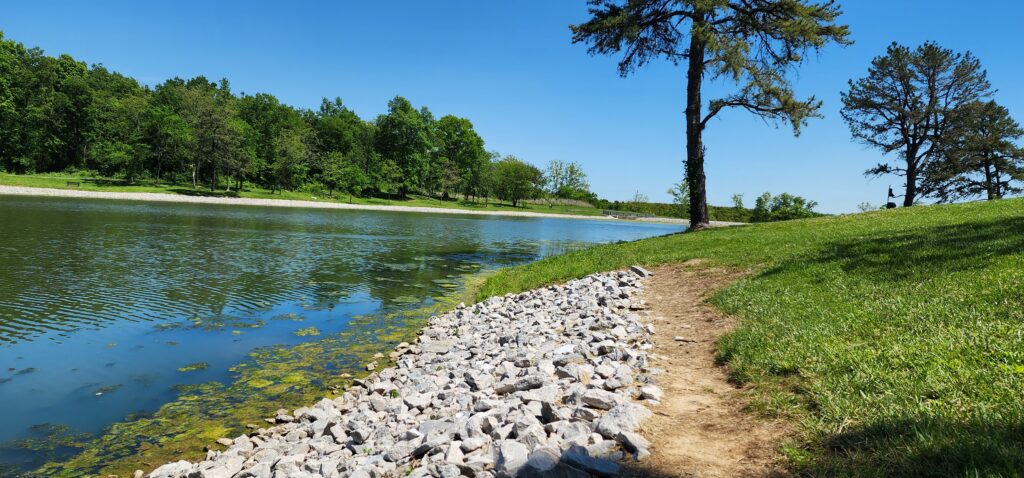
Owens Lake Park gives Walton-area families and beginning anglers something valuable: a public lake close to home where they can learn to read the shoreline, test simple presentations, and build experience without planning an all-day expedition.
Park and fishing status reviewed July 7, 2026.
Quick answer: Is Owens Lake Park worth trying?
Yes—with realistic expectations. Owens Lake Park is a promising new public fishing destination in Walton, Kentucky. Its manageable size, visible shoreline features, walking access, rock banks, vegetation, shade, and new fishing pier make it especially interesting for beginners.
However, this is still a developing fishing destination. Anglers should treat an early trip as a chance to explore and learn rather than expecting guaranteed fast action. Check every posted sign before casting because local rules, harvest restrictions, stocking information, and park-use policies may change as the fishery develops.
Important status note: The City of Walton confirms that fishing is available at the park, and a new fishing pier opened in April 2026. Kentucky Fish and Wildlife has proposed adding Owens’ Lake to the Fishing in Neighborhoods program, but the lake was not yet shown in the agency’s public FINs directory when this guide was reviewed. Do not assume that a FINs stocking schedule or FINs harvest limit is active unless current signage or Kentucky Fish and Wildlife confirms it.
A new public fishing opportunity in Walton
The full name of the property is the Dr. O’Dell Moreno Owens & Family Nature Park. The 54-acre park opened to the public in April 2025 at 74 Church Street in Walton. Its lake covers approximately nine acres and was once part of Walton’s former water-reservoir property.
Today, the property includes walking trails, picnic space, fishing access, swimming, and rental kayaking. The addition of a dedicated fishing pier in 2026 made the lake more approachable for anglers who may not be comfortable standing on uneven shoreline.
That combination gives Owens Lake Park an advantage that many beginning anglers need: it is not only a place to cast. It is a place where someone can slow down, walk the shoreline, observe changes in the water, and begin learning why one area may hold more fish than another.
For anglers still building those skills, start with the broader Kentucky fishing guide for bank anglers before your trip.
Why beginners should watch Owens Lake closely
A manageable body of water
A lake of approximately nine acres feels less overwhelming than a major reservoir. Beginners can explore several shoreline conditions during one short trip without needing a boat or complicated electronics.
Visible shoreline clues
Rock, aquatic growth, shaded banks, open water, shoreline transitions, and a fishing pier give anglers recognizable targets instead of one long, featureless bank.
Room to observe before casting
The surrounding path gives an angler a chance to walk, watch the wind, look for surface activity, and compare different sections of the lake before choosing a spot.
A fishery worth documenting
New public fishing destinations can change quickly as habitat develops, fish populations adjust, and fishing pressure increases. Notes from each visit may become more valuable over time.
Owens Lake is new to the public—not a newly built lake
The word “new” needs some context. Owens Lake itself existed before the nature park opened. What is new is the public access, park development, fishing pier, and opportunity for Walton residents to use the property as a community fishing destination.
That distinction matters because an older lake may already contain established habitat, natural forage, vegetation, and fish. At the same time, public fishing pressure and formal fishery management may still be entering a new phase.
This is why Owens Lake should be approached as a lake to learn over several visits. One slow afternoon does not prove that the lake is poor. One good morning does not guarantee that the same bank will produce every week.
Where should a beginner cast first?
Do not begin by walking to the closest opening and throwing toward the middle. Start by looking for changes. Fish commonly use edges, cover, shade, depth transitions, and places where food can collect.
1. The rock-to-natural-bank transition
Rock-lined shoreline can provide cover and attract small aquatic life. Pay particular attention to the place where rock ends and soil, grass, or vegetation begins. A change in shoreline material can also indicate a change below the surface.
2. The outside edge of vegetation
Rather than dropping a lure directly into thick growth, work the visible outside edge. Fish can use that boundary as both cover and a feeding route.
3. Shade beside deeper-looking water
Tree shade can become more valuable during bright, warm conditions. Look for shade that reaches the water near a bank that drops away more quickly.
4. The fishing pier
Piers create shade, vertical structure, and a clear casting platform. Work the edges and corners before casting as far as possible. Avoid disturbing another angler’s water.
5. The bank receiving the wind
A moderate breeze can push surface food, insects, and small organisms toward one side of a lake. Slightly stained, wind-ruffled water can also make fish less cautious.
6. Quiet water away from traffic
When the pier, swimming area, or most convenient bank becomes busy, a quieter stretch may offer a better chance. Move carefully and keep your profile low near the water.
Use the L.A.K.E. Method before choosing a lure
Every Lake Guide encourages anglers to start with the lake, not the lure. Owens Lake Park is an ideal place to practice that approach because several visible shoreline conditions can be compared during one visit.
L — Look Before You Cast.
Check wind direction, water clarity, shade, vegetation, surface movement, people, swimmers, kayaks, and open casting space.
A — Analyze the Lake.
Identify rock banks, points, small pockets, pier shade, vegetation edges, shoreline changes, and any area that appears to reach deeper water quickly.
K — Key In on Productive Water.
Choose two or three high-percentage areas instead of trying to cover every foot of shoreline. Focus on places where more than one useful feature comes together.
E — Execute a Simple Plan.
Begin with a natural, easy-to-detect presentation. Change location before repeatedly changing lures. Give each selected area enough time to reveal whether fish are present.
Learn more about the complete process in Gateway to Fishing Success.
A simple beginner tackle plan
Until an official, current species list and stocking record are published, avoid building the trip around one assumed fish species. Carry a small selection that can help you investigate the water without turning the outing into a tackle-management project.
| Equipment | Beginner choice | Why it works here |
|---|---|---|
| Rod and reel | 6- to 7-foot light or medium-light spinning combination | Easy to handle around a pier, open bank, vegetation, and rock. |
| Line | 6- to 10-pound monofilament | Simple knot tying, useful stretch, and enough versatility for small-lake fishing. |
| Natural presentation | Small barbless hook, split shot, float, and a piece of worm | Helps reveal whether small fish are using shallow cover and vegetation edges. |
| Artificial presentation | Small jig or 2- to 3-inch soft plastic | Can be worked beside rock, along vegetation, and around pier edges. |
| Landing tools | Needle-nose pliers, small net, and wet hands | Supports faster, safer hook removal and careful release. |
A beginner does not need six rods and a backpack full of lures. One dependable spinning combination, one natural presentation, and one small artificial lure can provide enough information for a productive first visit.
Your two-hour Owens Lake Park fishing plan
This plan is designed for busy anglers, parents introducing a child to fishing, and beginners who want a clear structure instead of randomly moving around the lake.
Minutes 0–15: Walk and observe
Read all posted rules. Note the wind direction, water clarity, active wildlife, visible fish movement, shade, vegetation, and areas being used by swimmers or paddlers. Select three possible fishing spots.
Minutes 15–45: Test shallow cover
Begin with a small worm beneath a float beside vegetation, rock, or pier shade. Adjust the depth rather than casting to the same empty spot repeatedly.
Minutes 45–75: Work a shoreline edge
Move to a rock transition, vegetation edge, or shaded bank. Cast partly along the shoreline instead of sending every cast toward the center.
Minutes 75–105: Follow the best clue
If you saw bites, minnows, surface movement, or birds feeding near one section, return to that type of water. If the lake appears inactive, try the wind-affected bank or a slightly deeper presentation.
Minutes 105–120: Record what happened
Write down the date, time, weather, wind, water appearance, productive depth, crowd level, and presentation used. Those notes can turn a developing public lake into familiar home water.
Owens Lake versus an established FINs lake
| Consideration | Owens Lake Park | Established FINs lake |
|---|---|---|
| Public fishing history | Relatively new public destination | Longer public fishing and management history |
| Stocking information | Confirm current status before relying on a stocking pattern | Stocking schedules and program rules are generally easier to verify |
| Best beginner use | Observation, exploration, shoreline reading, and short local trips | Trips built around published seasonal stocking opportunities |
| Expectations | Treat each visit as part of the learning process | Fish may still be pressured, but management expectations are clearer |
| Long-term value | An opportunity to learn a local lake as it develops | A dependable part of a broader Kentucky fishing rotation |
Owens Lake does not have to replace an established destination. It can become one more useful option in a balanced fishing plan. Explore additional possibilities in our guide to where to fish in Kentucky and our current overview of Kentucky FINs lakes.
Safety and courtesy at a multi-use park
Owens Lake Park is shared by anglers, walkers, families, swimmers, cyclists, and paddlers. Fishing successfully also means protecting the experience of everyone using the property.
- Read entrance signs and fishing notices before unloading equipment.
- Keep hooks, line, and tackle away from walking paths.
- Never cast toward swimmers, kayaks, people, pets, or occupied shoreline.
- Give other anglers enough room to cast and land fish safely.
- Supervise children closely near rock banks, docks, and deeper water.
- Consider a properly fitted life jacket for young children near the shoreline.
- Carry out broken line, bait containers, hooks, and all other waste.
- Use barbless hooks or carefully pinch down the barb for easier release.
- Wet your hands before touching a fish and keep it out of the water briefly.
- Follow posted catch-and-release or harvest rules, even if they differ from general statewide regulations.
Four-question Owens Lake knowledge check
1. Should a beginner immediately cast toward the center of the lake?
Not necessarily. First inspect nearby rock, vegetation, shade, pier edges, shoreline transitions, and other features that may concentrate fish closer to the bank.
2. Can anglers assume Owens Lake currently follows FINs stocking schedules?
No. The lake has been proposed for inclusion, but anglers should verify its current status through posted signs and official Kentucky Fish and Wildlife information.
3. What should an angler change first after an unproductive period?
Location or depth. Moving to a different type of water often provides more useful information than repeatedly changing lures in the same inactive spot.
4. Why are notes especially useful at Owens Lake?
The public fishery is still developing. Notes about wind, season, water conditions, fishing pressure, productive banks, and successful presentations can reveal patterns over several trips.
Frequently asked questions about Owens Lake Park fishing
Is fishing allowed at Owens Lake Park?
Yes. The City of Walton lists fishing among the activities available at Dr. O’Dell Moreno Owens & Family Nature Park. Anglers should still read all signs at the lake for current local restrictions.
Is Owens Lake officially a FINs lake?
Kentucky Fish and Wildlife proposed adding Owens’ Lake to the Fishing in Neighborhoods program. However, it was not shown in the agency’s public FINs lake directory when this article was reviewed on July 7, 2026. Check the current official directory before treating it as an active FINs water.
What fish can anglers catch at Owens Lake?
A complete current species list and official stocking schedule were not available through the public sources reviewed for this guide. Observe posted information at the park and check Kentucky Fish and Wildlife updates rather than relying on unverified reports.
Does Owens Lake Park have a fishing pier?
Yes. A new fishing pier opened in April 2026, providing another option for anglers who prefer a stable casting platform.
Do adults need a Kentucky fishing license?
Unless an exemption applies, residents and nonresidents age 16 or older need a valid Kentucky fishing license. Youth age 15 or younger may fish without a license. Always confirm current requirements before your trip.
Is Owens Lake Park suitable for children learning to fish?
Its manageable size, public setting, walking access, and fishing pier may make it useful for family outings. Children still require close adult supervision around water, rocks, hooks, swimmers, and moving kayaks.
Learn to read the lake before changing your lure
Owens Lake Park could become an important local destination, but the real opportunity is learning how to recognize productive water. Build that skill once, and you can use it at community lakes throughout Kentucky.
Explore the Kentucky Fishing Guide
Browse Every Lake Guide Resources