
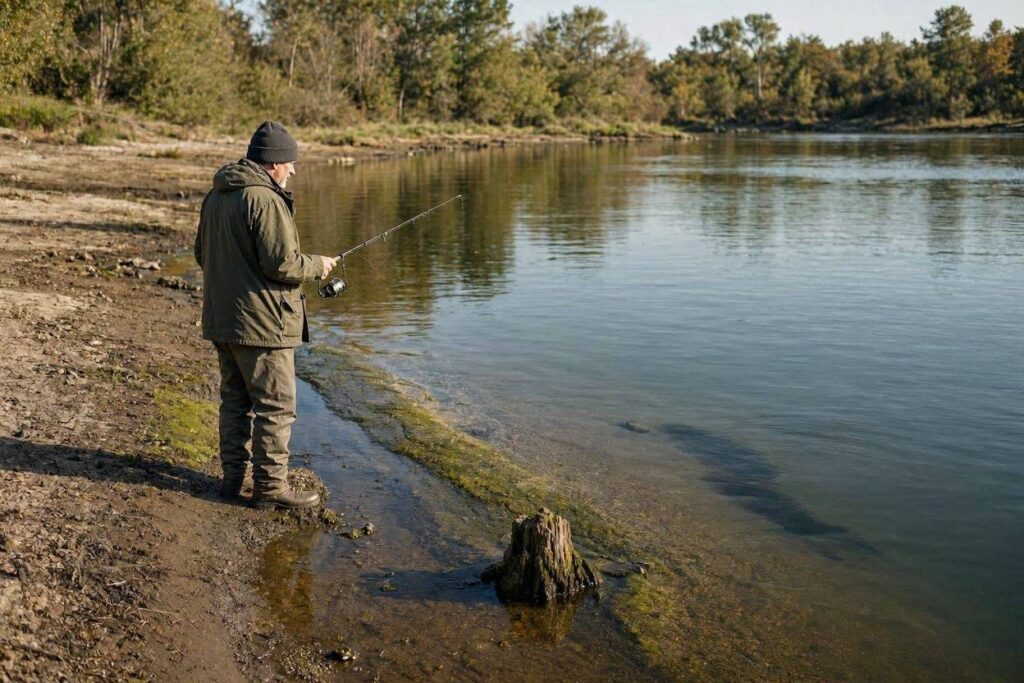
Every Lake Guide · Summer Shoreline Change
The Waterline Moved. Your Old Spot May Not Be the Same Spot.
Falling water can expose yesterday’s cover, shrink shallow feeding areas, change casting angles, and reveal the lake’s shape. The right response is not automatically to cast farther. Read what the lower water removed, what it exposed, and where the nearest usable edge moved.
Start With the Lake, Not the Lure.
Quick answer
Where should a bank angler cast when the water level drops?
Start where the old shallow water connects to the nearest remaining depth, cover, or travel route. Look for the end of a point, the outside edge of remaining vegetation, the first drop beside an exposed flat, a cove mouth, a dock corner that still has water, or a narrow band of submerged rock or wood.
Falling water can concentrate fish along the next usable edge, but it can also make familiar cover too shallow or disconnected. Locate what still gives fish food, security, depth, and a safe route.
Quick comparison
What changed—and what should you do next?
| What you see | What it may mean | Best first response | Avoid |
|---|---|---|---|
| Weeds are partly exposed | The shallow cover lost usable water. | Fish the outside edge that remains submerged. | Casting into nearly dry grass because it held fish before. |
| A flat is visibly shallower | Fish may have shifted toward the first break or cove mouth. | Cast across the nearest depth transition. | Throwing farther over the same featureless flat. |
| Rock, stumps, or cover are newly visible | The exposed objects reveal structure and former routes. | Trace the line toward its submerged continuation. | Fishing the dry object instead of the underwater edge. |
| A dock has less water beneath it | The cover may have lost depth and security. | Check the deeper end, outside corner, or nearby drop. | Assuming familiar cover remains productive. |
| The exposed bank is soft or steep | Access may be the main problem. | Choose a safer legal angle or another bank. | Walking onto slick mud to regain an old position. |
Use the exposed bank as a map
Five clues falling water can reveal
1. The real bank slope
Exposed shoreline shows whether the water leaves gradually across a flat or falls quickly beside a steeper edge.
Use it: follow the visible slope toward the first meaningful depth.
2. Rock or wood continuation
Exposed rock, roots, stumps, and branches may point toward submerged structure that still offers cover.
Use it: cast toward the underwater continuation.
3. Old weed lines and clean lanes
The former vegetation edge can reveal old travel routes. The remaining submerged outside edge may now be more important.
Use it: fish the clean lane beside healthy submerged grass.
4. Small channels and drains
A runoff cut or shallow ditch may become visible and reveal a route from a flat toward deeper water.
Use it: test where that channel enters the remaining lake.
5. Cover-to-depth distance
Lower water can disconnect cover from a safe retreat.
Use it: choose cover with the shortest route to usable depth.
What it does not prove
Falling water does not mean every fish moved deep or every exposed object once held fish.
Use it: treat the bank as evidence, then test it.
Continue with Beginner’s Guide to Points, Coves, Flats, and Drop-Offs. If the change followed storms or runoff, compare it with Fishing After Summer Rain From Shore.
The strongest beginner rule
Follow the old feature to its new underwater ending
If a weed line, point, rock strip, root system, drain, or flat helped before the water dropped, follow it toward the portion that still has water, nearby depth, and safe access.
The fish may not have left the area. The useful part of the area may simply have moved.
Use the Every Lake Guide framework
Apply the L.A.K.E. Method to a changing waterline
Look Before You Cast
Notice the old waterline, exposed mud, remaining vegetation, visible rock, cover, slope, safe footing, and where darker water begins.
Analyze the Lake
Connect exposed flats, points, channels, weeds, wood, and docks to the nearest remaining depth.
Key In on Productive Water
Choose the strongest overlap of remaining cover, food, depth, movement, and safe casting room.
Execute a Simple Plan
Test the submerged continuation, adjust depth or angle, compare one different bank, and move when the old pattern no longer has a useful ending.
Use How to Read Any Lake for the complete ranking process, scorecard, and printable tools. For a deeper shoreline system, explore Kentucky Shore Fishing.
A focused falling-water trip
A two-hour plan for newly exposed shoreline
Walk the old waterline
Find two safe areas where exposed features still connect to submerged water.
Test the strongest continuation
Fish the underwater end of a point, weed line, channel, rock strip, dock, or laydown.
Change one variable
Adjust depth, angle, speed, bait position, or distance from the visible edge.
Compare a different bank shape
If you began on a flat, try a steeper bank. If you began beside weeds, compare rock or a point.
Return to the best evidence
Finish where structure, cover, activity, bites, or casting control gave the clearest explanation.
Save one shoreline note
Record what the lower water exposed so it can help when the lake rises again.
For the broader routine, use the Kentucky Fishing Guide for Busy Bank Anglers and the Kentucky Wind & Structure Cheat Sheet.
Reader engagement
Use the three-line waterline scan
- Old waterline: Where was the shoreline before the drop?
- Remaining cover line: Which weeds, wood, rock, or dock edges still touch water?
- Darker-water line: Where does visible shallow water give way to greater depth?
Complete this sentence: “My first cast follows the exposed ______ toward the submerged ______.”
Safety and access
New shoreline does not automatically mean safe shoreline
- Do not trust newly exposed mud, clay, algae-coated rock, or steep cuts.
- Keep children and pets away from soft banks and hidden holes.
- Do not enter closed reservoir, dam, or spillway areas.
- Watch for glass, hooks, wire, sharp rock, and exposed debris.
- Leave for substantial shelter when thunder is heard.
- Confirm access, hours, licenses, and waterbody-specific rules.
Verify current Kentucky fishing information through Kentucky Fish & Wildlife.
Interactive knowledge check
Can you read a falling waterline?
Continue learning
Related Every Lake Guide resources
How to Read Any Lake
Learn how food, comfort, safety, edges, depth, wind, cover, and movement work together.
Read the Free GuideHow to Read Any Lake Ebook
Use the complete L.A.K.E. Method, practice examples, scorecard, and printable tools.
Explore the EbookKentucky Shore Fishing Ebook
Study coves, flats, first drop-offs, shoreline cover, and reachable structure.
Explore the EbookWhere to Fish in Kentucky
Compare neighborhood lakes, reservoirs, rivers, trout water, and family-friendly options.
Choose Kentucky WaterFrequently asked questions
Falling-water bank-fishing FAQs
Do fish always move deeper when the water drops?
No. Fish may use the first remaining edge, deeper cover, a channel, vegetation, a point, or a cove mouth.
Is falling water bad for bank fishing?
Not automatically. It can weaken shallow cover, but it can also reveal structure and concentrate fish along remaining edges.
Should I cast farther when the lake drops?
Only when the farther cast reaches a useful feature. Distance alone is not a pattern.
Are exposed stumps and rocks useful clues?
Yes, when they help you trace the structure into the water. The submerged continuation is usually the better target.
What if the exposed bank is muddy?
Avoid unstable mud, clay, hidden holes, and steep edges. Use a safer legal position.
Can exposed shoreline help when water rises?
Yes. Photos and notes of channels, rock, wood, slopes, weed lines, and drains can help after those features are covered again.
Final takeaway
Lower water does not erase the pattern—it moves the useful edge
Read the old waterline, trace exposed features toward their submerged continuation, and choose the remaining overlap of cover, depth, food, movement, and safe access.
Use the exposed bank as a map, then let the underwater ending earn the cast.
Study Kentucky Shoreline Structure