
Every Lake Guide · Summer Water-Reading Lesson
Green Water Is a Clue—But Some Clues Mean Leave
A summer lake can look green for several reasons. Color alone cannot tell you whether the water is harmless, productive, uncomfortable for fish, or potentially unsafe. Kentucky bank anglers need a simple way to separate ordinary seasonal color from warning signs that call for distance, caution, and another fishing location.
Start With the Lake, Not the Lure—and never let the promise of a bite override a warning sign.
Quick answer
Is green lake water safe to fish?
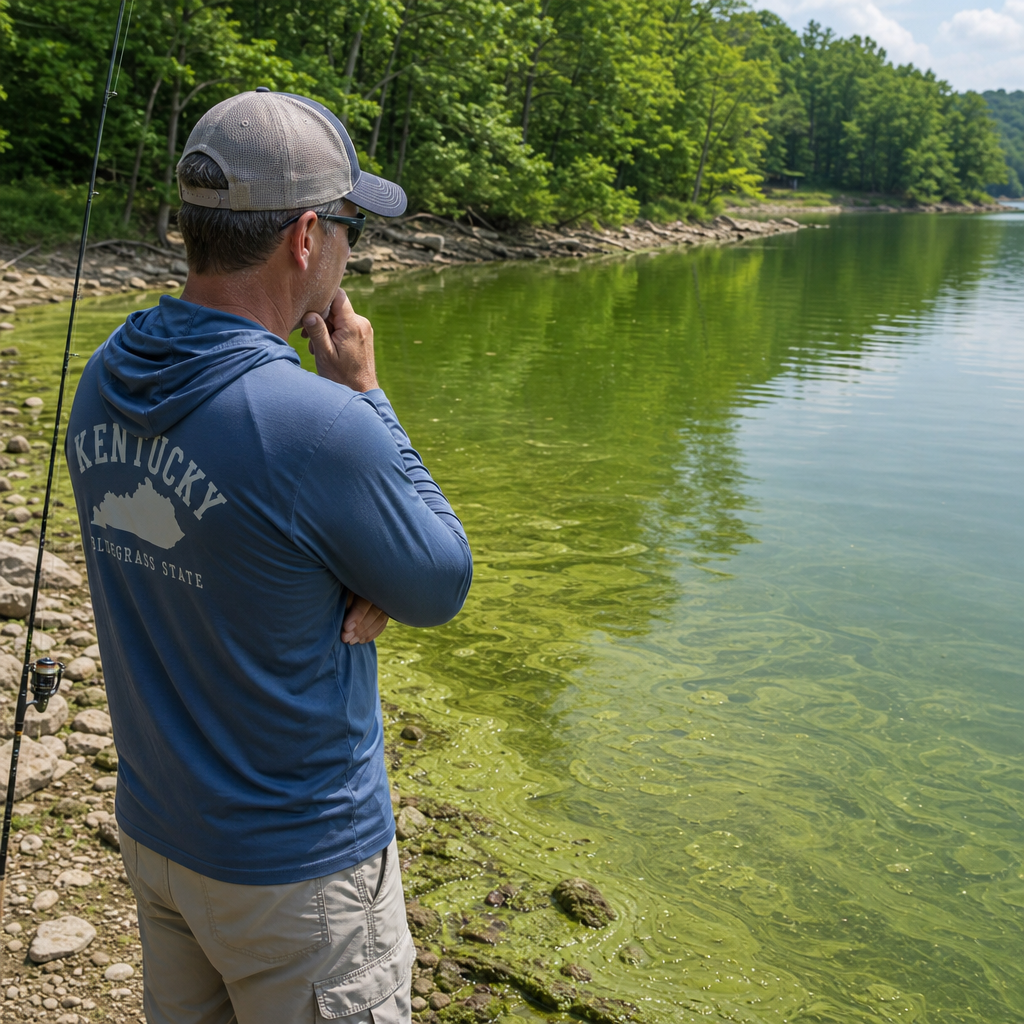
Do not decide by color alone. A mild green tint may come from microscopic algae, suspended material, aquatic plants, or reflected light. Bright green or blue-green surface scum, paint-like streaks, pea-soup patches, strong odors, dead or distressed fish, posted advisories, or sick wildlife are reasons to avoid contact and leave the affected shoreline.
You cannot confirm whether a bloom is harmful just by looking at it. Do not touch, wade through, cast into, clean fish beside, or let children or pets approach suspicious surface accumulations. Check Kentucky’s current advisories and choose another access point or another lake.
The safety line
When in doubt, stay out of the affected water
- Keep children and pets away from suspicious green or blue-green scum.
- Do not handle the material, even to inspect it.
- Do not fish through a visible accumulation or rinse gear in it.
- Leave an area with a posted harmful-algal-bloom advisory or closure.
- Choose clean, legally accessible water elsewhere rather than trying to “fish around” an obvious bloom.
Review Kentucky’s official harmful-algal-bloom information before your trip.
Quick comparison
What does the green water look like?
This comparison is a decision aid—not a visual diagnosis. Different materials can overlap in appearance, and only appropriate testing can confirm whether algal toxins are present.
| What you notice | What it might represent | Bank-angler response | Fishing meaning |
|---|---|---|---|
| Even green tint throughout the water | Microscopic algae, suspended material, or light conditions may contribute. | Check advisories, odors, surface accumulations, fish behavior, and posted signs before deciding. | Visibility may be reduced, but color alone does not prove poor fishing or a harmful bloom. |
| Stringy growth attached to rocks or plants | Filamentous algae or plant growth may be present. | Avoid slippery footing and consider the entire scene rather than relying on one visual clue. | Clean outside edges may hold life, while dense mats can foul lures and block useful casting lanes. |
| Tiny floating leaves covering calm pockets | Duckweed or similar floating plants may be present. | Observe without touching and compare the area with nearby open water and official notices. | Thin cover can create shade, while heavy coverage can make presentation and oxygen conditions less predictable. |
| Bright green, blue-green, turquoise, or paint-like scum | A possible cyanobacterial accumulation or harmful algal bloom. | Stay out, keep pets away, do not fish the affected area, and check or report the condition. | Do not treat it as a fishing opportunity. |
| Brown water after heavy green growth fades | Algae may be dying and decomposing. | Watch for odor, gasping fish, dead fish, and official advisories. Choose another location when the water looks distressed. | Decomposition can consume oxygen and stress fish. |
| Wind-piled scum along one bank | Floating material or a bloom may have concentrated on the shoreline. | Do not assume the rest of the lake is safe. Leave the accumulation and verify current guidance. | The easiest bank to reach may also contain the strongest surface concentration. |
Read the whole scene
Green water can also point toward an oxygen problem
Algae are a natural part of aquatic systems. Trouble can develop when a heavy bloom grows, dies, and decomposes. Bacteria breaking down that material use oxygen, which can stress fish—especially in small, warm lakes and ponds.
For a broader summer strategy, read Where Do Fish Go When the Lake Gets Hot? The goal is not to chase distressed fish. It is to recognize when conditions call for healthier water—or another lake entirely.
Use the Every Lake Guide framework
Apply the L.A.K.E. Method without crossing the safety line
The L.A.K.E. Method helps beginners organize visible clues. It never replaces an advisory, closure, posted rule, or common-sense decision to leave suspicious water alone.
Look Before You Cast
Scan for scum, streaks, odor, dead fish, distressed wildlife, posted notices, wind direction, inflows, water color, and safe footing.
Analyze the Lake
Ask whether the green material is evenly dispersed, attached, floating, concentrated by wind, or collecting in a stagnant pocket. Do not touch it to find out.
Key In on Productive Water
Only after the safety check, compare clean reachable edges, moderate wind, healthy vegetation, shade, nearby depth, and gentle water movement.
Execute a Simple Plan
Fish a safe area with one simple presentation. If warning signs appear, stop. Do not keep adjusting tackle when the correct adjustment is changing locations.
This free article gives you the immediate safety decision. The complete How to Read Any Lake: A Beginner’s Fishing System goes deeper into comparing edges, wind, cover, depth, food, comfort, safety, and movement without turning an unfamiliar lake into guesswork.
A safer short-trip framework
The two-hour green-water decision plan
This is not a plan for fishing a suspected bloom. It is a plan for checking conditions quickly, leaving questionable water alone, and using the remaining trip wisely.
Check the exact water
Review Kentucky advisory information, local park notices, recent weather, access hours, and any credible report of a fish kill or bloom.
Walk before unloading everything
Observe the windward shoreline, protected pockets, pier area, inflows, water color, odor, visible fish behavior, and posted signs.
Leave suspicious water
Visible scum, paint-like streaks, dead fish, strong odor, an advisory, or uncertainty around children and pets is enough reason to choose another location.
Test the cleanest safe edge
When no warning signs or advisories are present, compare an open edge near depth, mild wind, shade, healthy vegetation, or moderate water movement.
Make one deliberate move
Move toward cleaner-looking water with a stronger depth or cover route—not toward a suspicious surface accumulation.
Finish where conditions remain healthy
Prioritize safe access, visible activity, stable water, and a clear exit before dusk, storms, or park closing.
Green water can overlap with other summer clues. Compare How to Fish Grass Lines and Weed Edges From the Bank, Fishing After Summer Rain From Shore, and Dawn, Dusk, or Dark? before building the trip.
After the safety check
What healthier summer water may look like
Moderate wind without surface scum
A manageable breeze may mix the upper water and organize food. Compare the wind-touched bank with nearby depth and safe casting room.
Healthy vegetation with open edges
Green, rooted vegetation with clean pockets can provide cover, food, shade, and a defined casting lane. Decaying mats are a different clue.
Gentle inflow with stable footing
Moderate moving water can create a seam, but avoid polluted runoff, violent flow, debris, lightning, steep mud, and posted restrictions.
A reachable drop or steeper bank
Nearby depth gives fish a shorter route between warm shallows and more comfortable water, especially during bright summer periods.
Use the free Kentucky Wind & Structure Cheat Sheet as a field reference. For a deeper shoreline system, explore Kentucky Shore Fishing: How to Fish Coves, Flats, and Drop-Offs.
Interactive knowledge check
Would you make the safe lake-reading decision?
Select one answer for each question, then check your score.
Continue learning
Related Every Lake Guide resources
How to Read Any Lake
Learn how edges, wind, cover, depth, food, comfort, safety, and movement work together before the first cast.
Read the Free GuideWhere Do Fish Go When the Lake Gets Hot?
Compare shade, depth, wind, healthy vegetation, inflows, and low-light movement during summer heat.
Read the Summer GuideHow to Read Any Lake Ebook
Use the complete L.A.K.E. Method, practice examples, lake scorecard, and printable tools on unfamiliar water.
Explore the EbookKentucky Shore Fishing Ebook
Study coves, flats, first drop-offs, cover, and shoreline routes as part of a larger bank-fishing decision.
Explore the EbookOfficial Kentucky resources
Check current conditions before fishing
Water conditions, advisories, access notices, and fishing rules can change. Use official Kentucky sources before relying on a visual shoreline assessment.
Frequently asked questions
Green water and summer fishing FAQs
Does green water always mean a harmful algal bloom?
No. Green color can come from several sources, and appearance alone cannot confirm toxins. Treat suspicious scum, streaks, odor, dead fish, and posted advisories as warning signs and avoid contact.
Can I fish on the other side of a lake if scum is piled on one bank?
Do not assume the rest of the lake is unaffected. Wind can concentrate floating material along one shoreline while the underlying condition extends farther. Check official advisories and choose another lake when conditions are uncertain.
Why are fish gasping near the surface?
Surface gasping can be a sign of low dissolved oxygen or another source of stress. Do not target visibly distressed fish. Avoid contact, note the location, and report a suspected fish kill or water-quality problem.
Is stringy algae on rocks the same as blue-green algae?
Not necessarily. Stringy attached growth may differ from a floating cyanobacterial bloom, but visual identification is not reliable enough to establish safety. Consider the entire scene and follow current official guidance.
Can my dog drink from a lake that looks green?
Keep pets away from suspicious water and visible blooms. Dogs may swallow water or lick material from their fur, so the safest response is to leave the affected area.
Where can I check Kentucky water advisories?
Use Kentucky’s HAB Viewer and official harmful-algal-bloom information, then check local park notices and posted signs at the exact access point.
Final takeaway
The best cast is sometimes the one you decide not to make
Green water is not one simple condition. Read color, surface texture, wind, odor, fish behavior, recent weather, advisories, and shoreline safety together. When the clues suggest a possible bloom or oxygen problem, leave the affected water alone.
Start With the Lake, Not the Lure—and protect the people and animals who came with you.
Open the Kentucky Fishing Guide